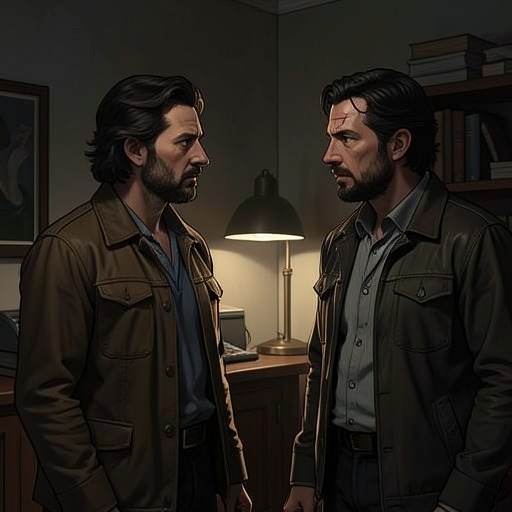
Hugh Legat and Paul von Hartmann’s friendship
MunichThe friendship between Hugh Legat and Paul von Hartmann is the human link between an old, unresolved estrangement and a shared attempt to avert catastrophe during the Munich crisis. Their renewed trust is neither easy nor complete: it has to survive accusation, professional risk, and the knowledge that they may have little power to change events. Its resolution comes not through a promise of safety, but through Legat and Hartmann recognizing that they have tried to act together.
An old bond under strain
At the conference, Hartmann’s first private question to Legat is whether he made contact with his friend. The brief exchange places their connection inside the urgent work of the German resistance: Hartmann is waiting for news, and Legat is someone he can ask directly. Their familiarity is apparent, but it does not erase the past. Much later, Legat reflects that he had left Hartmann behind after an earlier encounter with Leyna and had written to her twice, letters that came back unopened. He had long suspected that Hartmann knew of what he considered his betrayal, and took the years without contact as evidence that the friendship had ended.
That history makes their reunion more than a convenient alliance. When Legat sees Hartmann at the hotel reception desk, he is caught off guard, but Hartmann moves toward him rather than seeking a discreet place to speak. The two men are again drawn together at a moment when private feeling and public danger cannot be separated. Their closeness is real, yet Legat does not know whether Hartmann has forgiven him or even how much Hartmann knows about the past.
Conscience, accusation, and renewed trust
The immediate test comes when Hartmann wants to take his document directly to Chamberlain. Legat catches his arm at the stairs and urges him to stop, arguing that a reckless confrontation will achieve nothing and that they need to talk first. Hartmann answers that he cannot live with having done nothing. The dispute is about tactics, but its force comes from the difference between their positions: Hartmann is ready to risk himself in person, while Legat is trying to find a way to make the warning heard without making the effort futile.
Hartmann presses the disagreement into a personal challenge, asking whether Legat is hesitating because he fears damage to his career. Legat pauses rather than answering at once. The accusation stings because it touches a genuine conflict between professional caution and responsibility. He nevertheless agrees to see what he can do. Hartmann’s familiar broad smile returns, and he tells Legat that he is a good man. The small warmth of that moment does not settle their differences; it marks a decision to trust one another enough to proceed.
Legat helps Hartmann reach Chamberlain, first warning him not to lecture the Prime Minister and to present facts. Hartmann then stands before Chamberlain and argues that the document contradicts Hitler’s claim to have no further territorial demands. He describes a planned war of conquest, warns that the incorporation of Austria and Czechoslovakia is only a beginning, and says that the replacement of military commanders and the Foreign Minister has removed opponents from positions of influence. His purpose is to persuade Britain not to sign the agreement, which he believes would strengthen Hitler and eliminate the chance that the German Army might move against him. The warning places Hartmann’s personal risk within a political argument; Legat’s role is to make that argument possible, not to speak in Hartmann’s place.
A document entrusted to Legat
Chamberlain praises Hartmann’s courage and sincerity but rejects his reasoning. He puts the right of ethnic Germans to self-determination and the immediate need to avert war ahead of Hartmann’s predictions about Hitler’s future conduct. He folds the memorandum and advises Hartmann to return it as government property. The encounter therefore fails to change the Prime Minister’s decision, but it does not end the cooperation between the two friends.
After Sturmbannführer Sauer leaves, Hartmann tells Legat that they must assume they are being watched and continue to play their parts. He apologizes for having embarrassed Legat and instructs him to keep the memorandum, hide it in his room, and take it back to London for a more receptive audience. The document becomes a concrete sign of the trust Hartmann is placing in him: Legat is not merely a messenger but the person entrusted to carry the warning beyond the immediate conference. Hartmann also says they should stop speaking and move apart for their own safety, adding that it would be better if they did not speak again. Separation here is not a renewed rejection; it is part of protecting the work and each other.
Legat waits with the British delegation as the documents are finalized. He can imagine the professional consequences of defying expectations and considers leaving the diplomatic service, but he accepts the possibility of a damaged career with unusual calm. Hartmann’s trust has already brought him to a choice that cannot be reduced to career advancement. The friendship has become a practical bond of shared responsibility, even as circumstances require them to appear distant.
Rupture and return
The relationship carries a second, older wound. After the earlier episode involving Leyna, Hartmann did not return that night, and Legat left the city the next morning on the earliest train. Legat later believed Hartmann must have known about his betrayal, since Hartmann never contacted him in the years that followed. The narration leaves that belief unresolved: Legat has an explanation for the silence, but no confirmation of Hartmann’s knowledge. That uncertainty gives their present cooperation its emotional reserve. They can act with intimacy and trust without pretending that the earlier absence has been fully explained.
In the later journey, Hartmann speaks to Legat about what he has learned over six years: Nazi antisemitism cannot be treated as an isolated evil, detachable from the regime’s other actions. He recounts the persecution of a woman and argues that a capacity for such cruelty means the regime is capable of anything. Legat tells him that he understands. This exchange is more than an account of Hartmann’s political education. It is a moment in which Legat acknowledges the moral reality Hartmann is trying to make him see, completing a movement from the earlier distance between them toward shared understanding.
Farewell without certainty
Hartmann says that he cannot simply kill Hitler: everything in him prevents it, and he believes the consequences would include a bloodbath and the destruction of his family. He continues in hope despite recognizing its terrible cost. His words expose the limits around his resistance, as well as the personal danger that informs his earlier appeal to Chamberlain. Legat does not answer with a solution; the scene gives their friendship no easy means of overcoming the forces against them.
At the end of their drive, Hartmann drops Legat near a grand official building and tells him that all is well between them. Whatever happens, he says, they can take consolation in knowing that they tried. Legat turns to say goodbye, but Hartmann is already driving away. The quick departure preserves the danger and uncertainty surrounding them, while the farewell settles the question that the earlier years had left open: their friendship has survived the rupture. Its final measure is not whether they succeed in preventing events, but that each has trusted the other with a consequential part in trying.