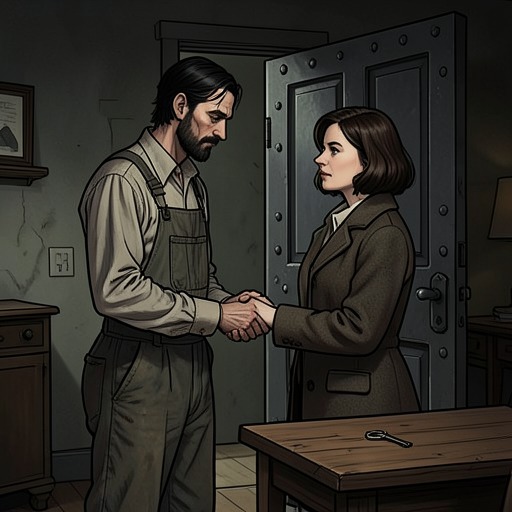
Paul von Hartmann and Frau Winter’s relationship
MunichPaul von Hartmann and Frau Winter’s relationship is presented as an intimate bond lived under the threat of political repression. The Gestapo’s arrest of Frau Winter briefly leaves Hartmann fearing for her, while their reunion in Berlin brings the danger into their private life: she has been warned to stay away from him, and he recognizes that the warning may be true. The relationship’s significance lies in this conjunction of intimacy and risk, ending not in safety but in Hartmann’s resolve to keep living and fighting for a cause he considers worth dying for.
Arrest and separation
As Hartmann leaves the Führerbau in Munich, Schmidt tells him that Ernst von Weizsäcker and Erich Kordt have returned to Berlin and that there may be trouble in the Wilhelmstrasse. Schmidt then identifies the immediate danger: Frau Winter, Weizsäcker’s assistant, has apparently been picked up by the Gestapo the previous night. The report reaches Hartmann while the men are travelling together, and his alarm is immediate. At this point he does not know what has happened to her, only that the regime has taken her into custody.
The news gives political repression a personal consequence. Frau Winter is not merely an assistant caught in trouble at the Foreign Ministry: she is someone Hartmann is closely attached to, and her disappearance makes his own position feel more precarious. The account does not explain the circumstances of her arrest or what happens during her detention. It preserves the uncertainty that Hartmann faces when he hears the news, then later answers only the central question of whether she has been released.
Return to Berlin and reunion
Hartmann’s journey home is marked by the expectation that he, too, may be arrested. Leaving the Führerbau, boarding the Foreign Ministry’s chartered Junkers passenger plane, and arriving at Tempelhof are successive stages in which he anticipates a confrontation with plain-clothes officers. None comes; he walks through the terminal to the taxi rank unmolested. His freedom is therefore a reprieve, but not reassurance that the danger has passed.
In Berlin, the Friday-night celebrations alter how Hartmann sees the people around him. The revellers had drawn his contempt in Munich, but now he regards their raised glasses, smiles, and embraces as gestures against the regime. This change in perception accompanies his return to Frau Winter: after a long wait at her apartment, the door opens and she is there. The narrative does not account for how she was released or describe their reunion in detail. Instead, the delayed opening of the door holds the scene between apprehension and relief, before their relationship becomes visible again in the private conversation that follows.
Intimacy under surveillance
Later that night, Hartmann and Frau Winter lie at opposite ends of a bath, facing each other. A candle burns, and an illegal foreign radio station plays jazz through the open door. The scene places their closeness within a world that has not become safe: the radio is illegal, and the conversation turns directly to the danger attached to Hartmann’s political life. Their private intimacy and the regime’s reach occupy the same moment rather than separate worlds.
Frau Winter tells him that the Gestapo warned her, just before releasing her, to stay away from him. They said they knew his type and would eventually catch him, though they delivered the warning politely. Her report establishes that the authorities connect her to Hartmann and regard him as someone they intend to expose or arrest. Her reply to them was to thank them for the warning. The restrained answer does not remove the threat; it shows that the warning has not made her disown him. Nor does the text present the release as an end to danger: the Gestapo’s words follow her into the apartment and shape what the couple must acknowledge between them.
Foreknowledge and resolve
Hartmann laughs, stretches his long legs, and splashes water onto the floor. He knows Frau Winter’s warning is right, and the narration makes that knowledge concrete by naming his eventual fate: on 20 August 1944, he will be hanged at Plötzensee Prison with piano wire. This future execution gives the earlier danger a fixed endpoint, but it does not turn their present intimacy into a farewell. Hartmann senses his destiny without knowing its exact date, and the account places that foreknowledge beside the life still before him.
The relationship is thus bound to a cause beyond the couple. Hartmann recognizes that there is a battle to fight and that the cause is worth dying for; Frau Winter’s warning neither persuades him to retreat nor dissolves their closeness. The contrast between the Gestapo’s polite threat and the lovers’ ordinary physical nearness gives the scene its force: the state can name the danger and predict capture, but it cannot make the cause, or the life Hartmann still intends to live, disappear.