Bouville Municipal Library
NauseaBouville Municipal Library is the municipal repository where Antoine Roquentin conducts his research on the Marquis de Rollebon and observes the Self-Taught Man’s alphabetical program of reading. Its papers make historical reconstruction possible, but the institution’s broader significance lies in the contrast it stages: ordered collections and inherited civic memory on one side, and the contingency of lived existence on the other.
Collections and Research
The library’s Rollebon archive gives Roquentin a practical reason to settle in Bouville rather than Paris or Marseilles. A descendant of Rollebon, an architect named Rollebon-Campouyre, left the library a substantial legacy in 1912: the Marquis’s letters, a fragment of a journal, and assorted papers. Roquentin has not yet examined the whole collection. The archive therefore appears not as a finished account of the past but as a store of incomplete documents from which he tries to assemble one.
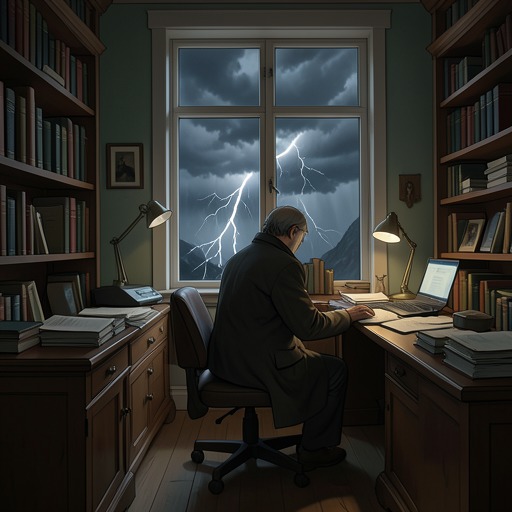
That work advances in measured increments. After working from nine until one, Roquentin starts Chapter XII, covering Rollebon’s stay in Russia through the death of Paul I. He considers the work finished for now, pending final revision. The chapter marks a moment when archival labor seems manageable: a defined historical episode has been organized into a completed section, even as the larger research project remains open.
The library is also where Roquentin’s remembered attachment to Rollebon takes shape. He recalls first encountering the Marquis through a few lines in notes by Germain Berger and describes how attractive the figure seemed to him. The municipal collection connects that early fascination to his present work, turning documents into the basis of both a scholarly undertaking and a personal investment in a reconstructed historical life.
The Reading Room and the Self-Taught Man
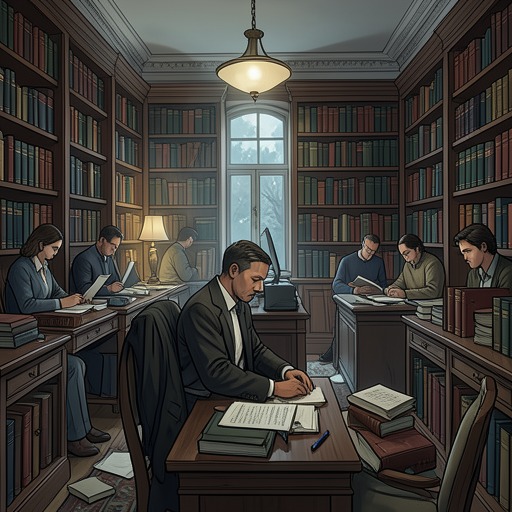
The reading room places Roquentin’s research beside a very different effort to master knowledge. The Self-Taught Man selects books by the alphabetical order of their authors. Roquentin recognizes the method when the names Lambert, Langlois, Larbaletrier, Lastex, and Lavergne recur in the choices before him. The latest books include a study of peat mosses, a work of instruction, and a Norman chronicle; their variety makes the system visible as a deliberate procedure rather than a sequence shaped by subject matter.
The Self-Taught Man has followed this plan for seven years. Beginning with the first book on the first shelf at the far right, he has proceeded through the library’s collection, moving among fields as distant as beetles, quantum theory, Tamerlane, and arguments against Darwinism. Roquentin admires the persistence required by the project, but also sees the unresolved question awaiting its completion: after the final book on the last shelf, the reader will have to ask what comes next. The library’s alphabetical order can organize the encounter with knowledge; it cannot itself supply an end or purpose.
Civic Memory and the Museum
The library’s Rollebon papers belong to a larger civic practice of preserving and arranging the past. The novel links Roquentin’s archival research to Bouville’s public commemorations, especially the museum’s display of portraits of the local elite. A portrait of the bachelor titled “The Bachelor's Death” gives Roquentin a warning about the costs of a life lived only for oneself; beyond it, more than a hundred and fifty portraits await him. The library and museum thus offer different forms of remembrance: documentary traces to be researched and painted figures presented as civic exemplars.
In the portrait gallery, Roquentin sees members of Bouville’s elite from 1875 to 1910, painted by Renaudas and Bordurin. Their public achievements are set out as a collective history of civic improvement: the men built Sainte-Cecile-de-la-Mer, founded the Federation of Shipowners and Merchants of Bouville in 1882, expanded the port, and broke the shipping strike of 1898. A visitor calls Remy Parrottin’s portrait “History!” The museum makes such judgments look settled and permanent, while Roquentin’s encounter with the portraits exposes the human values and exclusions concealed by that polished record.
Historical Order and Existence
The library’s ordered holdings invite the belief that the past can be recovered and made coherent through study. Yet the archive consists of letters, a journal fragment, and papers still waiting to be examined; its contents do not automatically add up to a complete life. Roquentin’s research on Rollebon depends on interpreting surviving evidence, and the distinction between the historical person and the figure assembled from documents remains central to the project.
That uncertainty is sharpened by the novel’s contrast between historical narratives and existence as Roquentin experiences it. In the museum, Jean Pacome’s portrait confronts him with a confident social order founded on rights, duties, and inherited standing. Roquentin instead understands himself as having appeared by chance, like a stone, a plant, or a microbe. The library is not presented as the source of this realization, but its archival promise belongs to the same problem: records can preserve and arrange accounts of people, while the existence those accounts seek to explain cannot be made necessary merely by being written down.