Federation of Shipowners and Merchants of Bouville
NauseaThe Federation of Shipowners and Merchants of Bouville is an organization created by the town’s elite in 1882 to unite local commercial leaders and advance what they described as national recovery. Its record of civic and economic achievement is also part of a larger self-portrait: the men who built and governed Bouville appear in the museum as guardians of progress, their authority presented as both useful and deserved.
Foundation and Stated Purpose
The Federation was founded in 1882 to bring together “all men of good will” in a powerful body, cooperate in national recovery, and hold in check the parties of disorder. That declared purpose joins economic coordination to political order: the organization’s public mission was not only to develop the port but also to define which forces counted as constructive and which as threats.
The Federation belonged to a wider network of civic authority. The men associated with Bouville’s elite built Sainte-Cecile-de-la-Mer and, alongside the Federation’s work, shaped the town’s infrastructure and public life. The women of the same elite are credited with founding most of Bouville’s charitable and philanthropic organizations, while the men’s achievements are narrated through commerce, civic construction, and command.
Economic and Civic Record
The Federation’s members are credited with making Bouville the best-equipped port in France for unloading coal and wood. They lengthened and widened the quays, extended the Marine Terminal, and used constant dredging to raise the low-tide anchorage depth to 10.7 meters. These specific works make the organization’s claim to public usefulness concrete: its power was exercised through the reshaping of the harbor and the land around it.
The account also links the Federation’s influence to the growth of the fishing industry. The fleet’s catch rose from 5,000 barrels in 1869 to 18,000 barrels over twenty years, an increase attributed to the elite’s efforts. Its members further claimed to support the working class by establishing technical and professional study centers, which they described as prospering under their protection. The language frames education as benevolent provision, while making clear that it was initiated and supervised from above.
Labor and Political Authority
The Federation’s record includes the breaking of the famous shipping strike in 1898. Set beside port expansion and vocational education, this episode exposes the harder edge of its program: the same organization credited with developing the town also acted to defeat collective labor resistance. Its stated commitment to holding “parties of disorder” in check thus has a material counterpart in the suppression of a strike.
The organization’s prominence also rested on family and public standing. Its members’ sons were given to the country in 1914, a sacrifice incorporated into the elite’s account of civic duty. In the museum’s account of Bouville’s leading families, wealth, public service, and inherited obligation reinforce one another, making authority appear not merely powerful but morally warranted.
Commemoration and Significance
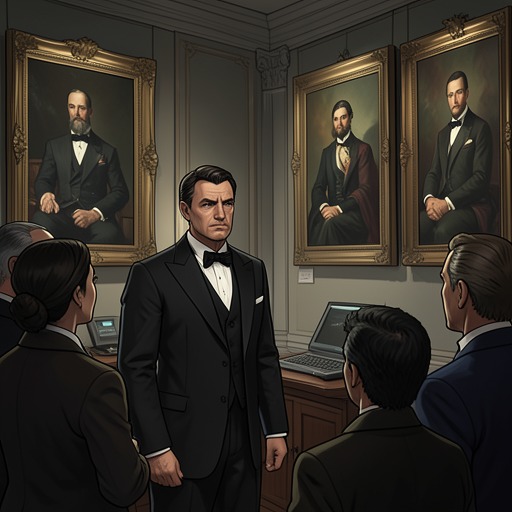
More than 150 portraits of Bouville’s elite, painted by Renaudas and Bordurin, turn the museum into a monument to the class that governed the town between 1875 and 1910. The Federation’s history forms part of the public case made by those portraits: the quays, dredged harbor, expanded fishing fleet, educational institutions, and defeat of the 1898 strike are assembled as evidence of leadership. The paintings, in turn, refine that account into an image of respectable permanence, with formal presentation and restrained color displacing visible weakness.
The museum’s commemorative logic is summed up by the narrator’s observation that the portraits offer humanity “a bouquet of the Rights of Man and Citizen.” The organization’s public works are real within the account, but their presentation also helps convert privilege into apparent entitlement. The Federation therefore stands at the center of a tension: it serves Bouville through material development while embodying a ruling class that treats its own rights, duties, and authority as the natural order of the town.