Several weeks before the diary, around early January 1932
The Pebble by the Sea
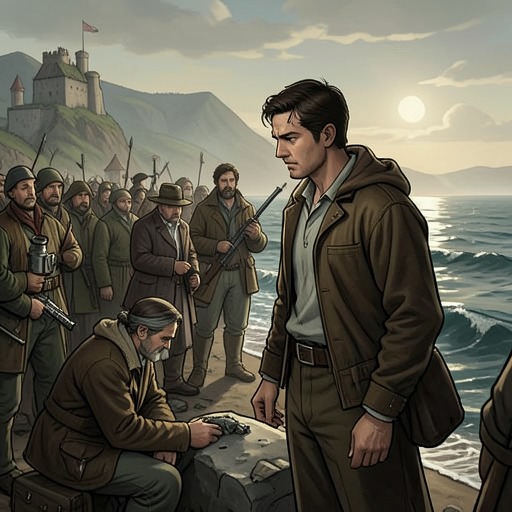
While walking by the sea, [Antoine Roquentin](entity:character-recall-character-antoine-roquentin-558efdd9d321) picked up a [pebble](entity:object-recall-object-6e1b9e63f1ea) and abruptly felt disgusted by it. He dropped it and left, unable later to tell whether the stone or the sea had provoked the feeling. The incident marked the beginning of a change he could sense but not yet explain.
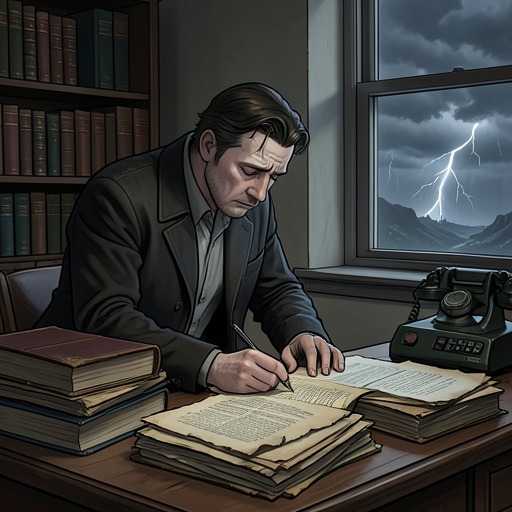
He began keeping notes to preserve the small details of the change, while worrying that writing a diary might make him exaggerate. The strange reaction to the pebble remained the first warning that ordinary objects were becoming disturbing in their sheer presence.
Around January 1932, before the diary proper
A Temporary Return to Normal
After an unsettling spell, Roquentin convinced himself that he had recovered. In his room at the [Hotel Printania](entity:location-recall-location-hotel-printania-783ae403dcc5), the familiar streets and the steady timetable of the trams reassured him that the world was regular and safe.
He abandoned the idea of keeping a diary, treating the earlier feelings as nonsense. His confidence proved temporary: the diary opens when the unease returns and can no longer be dismissed as an isolated episode.
Monday, 29 January 1932
The Change Takes Hold
Roquentin wrote that something had happened to him and that it had taken hold gradually, like an illness. Everyday objects and gestures now seemed unfamiliar: a door handle held his attention like a personality, and the Self-Taught Man’s handshake felt like contact with a limp, living thing.
He wondered whether he himself had changed or whether the room, [Bouville](entity:location-recall-location-bouville-3544f2b89611), and nature had changed around him. Remembering how abruptly his passion for travel had once vanished in Hanoi, he feared another inner upheaval might force him to abandon his research and begin again.
Tuesday, 30 January 1932, morning
The Paper He Cannot Pick Up
On his way from the [Hotel Printania](entity:location-recall-location-hotel-printania-783ae403dcc5) to the library, Roquentin saw a rain-soaked page beside a puddle. He usually enjoyed picking up and handling scraps of paper, but this time he bent down and could not make himself touch it.
The failure left him feeling that he was no longer free to act as he wished. It clarified that the disturbance was not simply a mood inside him: objects seemed to press upon him with an intolerable, almost living presence.
Tuesday, 30 January 1932, late afternoon
The First Nausea in the Café
At the Railwaymen’s Rendezvous, Roquentin was overcome by nausea while waiting for the patronne. The room, the patrons, the waitress, and even a pair of purple suspenders seemed to thicken into a wave of existence that surrounded him rather than arising within him.
He asked Madeleine to play a record. As the singer’s voice rose above the café’s shabby present, the music briefly steadied him: its ordered melody seemed distinct from the loose, contingent things around it. The relief suggested that art might offer a way of enduring what ordinary life could not explain.
Tuesday, 30 January 1932, evening
Walking the Boulevard Noir
After leaving the café, Roquentin walked through [Bouville](entity:location-recall-location-bouville-3544f2b89611) toward the deserted [Boulevard Noir](entity:location-recall-location-boulevard-noir-7c1ab9e8e51c). Its mud, walls, and darkness seemed mineral and inhuman, a stark contrast to the crowded, brightly lit streets he had fled.
He encountered Lucie, the charwoman, in the depths of a desperate quarrel with Charles. Her grief appeared to draw its force from the bleak street itself, and Roquentin envied the intensity of a suffering he could not share. The walk strengthened his sense of separation from other people and from the consolations of ordinary life.
Late January 1932, during Roquentin’s library visits
The Self-Taught Man’s Alphabetical Project
Roquentin discovered that the Self-Taught Man read the library’s books in alphabetical order, moving methodically from author to author. For seven years, the clerk had pursued this vast plan, imagining that he could absorb the store of human knowledge one book at a time.
Roquentin admired his perseverance but also saw the project’s comic limits: the Self-Taught Man might one day reach the last volume and have no answer to what came next. Their contrasting ways of seeking meaning—one through accumulated knowledge, the other through an inward crisis—became a recurring tension in their encounters.
Early in the diary, Friday afternoon
Time at the Window
Watching an old woman shuffle down the street from his window, Roquentin found himself unable to distinguish her present movements from the future he seemed to foresee. Her slow progress made time feel exposed and oppressive, a sequence already underway rather than a neutral setting for life.
He tore himself away from the window and his reflection, then tried to summon memories of travel. The remembered places came back only as fragments and labels; the living past he hoped to recover had largely dissolved into words.
Early in the diary, after the window episode
The Lost Meaning of Travel
Roquentin admitted that the adventures he once prized had become inaccessible. Memories of [Meknes](entity:location-recall-location-8197c6737f47) and other travels appeared as scraps of images or stories, and even photographs could not restore their original immediacy.
When the Self-Taught Man asked about his travels, Roquentin first claimed to have had adventures, then recognized that he no longer knew what the word meant. The discovery unsettled him: his old sense of a life made significant by extraordinary episodes had depended on a narrative interpretation he could no longer believe.
Early in the diary, following the Self-Taught Man’s visit
Adventure as a Story
Roquentin concluded that an ordinary event becomes an adventure only when it is recounted as a story. While living, people encounter a succession of moments without clear beginnings or endings; narration later rearranges them so that the ending makes earlier details seem like signs and promises.
He recognized that he had wanted his own life to unfold with this retrospective shape, as if each moment were leading toward a meaningful conclusion. That desire had made his travel stories feel precious, but it had also concealed the difference between living an event and turning it into a tale.
Sunday, early in the diary
The Sunday Crowd
Roquentin watched [Bouville](entity:location-recall-location-bouville-3544f2b89611)’s [Sunday](entity:time-recall-time-sunday-073632221971) ritual gather along [Rue Tournebride](entity:location-recall-location-rue-tournebride-711fa062db5c). The town’s families and social classes moved in orderly columns, greeting one another with elaborate hat-raising ceremonies beneath the monumental church of [Sainte-Cecile-de-la-Mer](entity:organization-recall-organization-sainte-cecile-de-6677fbd49376).
The procession displayed the town’s hierarchy as a performance of inherited respectability. Roquentin observed the gestures as if they were theatrical machinery, exposing how the townspeople used custom and social recognition to make their lives feel stable and meaningful.
The same Sunday, afternoon
The Afternoon by the Sea
After lunch, Roquentin watched the townspeople walk along the [Jetty Promenade](entity:location-recall-location-jetty-promenade-03a87e5f93cd). Their morning formality had softened into a shared, subdued rest; families and neighbours seemed intent on conserving their strength for the return to work.
As the light faded, a child admired the lighthouse and Roquentin felt a sudden surge of adventure. The feeling made the evening seem arranged toward an event, and he began to imagine that something at the end of the streets was waiting for him.
The same Sunday, at dusk
The Apparent Sunday Adventure
Walking through the town, Roquentin felt that a white stone ahead of him would mark the beginning of an adventure. Each step seemed to bring him closer to a destined encounter, and the streets, church, and distant sounds appeared to converge around his movement.
Nothing awaited him. He eventually found himself outside the Cafe Mably, where the cashier’s familiar face seemed to complete the day’s pattern and give it meaning. The exhilaration vanished afterward, revealing how readily he had imposed a story of purpose on an otherwise ordinary walk.
Shrove Tuesday, early February 1932
Anny’s Letter
Roquentin received a letter from [Anny](entity:character-recall-character-anny-92ec2a745226), who had been out of contact for years. She asked him to meet her in [Paris](entity:location-recall-location-657453741ed3) on 20 February, insisting that she had to see him.
The letter stirred his memories of their former relationship, but the feelings did not return with the force he expected. He remembered Anny’s exacting pursuit of perfect moments and recognized that the past had become difficult to reach except through scattered recollections.
Shrove Tuesday, after receiving Anny’s letter
A Dream of the Past
Roquentin tried to recall the precise words [Anny](entity:character-recall-character-anny-92ec2a745226) had written, but the letter contained only a brief request to meet. His memory instead returned to their old arguments about names, affection, and the formal arrangements Anny used to create perfect moments.
He wanted to feel tenderness for her, yet found himself emotionally dry. The gap between the woman he remembered and the person who had sent the letter made the coming meeting feel less like a return to the past than an encounter with someone changed beyond his reach.
The week before 20 February 1932
The Dead Bachelor’s Portrait
At the [Bouville](entity:location-recall-location-bouville-3544f2b89611) museum, Roquentin noticed a newly displayed painting titled The Bachelor’s Death. Its dead man lay unattended in a disordered room while a woman searched his belongings, a warning of the lonely fate supposedly awaiting a man without family or social ties.
The surrounding portraits celebrated Bouville’s prominent citizens as dutiful husbands, fathers, leaders, and believers. Their collective authority made Roquentin feel that he had no recognized right to exist, while also revealing how the town converted social position into a claim of moral legitimacy.
During the same museum visit
The Leaders in the Gallery
Roquentin studied the portraits of [Bouville](entity:location-recall-location-bouville-3544f2b89611)’s elite, including [Jean Pacome](entity:character-recall-character-jean-pacome-ba2552138d0a), [Remy Parrottin](entity:character-recall-character-remy-parrottin-2a16893a5692), and [Jean Parrottin](entity:character-recall-character-jean-parrottin-81270449f66b). Their painted faces seemed to embody unquestioned rights, authority, and duty; their lives had been arranged as though success and respect were their natural reward.
The portraits’ polished dignity exposed a system that treated social standing as proof of a right to rule. Roquentin found himself outside that system, neither patriarch nor citizen of consequence, and mocked the thought that he might be merely a specter among men who believed their lives were justified.
Later in the same museum visit
The Portrait of Blevigne
Roquentin returned to the portrait of [Olivier Blevigne](entity:character-recall-character-olivier-blevigne-955feb1fc222), whose proportions had long troubled him. By consulting the [Satirique Bouvillois](entity:organization-recall-organization-satirique-bouvil-a12e16c1abb9), he learned that Blevigne had been unusually short, although the painter had surrounded him with objects that concealed his stature.
The discovery showed how art could transform a small, flawed man into a commanding public figure. The portrait preserved an image more imposing than the life it represented, while the museum’s larger gallery revealed how [Bouville](entity:location-recall-location-bouville-3544f2b89611)’s elite had turned its own values into a polished monument.
A Monday in mid-February 1932
The End of the Rollebon Study
While working on the history of the Marquis de Rollebon, Roquentin realized that his account depended on hypotheses he had supplied himself. The documents did not disclose a stable person behind them; he had been arranging fragments into a convincing historical character.
He concluded that he could not rescue another man’s past when he could not hold on to his own. As the present moment overwhelmed the page, Rollebon ceased to function as a partner who gave Roquentin’s life direction. Roquentin abandoned the research and confronted the emptiness it had concealed.
Immediately after abandoning the Rollebon study
The Collapse into Existence
With the research ended, Roquentin felt existence surge through his body and ordinary surroundings. His hand, saliva, and weight became undeniable presences that thought could not set aside or explain.
In anguish, he tried to interrupt the experience by stabbing his palm with a knife. The wound produced no lasting change; even pain became another sensation among others. The episode made clear that neither historical work nor physical action could erase the fact of his existence.
The same evening
The Murder in the Newspaper
Roquentin read that the body of Little Lucienne had been found after she was raped and murdered. The report intensified his awareness of physical existence: the dead girl’s body had ceased to live, yet her flesh and the material world remained.
He became overwhelmed by a stream of thoughts about bodies, desire, violence, and the surrounding city. The newspaper offered no explanation or moral resolution; it only sharpened the sense that existence continued without regard for human meanings.
A Friday morning in mid-February 1932
The Fog and the Missing Manager
In thick fog, Roquentin entered the Cafe Mably and heard that its manager, M. Fasquelle, had not come downstairs. The possibility that he might be dead became fixed in Roquentin’s imagination, and the café’s ordinary objects seemed unable to secure the world against sudden change.
He left without confirming what had happened, then returned to find the café deserted. His fear grew as he moved through the streets, where familiar buildings and objects appeared unstable and menacing. The episode showed how quickly an unverified possibility could unsettle the boundaries of ordinary reality.
The same Friday, later that day
The Blue-Cloaked Man
In the public garden, Roquentin saw a man in a blue cloak smiling at a little girl. He sensed that the scene threatened to turn into an assault and felt both fascinated and powerless as the girl watched the stranger approach.
The man stopped when he noticed Roquentin, and the girl ran away. Roquentin shouted a warning to the man as he passed, but the encounter left him disturbed by the possibility of violence and by his own hesitation before acting.
The same Friday, evening
The Threat Passes
Unable to bear the city’s apparent instability, Roquentin sought refuge in the library. He and a few other readers delayed leaving when the building closed, each reluctant to step back into the night.
When the rain began and the square appeared peaceful, the sense of menace lifted. The episode did not provide an explanation for the day’s fear; it only showed Roquentin how ordinary environments could briefly become shelters from the uncertainty he carried everywhere.
A Wednesday lunch, several days before 20 February 1932
The War Captivity Confession
The Self-Taught Man told Roquentin that he had been a prisoner of war in Germany during the [First World War](entity:time-recall-time-82c88d06e845). In an overcrowded shed, surrounded by fellow prisoners, he had experienced an overwhelming sense of love and communion; he later returned to the shed alone to revive that feeling.
After the war, he found a sense of purpose in the [Socialist Party, S.F.I.O.](entity:organization-recall-organization-socialist-party-876129117ba6), and believed that humanity gave his life a goal. His confession revealed how deeply he depended on collective belonging, setting up the clash between his faith in human fellowship and Roquentin’s refusal to treat humanity as a ready-made answer.
The same Wednesday lunch
The Lunch Debate
Over lunch, Roquentin challenged the Self-Taught Man’s humanism. He argued that the other man loved abstract symbols such as youth and humanity rather than the particular people sitting before him, and rejected the claim that every person deserved admiration.
The discussion left the Self-Taught Man hurt and Roquentin increasingly sickened by the company around him. When the nausea returned, Roquentin recognized it as the undeniable evidence that both he and the world existed, without any guarantee of purpose. He left the restaurant, feeling that the others had mistaken his difference for a loss of humanity.
The same Wednesday, late afternoon
The Chestnut-Root Revelation
In the public garden, Roquentin stared at the chestnut tree’s root until the word that named it no longer seemed to fit. The root presented itself as a dense, naked existence, stripped of its familiar use and place within a human arrangement of things.
He understood that existence was contingent rather than necessary: things were simply there, with no reason that could be deduced from them. The revelation brought nausea and terror, but it also gave him a key to the experiences that had been accumulating since the [pebble](entity:object-recall-object-6e1b9e63f1ea). The world’s apparent order, including the rights claimed by [Bouville](entity:location-recall-location-bouville-3544f2b89611)’s respectable citizens, could not cancel its fundamental arbitrariness.
Immediately after the chestnut-root revelation
Nature’s Excess
Roquentin watched the trees and other objects as if each were struggling, without purpose, to continue existing. Their abundance seemed neither generous nor directed toward any end; every thing appeared superfluous and vulnerable to chance.
The garden’s ordinary scenery expanded in his perception into a vast, sticky, overwhelming world. When the vision passed, the trees seemed to smile at him, as if existence contained a secret he could sense but never fully understand. He left the garden carrying both the knowledge of contingency and the unanswered question of how to live with it.
The night after the chestnut-root revelation
The Move to Paris
Roquentin decided to leave [Bouville](entity:location-recall-location-bouville-3544f2b89611) because the end of his Rollebon research had removed the reason he had given for staying. He planned to move to [Paris](entity:location-recall-location-657453741ed3) after seeing [Anny](entity:character-recall-character-anny-92ec2a745226) and settling his affairs.
The decision was not a solution to his crisis so much as an act made in the absence of a guaranteed purpose. Roquentin still hoped that the meeting might change something, while recognizing that the freedom to begin again carried no promise of rescue.
20 February 1932
Anny’s Arrival
Roquentin met [Anny](entity:character-recall-character-anny-92ec2a745226) in [Paris](entity:location-recall-location-657453741ed3) after years apart. She was heavier and more tired than he remembered, and their reunion began in awkward silence rather than the intimacy he had imagined.
Anny teased him for remaining much the same and described him as a fixed point against which she could measure her own changes. Roquentin was moved by her presence but also felt the distance between the woman before him and the vivid figure preserved in his memories.
20 February 1932, during their meeting
Anny’s Lost Perfect Moments
[Anny](entity:character-recall-character-anny-92ec2a745226) explained that she had once searched for privileged situations—moments of love, death, conflict, or grandeur that could be shaped into perfect moments through precisely chosen actions and words. She had treated this transformation as a moral duty, organizing life as though it could be made into a work of art.
That faith had vanished. Anny no longer believed that passion could lift people into exceptional states or that action could give a moment the necessary meaning she once demanded. Her account revealed how much of their former relationship had depended on a private theatrical system Roquentin had never fully understood.
20 February 1932, evening
The Last Conversation
Roquentin told [Anny](entity:character-recall-character-anny-92ec2a745226) about his experiences of nausea and existence, hoping that their changed outlook might bring them together. Anny rejected the comparison: she had concluded that one could not be a person of action, while he was still searching for a way to endure his own existence.
They discussed their failed attempts to make life meaningful, including Anny’s work as an actor and her effort to reconstruct the past through spiritual exercises. Their conversation ended without reconciliation. Anny said she was expecting someone else and asked Roquentin to leave, making clear that the old relationship could not be resumed.
21 February 1932, 5:38 p.m.
Anny Leaves Paris
Roquentin waited at the station and saw [Anny](entity:character-recall-character-anny-92ec2a745226) depart on the train toward Dieppe with a handsome foreign man. She noticed him but did not call him over, and the train carried her out of his life again.
The sight made the meeting final in a way that words had not. Roquentin recognized that his hope of being saved by Anny had been misplaced, and that he would have to return to [Bouville](entity:location-recall-location-bouville-3544f2b89611) alone.
The day after Anny’s departure
The Final Day in Bouville
Back in [Bouville](entity:location-recall-location-bouville-3544f2b89611), Roquentin felt free but unable to find a reason to live. The past seemed finished: the Rollebon project was over, [Anny](entity:character-recall-character-anny-92ec2a745226) had left, and the future offered only the repetition of ordinary days.
He looked down at the town and imagined its citizens relying on habit and mechanical laws to reassure themselves. Yet he saw nature as present within their supposedly ordered lives, capable of changing without warning. His freedom felt close to death because no inherited purpose could tell him what to do next.
Roquentin’s last day in Bouville, afternoon
The Self-Taught Man’s Expulsion
In the library, Roquentin watched the Self-Taught Man speak quietly with two schoolboys. The librarian, [Paoli](entity:character-recall-character-paoli-a16cc838b9c1), accused him of making an improper advance and struck him in the face; a woman nearby joined the public denunciation.
Roquentin seized Paoli in anger but let him go without striking back. The Self-Taught Man fled, bleeding and refusing Roquentin’s help, while the library’s familiar order collapsed into humiliation and exclusion. Roquentin understood that the man he had argued with was now entering the loneliness he himself knew.
Roquentin’s last day in Bouville, late afternoon
The City Forgets Him
After leaving the library, Roquentin walked through streets that seemed already to have forgotten him. As he prepared to depart, he felt his identity thinning into a bare consciousness of existence, no longer supported by the city, his research, or his past.
He imagined the Self-Taught Man wandering through a different [Bouville](entity:location-recall-location-bouville-3544f2b89611), still painfully attached to what had happened in the library. Their separate solitude sharpened the contrast between Roquentin’s impersonal awareness and the other man’s immediate shame.
Roquentin’s last evening in Bouville
Goodbye at the Railwaymen’s Rendezvous
Roquentin said goodbye to the patronne and Madeleine at the Railwaymen’s Rendezvous. Their friendly memories and familiar talk could not restore the intimate routine he was leaving behind; even the patronne’s body now seemed inaccessible to him.
With less than an hour before his train, he counted his money and imagined the modest, repetitive life awaiting him in [Paris](entity:location-recall-location-657453741ed3). He knew that travel, women, and new possessions had lost their appeal, and that simply changing cities would not remove his nausea.
Roquentin’s last evening in Bouville, before his train
The Melody’s Other Time
Madeleine played the old recording of “[Some of These Days](entity:expression-recall-expression-some-of-these-days-5d4c5529dddb)” at Roquentin’s request. As the melody returned, he distinguished its firm, recurring form from the worn record and the changing lives of those listening in the café.
The music did not comfort him by sharing his suffering; it seemed to stand beyond the contingent world, untouched by the decay of its material performance. Thinking of the unknown composer and singer, Roquentin felt a fragile tenderness and wondered whether artistic creation could give a work a kind of endurance absent from ordinary existence.
Near the novel’s ending, before Roquentin boards the train
The Novel as a Possible Beginning
Listening to the record, Roquentin imagined writing a different kind of book—not a history that tried to restore a dead man, but a work that might be beautiful and hard as steel. He hoped such a book could make its readers feel that their existence was not the only possible measure of meaning.
He did not know whether he had the talent to accomplish it, and he did not mistake writing for an immediate escape from nausea. Still, the possibility gave his life a tentative direction: if he could finish the book, he might one day look back on his present without repugnance.
The final evening, as the train is due to leave
Departure from Bouville
As night fell, the lights came on at the [Hotel Printania](entity:location-recall-location-hotel-printania-783ae403dcc5) and the building yard smelled of damp wood. Roquentin was leaving [Bouville](entity:location-recall-location-bouville-3544f2b89611) with no completed research, no restored relationship with [Anny](entity:character-recall-character-anny-92ec2a745226), and no certainty that art would justify his existence.
The novel ends with his intention still untested. The melody had shown him a possible form of endurance, and the proposed book offered a future act, but neither could erase the contingency that had been revealed in the garden. His departure therefore marked a beginning only in the modest sense that he had chosen something to attempt.