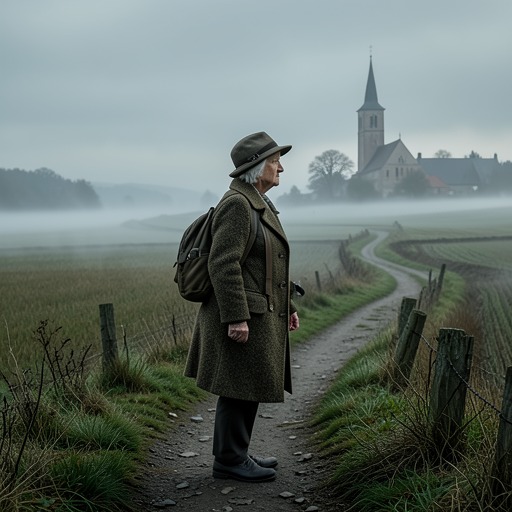
Carristown
NemesisCarristown is the town to which Elizabeth Temple is taken after the boulder attack, and its hospital becomes the setting for the most consequential late-stage exchange between the injured witness and Miss Marple. The location changes the investigation from an unsettling holiday incident into an urgent confrontation with evidence that may disappear when Temple dies.
Carristown as a Tour Destination
Carristown enters the narrative through the tour’s practical geography. After the boulder strikes Elizabeth Temple on the hillside, Emlyn Price explains that there is no local hospital and that she has had to be taken to Carristown, about eight miles away. The tour’s arrangements therefore acquire an unexpected dependence on the town: while the passengers return to the hotel, Mrs Sandbourne is expected to bring news of Temple’s condition.
The town is also part of the route designed by Jason Rafiel. His instructions had arranged for Miss Marple to join the Famous Houses and Gardens of Great Britain tour, whose itinerary leads her away from London and into unfamiliar parts of England. Carristown consequently functions both as an ordinary service centre on a guided excursion and as a point within the carefully engineered path by which Jason Rafiel brings Miss Marple into contact with the investigation.
The Hospital and Elizabeth Temple’s Condition
Carristown Hospital is introduced as the place Professor Wanstead takes Miss Marple to visit. He has telephoned Sister Barker in advance, and the hospital staff are expecting him. Sister Barker explains that Elizabeth Temple remains in a coma, with only rare intervals in which she recognizes her surroundings and manages to speak a few words. Doctors believe that she is sinking fast and may die without recovering consciousness; the concussion cannot be relieved, and the staff want someone present who might hear and record anything she says.
The hospital’s procedures turn the visit into a controlled act of witnessing. Miss Marple is placed alone beside Temple’s bed, while a nurse remains behind a screen and a police official waits with a notebook. The arrangements are intended to prevent Temple from becoming alarmed or losing the thread of whatever she wants to communicate. The institution thus imposes silence and restraint, but it also creates the protected conditions in which a damaged patient may give her last account.
The Final Testimony in Carristown
In a small, dimly lit private room, Temple lies almost statue-like, breathing in uncertain gasps. Miss Marple waits beside her for ten minutes, twenty minutes, half an hour, and then thirty-five minutes before Temple unexpectedly opens her eyes and addresses her by name. The setting’s stillness makes the moment feel less like a conventional interview than a brief return of consciousness under medical supervision.
Temple’s speech is broken and searching. She insists that the crucial question is which girl is meant, rejecting Nora Broad when Miss Marple suggests her and naming the other girl, Verity Hunt. She then refers to the large stone that came from above, calling it the Stone of Death, but cannot identify who rolled it down. Her inability to supply a culprit does not make the testimony useless: she directs Miss Marple toward Verity and links that name with truth.
The hospital room therefore becomes the place where physical incapacity and investigative urgency meet. Temple can offer only short bursts of language before consciousness recedes, yet those fragments redirect Miss Marple’s attention from the immediately visible attack to the older mystery surrounding Verity Hunt. After Temple relaxes and says goodbye, the nurse observes that the effort has been immense and that Temple may not regain consciousness. Temple dies an hour and a half later without recovering consciousness.
Narrative Significance of Carristown
Carristown is more than a backdrop for treatment. It is the point at which the tour’s apparent leisure, the hillside assault, and the buried history of Verity Hunt converge. The distance of about eight miles separates the scene of violence from the hospital, but the narrative carries the attack directly into the hospital room, where its meaning is reconsidered through Temple’s dying words.
The town also gives the investigation a sharply limited time frame. Medical staff can preserve access to Temple, but they cannot restore her health or guarantee another lucid interval. Miss Marple arrives as both an expected presence and an investigator, while Sister Barker, the nurse, the doctor, and the police official establish the conditions under which testimony can be heard. Carristown’s decisive role lies in this transformation of place: an apparently routine stop on a luxury tour becomes the guarded site of a final revelation, and Temple’s death turns the hospital visit into an irreversible transfer of responsibility to Miss Marple.