The Old Manor House
NemesisThe Old Manor House is not merely the setting for Jane Marple’s investigation; it is the physical structure in which the investigation’s central secret has been preserved, disguised, and emotionally repeated. At Jocelyn St Mary, the house, its garden, its three sisters, and the collapsed greenhouse form a single landscape of inheritance, grief, concealment, and delayed justice. The place appears neglected and harmless, yet its decay has helped hide the remains of Verity Hunt beneath a mound covered by Polygonum baldschuanicum.
House, Estate, and Inheritance
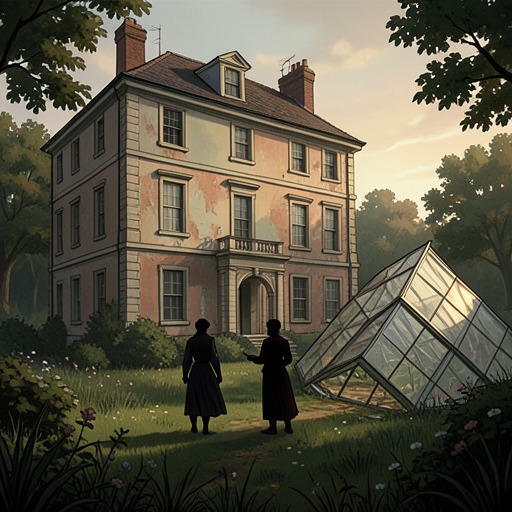
The Old Manor House is an old, well-proportioned house whose beauty belongs chiefly to the past. Its garden has been neglected, little money has been spent on it, and little work has been done for years. The furniture was once good but had received scant polishing or attention; the faded chintz curtains, worn carpet, ponderous sofa, and tired Victorian cabinets reinforce the impression that the house has ceased to be loved. Its name therefore carries an elegiac accuracy: it is a house built with grace and beauty, once cherished by a family whose children married and left.
The house was built in 1780 and belonged successively to the sisters’ great-uncle and uncle. After the uncle’s death, it was inherited by Clotilde Bradbury-Scott, Lavinia Glynne, and Anthea Bradbury-Scott. The uncle’s only son had been killed in the war, leaving the three women as the last members of the family apart from distant cousins. Lavinia came to live there with her sisters after her husband’s death, while the sisters’ incomes dwindled and domestic labour became harder to obtain. The property is thus both inheritance and burden: a remnant of family continuity whose material deterioration mirrors the sisters’ narrowing lives.
The Sisters in the House
The house is occupied by three sisters whose different appearances and behaviours give its rooms a charged human pattern. Clotilde Bradbury-Scott is handsome and imposing; Jane Marple associates her with Clytemnestra, imagining a woman capable of spectacular violence. Lavinia Glynne is plain but pleasant-looking and acts as the practical domestic member of the household, leaving the drawing-room to attend to the kitchen. Anthea Bradbury-Scott, thin and formerly fair-haired, has large grey eyes, a twitching eyelid, and a repeated habit of looking to either side and suddenly over her shoulder as though someone were watching her.
The sisters’ relations make the house feel less like a refuge than a closed emotional system. Clotilde says that Lavinia wants to leave and perhaps return to life abroad at Taormina, where she had been happy with her husband. She also admits that Lavinia is afraid of Anthea, though she dismisses Anthea as silly, jealous, and prone to strange ideas and sudden dislikes. Lavinia’s wish to sell the house and Anthea’s fear of remaining free within it suggest that the family’s apparent stability depends on avoidance, silence, and mutual apprehension.
When Jane Marple returns to the house, its atmosphere is not simply sinister but deeply unhappy, almost frightening in its intensity. Clotilde’s tears at the mention of Verity Hunt convince Jane that Clotilde had been genuinely attached to the girl, while Anthea’s wandering eyes and frightened glances suggest knowledge of something she cannot safely express. The house consequently gives emotional form to a secret shared unevenly among the sisters: one sister acts, another understands, and the household continues by refusing to speak plainly.
The Garden and the Collapsed Greenhouse
The garden is the decisive architectural and botanical feature of The Old Manor House. At the end of a grass path stands a hillock against the wall, the remains of what had once been a substantial greenhouse. Anthea remembers its grapevine and its muscat grapes and peaches with desperate nostalgia, wanting enough money to remove the mound, level the ground, rebuild the greenhouse, and restore the garden’s lost abundance. Her memory makes the ruin a monument to childhood, while her fear of it indicates that it is also a monument to something far darker.
The greenhouse fell into disuse after the end of the war, when repairs and gardeners became difficult to obtain. Its bricks collapsed into a heap, which was then covered with earth and turf and planted with Polygonum baldschuanicum. Jane Marple recognizes the creeper as a rapid-growing plant useful for hiding a dilapidated or ugly structure. It spreads over everything, becoming a menace to other growth; although its white flowers can look beautiful, its power to swallow and dry up what lies beneath gives it an ominous double character.
The plant therefore performs the work of concealment in plain sight. The mound looks like the natural consequence of neglect, and the fast-growing creeper makes the concealment seem ornamental rather than deliberate. Yet the garden preserves the secret through precisely the same process by which it erases the greenhouse. Decay, vegetation, and memory do not eliminate the past; they cover it while leaving its shape perceptible to anyone prepared to read the landscape.
The Hidden Remains and the House’s Crime
The Old Manor House becomes the burial place of Verity Hunt. Jane Marple concludes that Clotilde gave Verity a painless overdose of sleeping substance in coffee or milk, carried her body into the garden, pulled aside the fallen greenhouse bricks, and made a vault beneath the floor. She then covered it with bricks, earth, and turf before Polygonum was planted over the mound. Verity thus remained physically within the house’s grounds, while Clotilde maintained the emotional fiction that she had never truly been lost.
The burial explains the otherwise disproportionate atmosphere surrounding the greenhouse. Anthea’s distress is not only nostalgia for a childhood garden but fear connected with the mound and with what Clotilde has done. Jane Marple believes that Anthea gradually learned the truth: at first she may have understood only that Clotilde was creating a mound and covering it with flowering shrubs, but knowledge of the death emerged over time. Clotilde’s acceptance of evil then made further wrongdoing possible, and the garden became the first concealed chamber in a continuing sequence of crimes.
The house’s secret also depends on Clotilde’s attachment to Verity. Jane rejects the idea that Clotilde could have destroyed the girl she loved in the ordinary sense. Her conclusion is more disturbing: Clotilde killed Verity but refused to surrender her, keeping her in the garden as a permanent presence. The Old Manor House is consequently both home and tomb, a place where possessive love has been converted into imprisonment beyond death.
Jane Marple’s Assignment and Narrative Significance
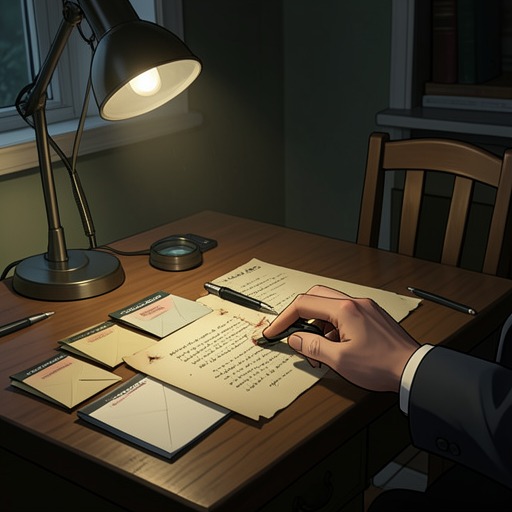
Jason Rafiel directs Jane Marple to The Old Manor House as part of a plan arranged before his death. He knows that the problem cannot be solved by his usual financial dealings, lawyers, or business methods, and he sends Jane away from St Mary Mead through a sequence of appointments and a tour before bringing her to this house. The location is therefore not accidental scenery but the next deliberate stepping-stone in his posthumous investigation.
Jane’s age and apparent frailty are essential to the house’s exposure. Doctors have forbidden her to work in her own garden, and she admits that she is old, with limited time and uncertain strength. Yet the qualities that make her seem harmless—her inquisitiveness, gossiping manner, slight deafness, imperfect eyesight, and ordinary appearance—allow her to move through the household without provoking defensive suspicion. Jason Rafiel identifies her most important qualification as a very fine sense of evil, while Jane understands that an apparently foolish old woman can ask questions more naturally than a professional investigator.
Her confrontation with Clotilde transforms the garden from mute setting into evidence. Clotilde threatens to silence Jane, but Jane answers that, despite having little strength in her arms or legs, she is in her own way an emissary of justice and trusts her guardian angel. The contrast between the frail investigator and the physically stronger woman reverses the house’s apparent power structure. The Old Manor House has protected violence through privacy, family loyalty, and natural overgrowth; Jane’s attention makes those same features legible, and the concealed past can no longer remain buried.