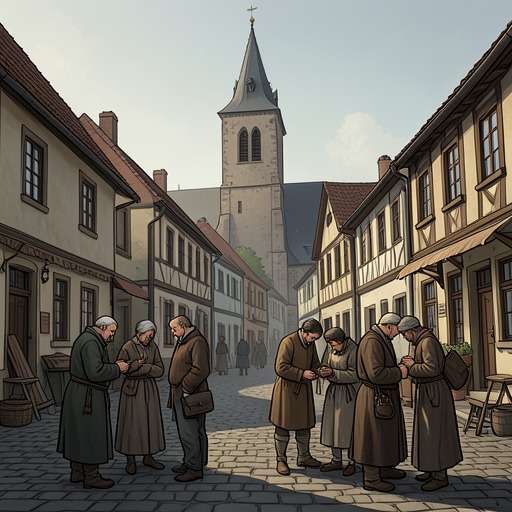
Jocelyn St Mary
NemesisJocelyn St Mary is the village setting to which Jane Marple is directed after Jason Rafiel’s death, and its decisive significance lies in the way a seemingly quiet house and landscape become a physical archive of violence. At The Old Manor House, the three Bradbury-Scott sisters live among neglected buildings, dwindling resources, old grief, and a secret that has been literally buried in the garden. The location’s apparent stillness conceals a chain of crimes and makes its domestic spaces inseparable from the investigation.
Setting and Household
Jocelyn St Mary is introduced through The Old Manor House, a once-graceful residence that has lost both care and affection. Its furniture was once good but had received little polishing or attention, while the garden had been neglected and little money or labor had been spent on the property for years. The house therefore presents decline not as sudden ruin but as the accumulated consequence of age, reduced incomes, and the difficulty of obtaining help.
Lavinia Glynne had inherited the house with her sisters from an uncle and moved there after her husband’s death. Her sisters, Clotilde Bradbury-Scott and Anthea Bradbury-Scott, had apparently remained unmarried; one was older and one younger than Lavinia. Their shared residence gives Jocelyn St Mary the character of an enclosed family world, separated from ordinary social life yet exposed to village observation. The house is both refuge and prison, preserving the sisters’ common past while forcing them to inhabit its consequences together.
Marple’s Arrival and Investigation
Jason Rafiel arranged Jane Marple’s stay at The Old Manor House weeks before his death. His instructions had led her first to a lawyer’s office, then to two letters read at home, and afterward to a conducted tour of famous houses and gardens. Jocelyn St Mary was the next appointed stage. Jane Marple understands that she has not arrived as an ordinary guest: the sisters must be connected with whatever Jason Rafiel wanted her to discover, although the precise nature of that connection is initially withheld.
Her investigation proceeds through the ordinary movements of village life. She leaves the house early, walks through the garden, passes through an open side gate, follows the village street, and visits the churchyard. Later, on her way to the inquest at the Curfew Arms, she pauses in a wool shop and uses a conversation about a local accident to gather information. After the coach party disperses, she takes an unobtrusive route to private addresses, including Mrs Blackett’s house. Jocelyn St Mary thus provides a network of apparently casual public encounters in which gossip, local memory, and overlooked testimony gradually supplement the formal investigation.
The village also supplies recurring names and buried records. In the churchyard, Jane Marple notices family names repeated across generations, including the Princes and the Broads. The graves do not immediately provide a solution, but they establish the community as a place where identity is carried through names, kinship, and memory. That local continuity contrasts with the uncertainty surrounding missing young women, whose disappearances can be explained away as departures with men until more disturbing evidence emerges.
Garden, Greenhouse, and Concealed Memory
The garden’s most important feature is the mound at the end of a grass path, against the wall. It is the remains of a greenhouse that had collapsed after falling into disuse, partly because repairs and gardeners had become scarce after the war. Bricks were piled up, covered with earth and turf, and planted over. The ruin is therefore not merely a neglected garden structure: it is a space where architectural decay provides the conditions for concealment.
The covering plant is Polygonum baldschuanicum, a rapidly growing creeper with white flowers. Jane Marple recognizes it as useful for hiding a tumbledown building or anything ugly, because it spreads over everything in a remarkably short time and suppresses other growth. Its beauty is inseparable from its aggressiveness. The plant turns the greenhouse’s collapse into a natural-looking mound, making concealment appear to be an ordinary process of gardening.
Anthea remembers the greenhouse for its grapes, especially the childhood promise of muscat grapes and peaches. She longs for enough money to dig up the mound, level the ground, rebuild the greenhouse, and restore its former produce. Her nostalgia gives the site an emotional history before its criminal meaning is known. Yet she is also visibly afraid of the mound, looking over one shoulder as though some presence were always behind her. The same place consequently carries two incompatible memories: for Anthea, the lost garden of childhood; for Jane Marple, an object of suspicion and a sign of suppressed terror.
Crimes Connected with the Place
Jocelyn St Mary is linked to the disappearance and supposed murder of Verity Hunt. Verity was said to have been seen with Michael Rafiel in a car resembling his, and the police considered him a possible suspect in crimes occurring in and around the district. Six months after Verity disappeared, a body was found thirty miles away in wooded country, in a ditch covered with stones and piled earth. It had been strangled, and the head and face had been disfigured by heavy blows. Clothing, a handbag, and identifying marks such as a mole and an old scar led to its identification as Verity.
The location’s deeper secret is revealed when Jane Marple confronts Clotilde. She argues that the body identified as Verity was not Verity at all. According to her reconstruction, Clotilde gave Verity a painless overdose of sleeping medication in coffee or milk, carried the body into the garden, removed fallen greenhouse bricks, and made a vault beneath the floor. The corpse was then covered, while Polygonum baldschuanicum grew over the site year after year. Verity therefore remained at The Old Manor House in death, held within the garden by the person who could not let her go.
Jane Marple further maintains that Clotilde arranged a second body to be mistaken for Verity. It was dressed in Verity’s clothes and accompanied by her handbag, letters, bangle, and little cross; the face was disfigured so that the identification would be accepted. The remote countryside and the ruined greenhouse serve different but complementary purposes: one creates the impression of a conventional murder and the other preserves the concealed truth. Jocelyn St Mary is the point at which the false identity and the real burial are joined.
The setting is also connected with the death of Elizabeth Temple. Jane Marple concludes that Clotilde killed Elizabeth because Elizabeth was coming to the area and might have known what Verity had written or said. A meeting between Elizabeth and Archdeacon Brabazon could have brought their separate knowledge together and exposed the truth. Elizabeth’s death on the hillside, attributed to the deliberate rolling of a boulder, extends the danger from the hidden garden into the wider landscape around Jocelyn St Mary.
Narrative Significance
Jocelyn St Mary transforms landscape into evidence. The village churchyard records names without explaining them; the streets enable conversations that reveal fragments of the past; the hillside offers an apparent accident; and the garden hides the decisive corpse. Each space permits a different degree of visibility, and the crimes depend on moving between those degrees: luring a girl away, concealing a body in remote woodland, disguising another body’s identity, and burying Verity beneath a domestic ruin.
The location also embodies the novel’s contrast between beauty and evil. The Old Manor House is graceful but unloved, the garden is neglected but observant, and Polygonum baldschuanicum produces lovely flowers while overwhelming and killing whatever it covers. The plant’s rapid growth makes concealment look organic, while the collapsed greenhouse turns family nostalgia into a structure of repression. What appears to be decay is thus active in the plot: the ruin supplies the vault, the vegetation seals it, and memory keeps the secret alive.
For Jane Marple, Jocelyn St Mary is not simply the destination of Jason Rafiel’s posthumous plan. It is the place where her instinctive response to atmosphere becomes a disciplined reconstruction of crime. The fear in Anthea’s manner, the mound’s physical history, the sisters’ divided accounts, and the village’s memories of missing girls converge until the house can no longer be treated as an innocent residence. Jocelyn St Mary’s final significance is that it makes concealment visible: the buried truth is not outside the landscape but embedded in its most familiar and apparently natural features.