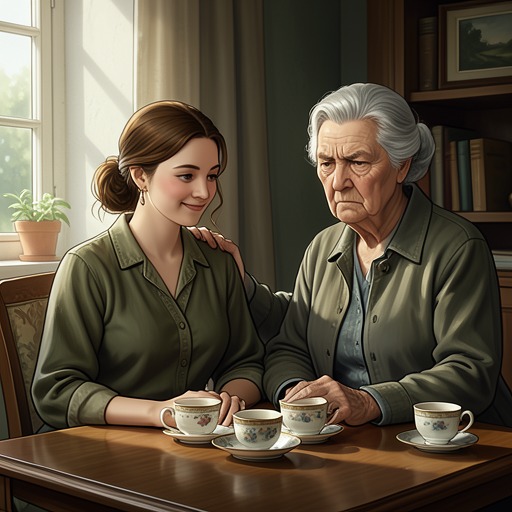
Clotilde Bradbury-Scott–Verity Hunt relationship
NemesisThe Clotilde Bradbury-Scott–Verity Hunt relationship is the emotional and criminal center of the tragedy surrounding Verity Hunt. It is founded on genuine care: after Verity loses both parents, Clotilde takes her into The Old Manor House, educates and protects her, and becomes the dominant figure in her life. Yet that protection gradually becomes possessive. When Verity falls in love with Michael Rafiel and attempts to escape into marriage, Clotilde cannot accept the change. Her devotion turns into coercive control, and finally into murder followed by an elaborate effort to preserve Verity as her possession.
Formation of the Bond
Clotilde Bradbury-Scott is the eldest of the sisters associated with The Old Manor House. Verity had been a pupil of Elizabeth Temple at Fallowfield, and was not related to Jason Rafiel, although she was once engaged to marry his son. Elizabeth describes Verity as a beautiful and sweet girl, while the Archdeacon later supplies the fuller history: Verity’s parents were killed in a charter plane accident during a holiday trip to Italy, leaving her without her real guardians before she had reached adulthood.
After leaving school, Verity went to live with Clotilde, who had been a close friend of Verity’s mother. Clotilde did everything she could to give the orphaned girl a happy life. She took her abroad, gave her art lessons in Italy, and cared for her with exceptional attention. Verity responded with an attachment approaching worship. Clotilde was handsome, accomplished, intellectual, and well educated; to Verity she became not merely a guardian but an idealized maternal and personal presence. The relationship therefore supplied Verity with security and stimulation, while also making Clotilde the person on whom Verity most emotionally depended.
Mutual Devotion and Unequal Dependence
The bond is presented as loving on both sides, but it is not equal. The Archdeacon says that Verity came to love Clotilde almost as she might have loved her own mother, whereas Clotilde came to love Verity as though she were her daughter. Their life at The Old Manor House seemed happy, and Verity appeared content. Clotilde did not force her toward university because Verity did not yearn for that path; instead, she supported Verity’s interests in art, music, and related subjects. Care, in this form, is attentive and apparently generous.
Its danger lies in the fact that Verity’s identity has been formed inside Clotilde’s affection. The Archdeacon believes that Verity gradually became conscious, without fully recognizing it, of a wish to escape from being so completely loved. She did not necessarily wish to reject Clotilde or deny the happiness she had known. She wanted a different adult life: a relationship with a man, marriage, children, and the ordinary future represented by a mutual choice between a woman and a man. Her movement toward Michael Rafiel therefore becomes, for Clotilde, not simply a new romance but the threatened collapse of the world they had made together.
The Conflict over Michael Rafiel
Michael Rafiel was an unsuitable and troubled young man, with a record of trouble involving the police and repeated mistreatment of girlfriends. Even so, Verity loved him, and the Archdeacon judged that their love was genuine. Michael told Verity about his own bad history and promised to turn over a new leaf when they married. The Archdeacon warned that people do not necessarily change, but Verity accepted the risk because she believed she might help him.
Clotilde opposed the relationship. She tried to keep Michael away from the house and told him not to return. The prohibition failed: Verity and Michael arranged meetings outside The Old Manor House, sometimes meeting at agreed places and sometimes returning late or not until the following day. Clotilde’s attempt to control access to Verity thus produced secrecy rather than separation. Her actions reveal a coercive pattern in which care becomes isolation, and opposition to an unwanted relationship becomes an effort to determine where Verity may go and whom she may see.
Clotilde later minimizes the possibility that Verity and Michael intended to marry, claiming that she did not think Michael wanted marriage. The Archdeacon’s account contradicts this version. He had agreed to marry the couple, fixed the necessary arrangements, and understood that their wedding was being kept secret because they feared that others would stop them. Verity’s secrecy was especially significant: she knew Clotilde would bitterly oppose the marriage and understood that she could not make Clotilde accept her desire to leave. The proposed marriage was therefore both a love match and an act of escape from the dependency that had defined Verity’s life.
Love as Possession and Murder
Miss Marple identifies the contradiction at the heart of Clotilde’s attachment. Clotilde did love Verity, but her love was so absolute that it could not tolerate Verity’s separate will. Miss Marple tells her that Verity wanted to escape from the burden of the love she shared with Clotilde and to live with the man of her choice. In this interpretation, Clotilde’s motive is not indifference or simple jealousy. She believes Michael is unworthy of Verity and experiences the threatened loss as an intolerable destruction of the person she loves most.
Clotilde admits the agony of knowing that Verity would be lost to a depraved delinquent. She says she had to stop the marriage. Miss Marple’s crucial distinction is that Clotilde did not kill Verity through the brutal violence initially associated with the discovered body. Clotilde loved the girl too deeply to strangle her or crush her face. Instead, Miss Marple concludes that Clotilde gave Verity coffee or milk containing a painless overdose of sleeping medicine, then moved the body into the garden.
The collapsed greenhouse becomes the physical expression of the relationship’s transformation. Its fallen bricks were rearranged to form a burial vault beneath the ground, and earth and turf were piled over Verity. The rapidly growing Polygonum baldschuanicum then covered the mound, concealing the remains beneath beautiful white flowers. The burial does not represent Clotilde’s acceptance of separation. It is a grotesque continuation of possession: Verity remains at The Old Manor House, hidden in the garden, and Clotilde never has to release her to Michael or to the outside world.
Concealment, Substitution, and the Sisters
The murder also required Clotilde to construct a false story about Verity’s disappearance. Miss Marple reasons that Clotilde arranged for Nora Broad, a village girl whom she could influence, to be taken on an outing far from The Old Manor House. Nora was strangled, disfigured, and buried under turned earth, leaves, and branches. Verity’s handbag and a chain associated with Verity were placed with the body, and Nora may have been dressed in Verity’s clothes. Rumours were then spread that Nora had been seen in Michael’s car and that Verity had broken off the engagement because of his infidelity.
This substitution extended the possessive relationship into the realm of identity. Clotilde not only removed Verity from her chosen future; she attempted to make the world believe that the dead girl was Verity, while the real Verity remained hidden within the family garden. The false narrative helped direct suspicion toward Michael Rafiel and made his apparent guilt seem consistent with his reputation. Clotilde’s control therefore operated through both physical concealment and manipulation of social knowledge.
The other sisters are caught inside the consequences of this attachment. Lavinia Glynne is described as wanting to leave The Old Manor House and being afraid of Anthea Bradbury-Scott. Anthea appears nervous, disordered, and persistently frightened, often glancing behind her as though someone were watching. Miss Marple senses a deep unhappiness at the house and connects Anthea’s fear with the mound. She concludes that Anthea gradually realized what Clotilde had done. The family system consequently preserves the crime through fear, silence, and avoidance rather than through open agreement.
Exposure and Final Meaning
When Miss Marple confronts Clotilde, she states that Nemesis concerns the beautiful girl Clotilde killed. Clotilde does not deny loving Verity; she insists that she was devoted to her and that Verity loved her. The confrontation exposes the relationship’s central paradox: Clotilde’s affection is real, but its refusal to recognize Verity’s freedom makes it destructive. She cannot accept that Verity’s love for Michael is different from her attachment to Clotilde, and she interprets Verity’s wish for an independent life as an unbearable loss.
The word that unlocks the relationship is “Love.” Elizabeth Temple had identified love as the cause of Verity’s death, and Miss Marple understands that this does not mean the young couple’s love alone. It means Clotilde’s overwhelming, possessive love, combined with Verity’s dependency and her eventual need to escape. The relationship thus moves from guardianship to idealization, from idealization to control, and from control to permanent confinement. Its final image is Verity still present beneath the Polygonum at The Old Manor House: cared for, hidden, and deprived of the life she chose.