The Bradbury-Scott sisters’ relationship
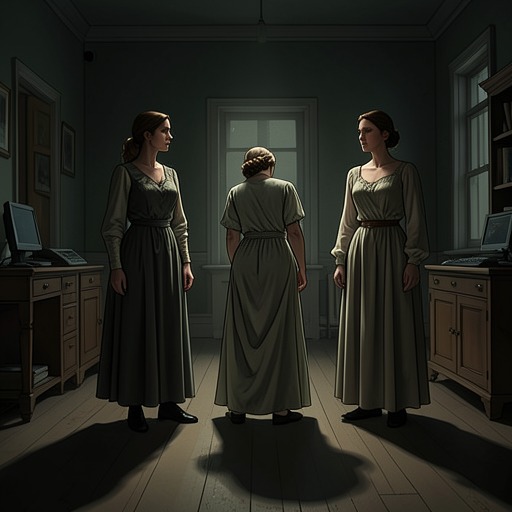
NemesisThe Bradbury-Scott sisters’ relationship is the governing domestic structure of The Old Manor House: an apparently genteel household whose dependence, silence, and fear preserve the consequences of Clotilde Bradbury-Scott’s crime. Clotilde Bradbury-Scott, Lavinia Glynne, and Anthea Bradbury-Scott are bound together by family inheritance and shared residence, yet they occupy sharply different emotional positions within the home. Their relationship moves from conventional sisterly cohabitation into a system of control and concealment, in which each sister knows, suspects, or fears a different part of the truth about Verity Hunt.
Family and Household
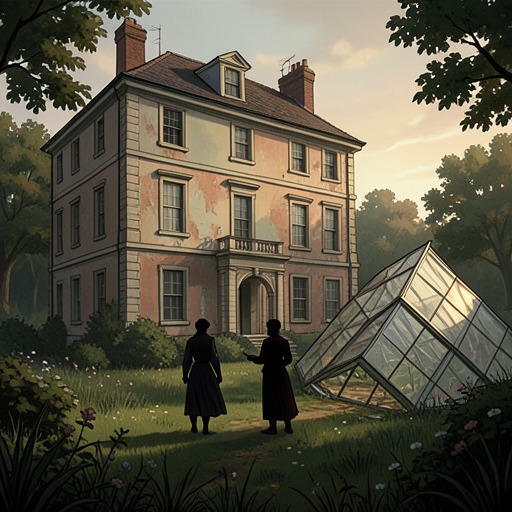
The sisters live in a neglected ancestral house inherited from their uncle. The Old Manor House once possessed proportion, good furniture, and a measure of beauty, but its upkeep has declined as the sisters have aged, their incomes have dwindled, and domestic labour has become harder to obtain. They are the last of the family apart from distant cousins: their uncle’s only son was killed in the war, leaving the property to the three women. The house therefore represents both inheritance and enclosure. It is not merely their residence but the remnant of a family line that has contracted around them.
Their lives have also been divided by circumstance. Lavinia Glynne became a widow and returned to live with her sisters after spending years abroad with her husband, while Clotilde Bradbury-Scott and Anthea Bradbury-Scott apparently remained unmarried. The absence of children and the lack of any younger generation make the household unusually self-contained. Jane Marple sees only a house with three sisters: a world in which old loyalties, old grievances, and old memories have no outside correction.
The sisters’ practical roles are unequal. Lavinia Glynne is the active domestic member, going to the kitchen and managing ordinary household tasks. Clotilde Bradbury-Scott presents the family history and appears to occupy the position of authority within the house. Anthea Bradbury-Scott is treated as unreliable and difficult, partly because of her mental deterioration and partly because her behaviour makes her a disturbing presence. The arrangement resembles a family system maintained by routine: one sister manages the home, one commands its narrative, and one is contained within the category of the unstable younger sibling.
Contrasting Personalities and Dependencies
Clotilde Bradbury-Scott is handsome, physically strong, and associated by Jane Marple with the commanding theatricality of Clytemnestra. Her appearance and forcefulness contrast with Lavinia Glynne’s plain but pleasant manner and with Anthea Bradbury-Scott’s thin, untidy, almost wraith-like aspect. Anthea’s eyelid twitches, her large grey eyes shift from side to side, and she repeatedly looks behind her shoulder as if someone were watching her. These bodily habits make visible a fear that the household does not openly name.
Lavinia Glynne appears outwardly comfortable and emotionally reserved. Jane Marple wonders whether years of stress and difficulty have taught her to reveal little of her inner life. Yet Lavinia is not content within the family arrangement. She speaks of returning abroad, particularly to Taormina, where she had been happy with her husband, and Clotilde reports that she sometimes seems not to like living in the same house as Anthea. Lavinia’s wish to leave is therefore more than a travel preference: it is a desire to escape the atmosphere and obligations of the shared home.
Anthea Bradbury-Scott is the most visibly vulnerable sister. Clotilde describes her as having been delicate when young and as having become increasingly unbalanced. She wanders away without knowing where she is, has hysterical fits of laughter, suffers sudden rages and dislikes, and is said to be jealous when attention is given to other people. Clotilde insists that Anthea is merely silly and queer, but also admits that she is not quite normal and may need treatment. The contradiction is crucial. Anthea is simultaneously protected as a member of the family and discredited as someone whose perceptions and statements can be dismissed.
Fear, Suspicion, and the Hidden Past
The sisters’ relationship is organized by fear rather than mutual confidence. Clotilde says that Lavinia is definitely afraid of Anthea, although she claims there is no danger that Anthea will do anything strange or dangerous. Anthea’s earlier conduct provides the basis for that fear: Clotilde recalls storms of rage, a past attack on someone, and an incident in which Anthea wrung the neck of a parrot. These memories allow Clotilde to portray Anthea as potentially violent, but they also reveal that Clotilde herself has never trusted her youngest sister.
Anthea’s fear, however, points in the opposite direction. Jane Marple senses deep unhappiness and an atmosphere of fear at The Old Manor House, especially in Anthea’s repeated backward glances. Clotilde later admits that Anthea became jealous of Verity Hunt and seemed to turn against her, even looking at her with hatred. Clotilde suspects that Anthea may have known something about Verity’s death, but her account is also a means of directing suspicion toward the sister whom the household has already marked as unstable.
The central secret is gradually disclosed as a family secret rather than an isolated act. Clotilde had been deeply attached to Verity Hunt, and Jane Marple is certain that the tears which came to Clotilde’s eyes when Verity’s death was mentioned were genuine. Yet Clotilde’s love did not prevent murder; it became the motive and emotional justification through which she acted. Anthea, meanwhile, seems to have learned the truth gradually after seeing Clotilde build up the mound at the end of the garden. She may not have understood at first that a death had occurred, but eventually she understood enough to fear that Clotilde knew she knew.
The Garden as a Family Memory
The sisters’ emotional history is materialized in the garden, particularly in the collapsed greenhouse. Jane Marple finds a mound formed from fallen bricks, earth, and turf at the end of a grass path. Anthea mourns the lost greenhouse and remembers its grapes from childhood; she longs to have enough money to level the mound, rebuild the structure, and restore its muscat grapes and peaches. Her nostalgia is therefore attached to a specific family space, but the space also contains the secret that has made the family’s present unbearable.
The mound is covered by Polygonum baldschuanicum, a rapidly growing creeper that spreads over and suppresses whatever lies beneath it. Its white flowers can appear lovely, but the plant is also a menace, swallowing and drying out other growth. The garden consequently performs the work of the household itself: beauty covers damage, growth conceals a ruin, and the visible surface makes the buried past seem natural. The plant’s recurrence and expansion turn concealment into a living process.
Jane Marple eventually concludes that Clotilde placed Verity’s body beneath the fallen greenhouse. She believes Clotilde gave Verity a painless overdose of sleeping medication, carried her into the garden, built a vault beneath the bricks, and covered it with the mound and Polygonum. Verity was thus kept at The Old Manor House, not released into burial or public mourning. Clotilde’s attachment transformed the garden into a permanent shrine and prison, while Anthea’s awareness transformed the same place into a source of terror.
Roles in the Crime and Its Aftermath
The sisters’ relationship also helps explain how the crime could remain hidden for ten years. Clotilde Bradbury-Scott is the active agent and the keeper of the secret. Jane Marple believes that, after accepting and committing evil, Clotilde found no difficulty in planning a second murder: she influenced Nora Broad, took her a considerable distance away, strangled and disfigured her, buried her under turned earth, leaves, and branches, and used Verity’s handbag, chain, and possibly clothing to make identification misleading. Rumours involving Nora Broad and Michael Rafiel then helped support the false account surrounding Verity’s disappearance.
Anthea’s position is that of a frightened witness who cannot safely speak. Clotilde gives her the parcel containing the red-and-black check polo-neck jumper, and Jane Marple interprets this as part of an attempt to remove conspicuous evidence through the post. At the same time, Clotilde presents Anthea as mentally disturbed and potentially persecuted, creating a ready explanation for any alarming behaviour or accusation. The family system therefore protects Clotilde through the very story that appears to protect Anthea.
Lavinia’s role is less directly defined, but her wish to leave and her fear of Anthea show that she is caught inside the consequences of events she may not fully understand. She is neither presented as the central criminal nor as a clear investigator of the truth. Her domestic usefulness and emotional reserve help the household continue, while her longing for Taormina signals the cost of remaining within it. The sisters’ apparent unity is thus sustained not by shared understanding but by different forms of avoidance.
Meaning of the Sisterhood
The Bradbury-Scott sisters’ relationship gives the novel’s mystery its domestic and psychological depth. The household is a three-way pattern of domination, withdrawal, and fear: Clotilde’s possessive love fixes the past in place; Lavinia seeks distance from the oppressive arrangement; and Anthea bears the visible symptoms of terror while being made into the family’s suspected danger. No sister can simply leave the emotional history of The Old Manor House behind, because the house, the garden, and the buried body continually return it to them.
Their relationship also complicates the boundary between love and evil. Clotilde does not kill Verity because she feels nothing; she kills because her attachment cannot accept Verity’s separation and later preserves the body because she cannot let her go. Jane Marple regards Clotilde as a lost and suffering woman, but not as an innocent one. The sisters’ tragedy lies in the fact that Clotilde’s grief does not redeem her, Anthea’s fear does not free her, and Lavinia’s desire to escape does not undo the family’s dependence. The relationship becomes the mechanism by which love, secrecy, and violence remain alive together.