The collapsed greenhouse at The Old Manor House
NemesisThe collapsed greenhouse at The Old Manor House is a ruined garden structure whose significance changes from family relic to crime scene. Once a large, productive greenhouse containing a muscat grapevine, peaches, nectarines, and Cherry Pie, it fell into decay after the Second World War, when gardeners were unavailable and the sisters could not afford repairs. Later, its bricks, earth, turf, and concealing Polygonum baldschuanicum formed a vault over Verity Hunt’s body, making the greenhouse the physical meeting point of nostalgia, concealment, memory, and murder.
Definition and Physical History
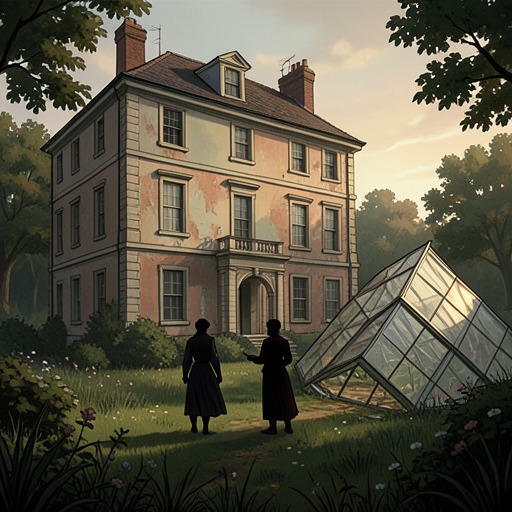
The greenhouse belongs to the neglected landscape of The Old Manor House, a house that had once been carefully maintained but had ceased to be loved or properly funded. Clotilde Bradbury-Scott explains that many outbuildings were allowed to fall down because repairs had become too expensive; the greenhouse was especially regretted because it had once been beautiful and large. Anthea Bradbury-Scott recalls its muscat grapevine and the Cherry Pie that grew along its inner walls, while the former structure is later remembered as having produced peaches and nectarines as well. Its collapse is therefore not presented as a single dramatic catastrophe but as the cumulative result of wartime labour shortages, dwindling incomes, and the sisters’ inability to restore what they had inherited.
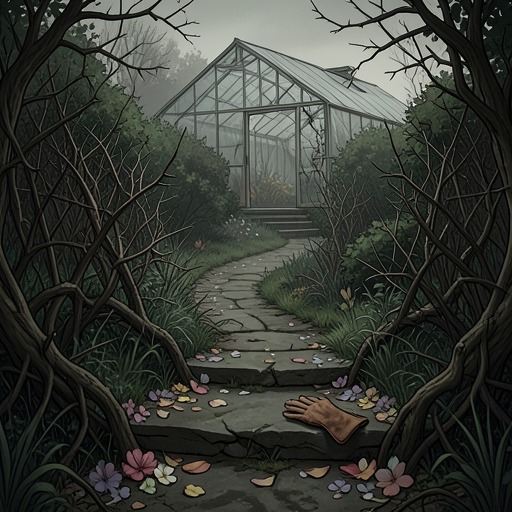
The remains appear as a mound at the end of a grass path, pressed against the garden wall. The sisters identify this mound as their greenhouse, and Anthea’s mourning gives the ruin an emotional life beyond its physical materials. The structure has become bricks piled beneath earth and turf, a visible absence that preserves the outline of a former abundance while concealing what lies beneath it. The garden’s condition makes neglect appear natural, even though the mound is the product of human choices and a history that has not been openly told.
Covering Plant and Concealment
The mound is thickly covered with Polygonum baldschuanicum, a rapidly growing flowering creeper known for hiding fallen or unattractive buildings. Miss Marple recognizes the plant and understands its aggressive habit: it covers everything quickly and threatens other growth by swallowing, drying, and eliminating what lies beneath it. Its white flowers and attractive appearance create a disturbing contrast with its suppressive force. The plant beautifies the ruin while making the ruin harder to read.
This concealment has a literal function in the plot. There was no bomb damage in the neighbourhood; the greenhouse fell through decay, and the sisters lacked the money either to repair it or to maintain it afterward. The explanation sounds ordinary, but the overgrown mound also provides precisely the kind of secluded, visually disguised space in which a secret could survive. The greenhouse is thus an object whose apparent transparency fails: what looks like a harmless remnant of wartime and domestic decline becomes evidence that demands interpretation.
The Hidden Burial Place
Miss Marple eventually reconstructs the greenhouse’s decisive role in Verity Hunt’s death. She argues that Clotilde Bradbury-Scott could not bear to lose Verity to Michael Rafiel, whom Verity loved and intended to marry. Rather than strangling and disfiguring Verity, Clotilde is believed to have given her a painless overdose of sleeping medication, then moved her body into the garden. She pulled aside the fallen greenhouse bricks, made a burial vault beneath the floor, and covered it with the bricks, earth, and turf.
The greenhouse’s ruin consequently serves as a man-made tomb hidden inside a domestic garden. The body is not merely placed in an anonymous outdoor location; it remains at The Old Manor House, within the emotional territory Clotilde refuses to surrender. Miss Marple’s interpretation gives physical meaning to the fear she has sensed in Anthea Bradbury-Scott and to the sisters’ repeated grief over the lost greenhouse. Anthea’s distress over the mound is connected not only with childhood memories of grapes and fruit but also with the presence of the buried woman beneath it.
Evidence, Misidentification, and Revelation
The hidden body is central to the larger confusion surrounding Verity’s presumed murder. Verity’s remains were thought to have been found after a girl disappeared and a body, dead for six months, was discovered in a ditch. The corpse had been strangled, and its head and face had been battered with heavy stones to delay recognition. Clothes, a handbag, jewellery, and identifying marks led to the body being recognized as Verity’s, and the resulting case helped support Michael Rafiel’s prosecution.
Miss Marple’s final explanation separates the two crimes. She concludes that Clotilde killed Verity and concealed her in the greenhouse, while Nora Broad was murdered separately and dressed in Verity’s clothes. The second body was then identified as Verity’s, in part because Clotilde herself was the person expected to recognize her. The greenhouse therefore holds the truth that the public evidence obscured: Verity was not the battered corpse used to condemn Michael, and the apparently settled identification depended on deliberate substitution.
Symbolic and Narrative Significance
The greenhouse combines the novel’s images of cultivation and destruction. It once sheltered living plants and preserved fruit; after its collapse, Polygonum baldschuanicum spreads over the wreckage and suppresses whatever might grow beneath it. That botanical process mirrors the way the past has been managed at The Old Manor House: family memories are preserved in sentimental form, while the violent fact beneath them is covered over and allowed to become part of the landscape.
Its repeated appearance also makes the structure a site of delayed recognition. At first it is an object of regret, associated with lost money, lost labour, and Anthea’s childhood. Miss Marple then notices the fear surrounding it, and only later identifies the mound as the hiding place of Verity’s remains. The change from ruin to tomb is the decisive reversal attached to the object. When the bricks and overgrowth are read as evidence rather than scenery, the greenhouse exposes the concealed history of Clotilde Bradbury-Scott’s possessive love, Verity Hunt’s death, and the false case against Michael Rafiel.