Polygonum baldschuanicum
NemesisPolygonum baldschuanicum is a vigorous flowering creeper whose attractive white blossoms conceal as much as they decorate. At The Old Manor House, it covers the ruins of the collapsed greenhouse and ultimately masks the place where Verity Hunt’s body has been secretly buried. The plant therefore links ordinary horticultural neglect with concealed murder: it transforms a visible mound of bricks, earth, and turf into a natural-looking part of the garden while allowing the house’s most terrible secret to remain physically present.
Appearance and Horticultural Use
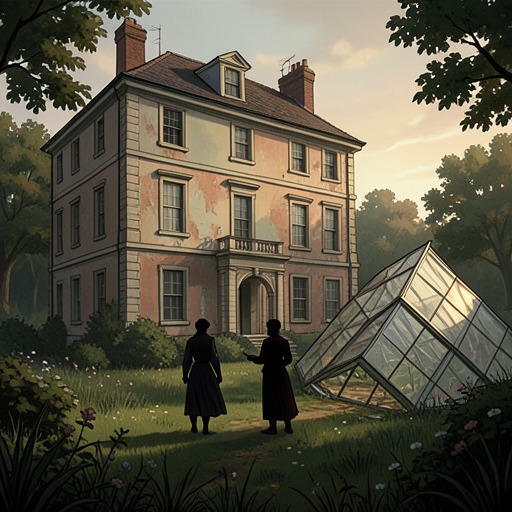
Polygonum baldschuanicum first appears when Miss Marple examines the neglected garden of The Old Manor House. The former greenhouse has collapsed into a mound beside the wall, and Anthea Bradbury-Scott explains that the structure fell through decay rather than bomb damage. The family lacked the money to repair or rebuild it, and the ruins were left to become overgrown. The creeper has spread across the mound in thick green and white cover, making the broken building difficult to distinguish beneath its growth.
Anthea cannot immediately remember the plant’s name, recalling only that it begins with a P. Miss Marple supplies the name, identifying Polygonum baldschuanicum as a very fast-growing plant and noting its usefulness for hiding a tumbledown building or anything ugly. This exchange gives the plant a practical, almost innocent role. It is a convenient solution to an impoverished household’s inability to restore the greenhouse, allowing decay to be concealed rather than repaired.
The plant’s speed is central to its significance. Miss Marple observes that Polygonum covers everything and does so remarkably quickly. In the later explanation of her investigation, she describes it as a creeper that swallows, kills, dries up, and gets rid of whatever it grows over. The contrast between its beautiful white flowers and its suffocating habit makes it an unsettling natural image: the plant is lovely to look at, yet its beauty is inseparable from its power to overwhelm and erase what lies beneath it.
The Collapsed Greenhouse and Memory
The plant grows over more than architectural debris. The greenhouse had once been a cherished part of the sisters’ childhood garden, producing grapes, peaches, and nectarines. Anthea remembers its fruit especially vividly and longs to have enough money to dig up the mound, level the ground, rebuild the greenhouse, and stock it again with muscat grapes and peaches. Her wish expresses a painful nostalgia for the household’s earlier life, before the sisters had grown old, their incomes had diminished, and the property had fallen into neglect.
That nostalgia is shadowed by fear. While walking with Miss Marple, Anthea appears desperately unhappy about the greenhouse’s loss, but her distress seems to exceed ordinary regret over a ruined garden structure. Miss Marple senses an atmosphere of fear around the mound and notices Anthea’s habit of looking sharply over one shoulder as though something were standing behind her. The garden thus holds two incompatible memories at once: Anthea sees the greenhouse as a lost emblem of childhood happiness, while her fear suggests that the mound also contains a secret associated with a crime.
The neglected grounds reflect the condition of The Old Manor House itself. The house was once well proportioned and furnished with good furniture, but in later years it had received little polishing, money, or care. It seems no longer loved. Polygonum gives this decline a living form: rather than preserving the old structure, the plant covers its collapse, turning abandonment into an attractive surface. Its growth makes the past appear softened and natural even as it prevents the underlying ruin from being examined.
Concealment of Verity Hunt
Miss Marple eventually concludes that Verity Hunt is still present in the garden. She rejects the idea that Clotilde Bradbury-Scott could have brought herself to strangle and disfigure the girl she loved. Instead, she reconstructs a quieter death: Verity was given coffee or milk containing a painless overdose of sleeping medication. After Verity died, her body was taken into the garden, the fallen greenhouse bricks were pulled aside, and a vault was made beneath the floor. The body was then covered over, and Polygonum was planted above it.
This reconstruction changes the plant from background decoration into an instrument of concealment. Its rapid growth helped hide the burial place, while its continuing spread ensured that Verity remained enclosed within the landscape of The Old Manor House. The mound could be explained as the ordinary remains of a greenhouse that had collapsed through lack of repair. The creeper made the explanation more convincing by covering the bricks and earth with the signs of vigorous garden growth.
The concealment also preserves Clotilde’s attachment to Verity in a perverse form. Verity was not allowed to disappear completely. She remained beneath the garden, within the house’s grounds and within Clotilde’s daily world. Miss Marple suggests that Clotilde knew where Verity was and might even have seen or imagined seeing her when picking a spray of Polygonum blossom. The plant therefore operates both as a screen and as a means of proximity: it hides the dead woman from others while keeping her emotionally and physically near the woman who killed her.
A Botanical Image of Buried Guilt
Polygonum baldschuanicum embodies the novel’s recurring tension between appearance and reality. Above ground, it is a common, useful, flowering creeper; beneath its cover lies a carefully concealed grave. The plant’s attractiveness does not cancel the horror beneath it. Instead, the white flowers make the concealment more disturbing, because the garden can look peaceful and even beautiful while preserving evidence of murder.
Its growth also parallels the delayed return of suppressed knowledge. The sisters’ fear, the neglected greenhouse, and the mound’s unexplained emotional charge gradually draw Miss Marple toward the truth. What has been covered is not destroyed. The past persists beneath the surface and returns through behavior, memory, and physical detail. Anthea’s fear, Clotilde’s attachment, and Miss Marple’s recognition of the plant all allow the buried crime to become legible.
The plant’s power to cover everything carries a further moral implication. It can conceal ugliness quickly, but it cannot make the concealed matter cease to exist. The ruins remain under the creeper, just as Verity remains under the garden. Polygonum thus gives the murder a naturalized appearance without making it natural: the garden’s beauty is produced by, and grows around, an act of violence. Its final significance lies in that contradiction. It is both ornamental growth and living evidence, a veil over the grave and a recurring sign that hidden guilt continues to occupy the space where it was buried.