Doggy games
NightbitchDoggy games are the private, ritualized play between Nightbitch and her young son that blur the line between human mothering and canine instinct. More than mere amusement, these games become the central mechanism through which Nightbitch embraces her transformation into a dog, redefines motherhood on her own terms, and ultimately discovers a form of freedom and connection that human society had denied her. The games are a shared language between mother and son, a way of being that is both a rejection of conventional domesticity and a profound return to an animalistic, instinctual mode of care.
Origins and Early Play
The games emerge organically from Nightbitch's growing identification with canine behavior, which begins with the discovery of a patch of coarse black hair sprouting from the base of her neck. When she first referred to herself as Nightbitch, she meant it as a good-natured, self-deprecating joke, the sort of lighthearted humor expected of a good sport who could poke fun at herself. But the physical reality of her transformation soon made the joke feel less like humor and more like prophecy. The games with her son develop as a natural extension of this new identity, a way for her to inhabit her changing body and to share that inhabitation with the boy. In one early instance, the boy asks her to "be doggy," and she responds by smiling and signing "All done" as she flips her palms toward him, saying, "All done, honey. More doggy later." The boy barks and returns to his food, content for now. This exchange establishes the fundamental dynamic of the games: they are a collaborative performance, initiated by the child's desire and validated by the mother's willing participation, conducted in a space of mutual understanding that excludes the outside world.
A Private World Excluding the Father
A crucial feature of the doggy games is their strict exclusivity. Nightbitch warns the boy that their games are "strictly Mommy-son entertainment" and tries to impart to him that Daddy is not interested and that the boy should never ask him to participate in activities like drinking water from a dog bowl or fetching a stick in his mouth. She dreads the day when the boy will inevitably introduce the husband to the games they play while he is gone. When that day comes, and the boy asks his father for meat in the manner of their play, Nightbitch, overhearing from the bedroom where she is putting away clean clothes while her husband scrolls infinitely on his phone, mutters under her breath, "Shit. Fuck. Shit. Fuck." The games thus mark a boundary between the mother-son dyad and the husband, who is excluded from this intimate, instinctual world. The husband's absence during the week for work creates the space in which the games flourish, and his return threatens to expose and disrupt them. The games are a secret language that consolidates the bond between mother and child while simultaneously alienating the father, who cannot understand or participate in this mode of being.
The Games as a Path to Freedom and Better Mothering
The doggy games are not merely escapist fantasy; they are a genuine path toward a better form of motherhood. Nightbitch comes to believe that she is becoming a better mother because she is becoming a better dog. Dogs do not need to work, and dogs do not care about art. This realization carries a liberating force: she likes the idea of being a dog because she can bark and snarl and not have to justify it, can run free if she wants, can be a body and instinct and urge, can be hunger and rage, thirst and fear, nothing more. She can revert to a pure, throbbing state. This freedom recalls the raw physicality of childbirth, when she had screamed and shat and sworn and would have killed had she needed to, while her husband nearly passed out from the noises coming from her mouth. The games allow her to recover that primal agency that motherhood had seemed to strip away. Through play, she and the boy drink from a shiny stainless-steel dog bowl they bought at the neighborhood hardware store, sharing it with the cat because they are good dogs. The boy wants to drink all his drinks from the dog bowl, like a dog, and she does also, so they do. This shared ritual transforms the mundane act of hydration into a declaration of their chosen identity.
Escalation and the Threat of Excess
The games escalate in intensity and consequence, eventually crossing a line that Nightbitch herself cannot fully control. The killing of the family cat, an animal she had resented for needing her attention, marks a violent rupture in the play. As the boy screeches "Get kitty!" with his blood rising from the scent of death, Nightbitch sinks deeper into worry: worry that the doggy games have gone too far, that she herself is out of control and has crossed some line, that her son might be permanently damaged from such a childhood, that some might construe this as abuse, bad parenting, or mental illness. There is blood all over the kitchen. She tries to explain the accident to herself, stopping short of articulating the horrifying truth: that she lost control of her human faculties and went dog-bananas on the cat, that she hated the cat but the cat did not deserve to die, that the cat was very beautiful yet very, very dumb. The games, which had been a source of liberation and connection, now reveal their dangerous underside, the potential for the animal to overwhelm the human entirely.
From Aimless Play to Focused Purpose
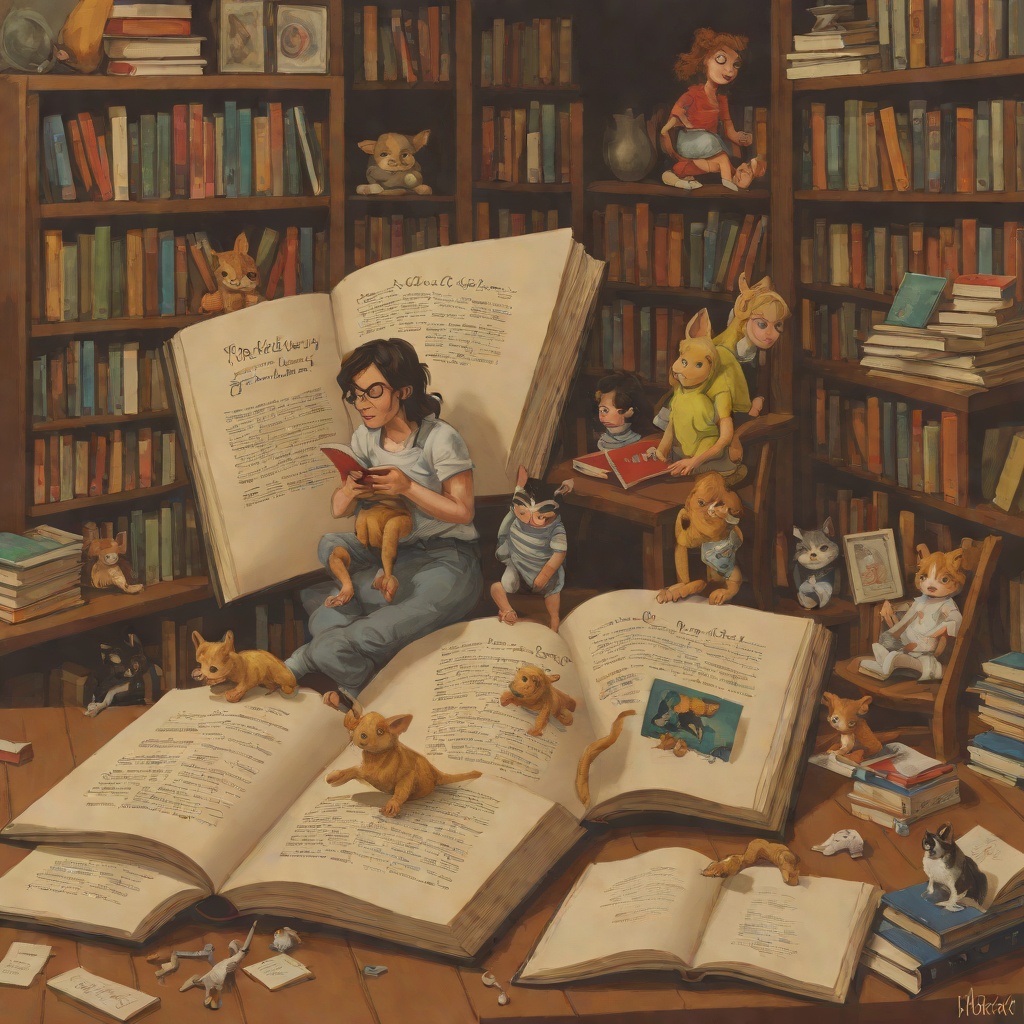
Despite this crisis, the doggy games ultimately evolve into something more deliberate and purposeful. Nightbitch realizes that she must grow focused and quiet, narrow her eyes and look into the future and see there her success and then work toward making that success happen. No more pouting, no more aimless doggy games. She must be single-minded in her pursuit and effective in her approach, and she will get her son to help her. The games become a form of training and study: on Thursday, she and the boy spend the day watching online videos of wolves and foxes and dogs, mothers with litters and lone wolves tracking prey, foxes pouncing and playfully plunging their heads into deep snow in search of warm, blood-beating mice far below. They go to the library and check out all the nonfiction books with the subject of "Dog" from the children's section, taking three trips to lug them out to the car. At home, they spread the books on the living-room floor and lie there, looking at pictures, reading, discussing, play-acting, trying out a hunt, a pounce, a chase, a hide, a confrontation, sniffing and circling and fighting and snuggling. The games are no longer mere play but a curriculum, a deliberate cultivation of the canine self that will lead to her ultimate transformation and performance.
The Games as a Philosophy of Connection
The doggy games culminate in a profound philosophical insight about the nature of being and connection. Nightbitch comes to understand that to be an animal is to look at another and recognize that one is so much that other thing that they are part of one another. This is what it means to be an animal: to see another and say, "I am so much that other thing that we are part of one another. Here is my skin. Here yours." Beneath the moon, they pile inside the warm cave, becoming one creature to save their warmth, breathing together and dreaming together. This is how it has always been and how it will continue to be, keeping each other alive through an unbroken lineage of togetherness. The games, which began as a joke and evolved into a secret language and then a training regimen, finally become a way of understanding the deepest bonds of love and kinship. Through the doggy games, Nightbitch and her son achieve a unity that transcends the conventional mother-child relationship, a merging of identities that is both primal and profound, a testament to the transformative power of embracing one's animal nature.