Hill of Thombo
NightfallThe Hill of Thombo is a low, irregular mound some fifteen minutes' walk south of the main Beklimot ruins on the Sagikan Peninsula. For more than a century it was dismissed as a mere midden-heap, a garbage dump of the ancient city, and was left unexcavated by the great archaeologists who worked at Beklimot—Galdo 221, Marpin, Shelbik, and others. That changed when a catastrophic sandstorm struck the site in the middle of Siferra 89's expedition. The storm's violence ripped an erratic zigzagging strip from the hill's face, laying bare the interior of its upper slope and exposing what generations of archaeologists had overlooked: a town site beneath the midden, and then another below that, and another, forming a stack of ancient settlements that rewrote the prehistory of Kalgash.
Discovery and Stratigraphy
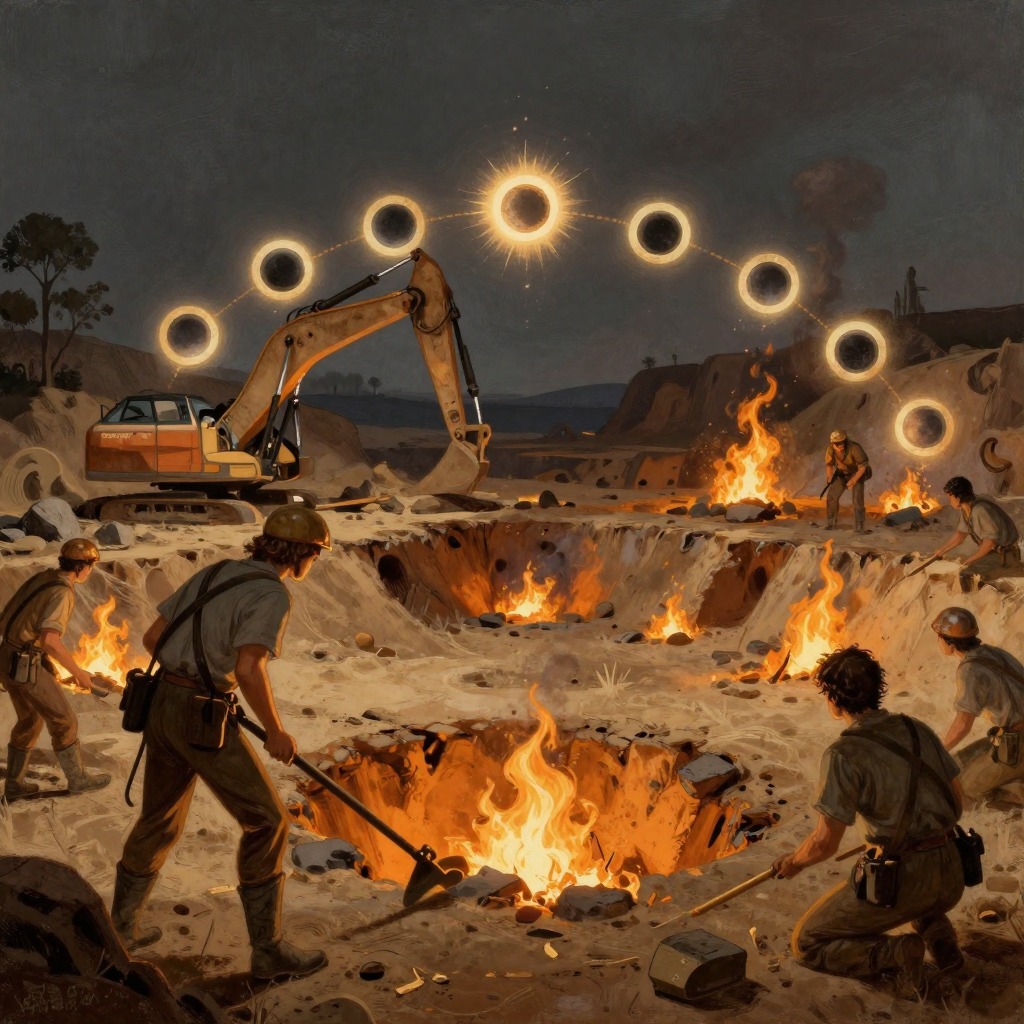
When the sandstorm passed, Siferra and her chief stratigrapher Balik 338 scrambled up the hill to examine the fresh gouge. Siferra immediately ran a trial cut with her pick, widening the storm's wound, and within minutes she had uncovered a charred layer at the foundation level of the cyclopean city—evidence of a widespread conflagration. Below that fire line lay a crosshatch-style town, and below that another dark line of charcoal, and then an even older village built in an unfamiliar architectural style. Working swiftly, Siferra and Balik cut through the ancient packing of windblown sand, revealing at least seven distinct occupation levels, each separated by a burn line. Siferra believed there might be as many as nine settlements, while Balik argued for seven; both agreed that the hill contained a sequence of cities built, destroyed by fire, and rebuilt on the same spot over an immense span of time. The occupation period, Siferra estimated, covered at least five thousand years, and possibly ten or fifteen thousand.
The Thombo Tablets and Their Meaning
Within the third and fifth levels from the top, Siferra's team discovered six baked-clay tablets—three square ones from Level Three and three oblong ones from Level Five. The square tablets were written in a very primitive form of the Beklimot script, while the older oblong tablets used a completely unfamiliar syllabic script. Siferra brought the tablets to Mudrin 505 of the Department of Paleography, who tentatively deciphered a couple of dozen words from the Level Three tablets. They appeared to be an account of the destruction of a city by fire—the work of angry gods who periodically punish mankind for wickedness. The tablets, Mudrin concluded, were a kind of priestly warning of the coming fire, a prehistoric version of the Book of Revelations. The Apostles of Flame later stole the original tablets, but Mudrin's preliminary translations, combined with the stratigraphic evidence, established that the Hill of Thombo had been swept by massive fires with clockwork regularity.
Correlation with the Eclipse Cycle
The most startling discovery was the periodicity of the fires. Siferra's initial eyeball estimate—that each settlement had flourished for approximately the same length of time before being destroyed—was confirmed by radiocarbon dating. The youngest settlement was destroyed 2,050 years ago (plus or minus twenty years); the one below it, 4,100 years ago; the third, 6,200 years ago; the fourth, 8,300 years ago; and so on. The fires occurred at intervals of a little more than twenty centuries—exactly 2,049 years, within the margin of error. This figure matched precisely the frequency of the eclipses of Dovim that Beenay 25 and Athor 77 had calculated, and also the length of what the Apostles of Flame called a Year of Godliness. The correlation was inescapable: every 2,049 years, when Kalgash Two eclipsed Dovim and plunged the world into total Darkness, the resulting mass insanity caused people to light fires that burned down their cities. The Hill of Thombo was the physical record of that recurring catastrophe.
Narrative and Thematic Significance
The Hill of Thombo functions as the archaeological proof that anchors the novel's central thesis: that civilization on Kalgash is caught in an inescapable cycle of destruction and rebirth. Siferra's discovery transforms the Apostles' apocalyptic prophecies from mere superstition into a historically documented pattern. The hill's layers of ash and rebuilt cities become a tangible monument to the fragility of human achievement and the power of cosmic forces beyond human control. For Siferra, the hill is both a professional triumph—the making of her career—and a source of profound unease, as it threatens to validate the very irrationalism she despises. For the other scientists, the Thombo data provides the final, chilling confirmation that the coming eclipse will not merely darken the sky but will trigger a conflagration that will consume their world, just as it had consumed the cities of the hill, again and again, for thousands of years.