The Tunnel of Mystery
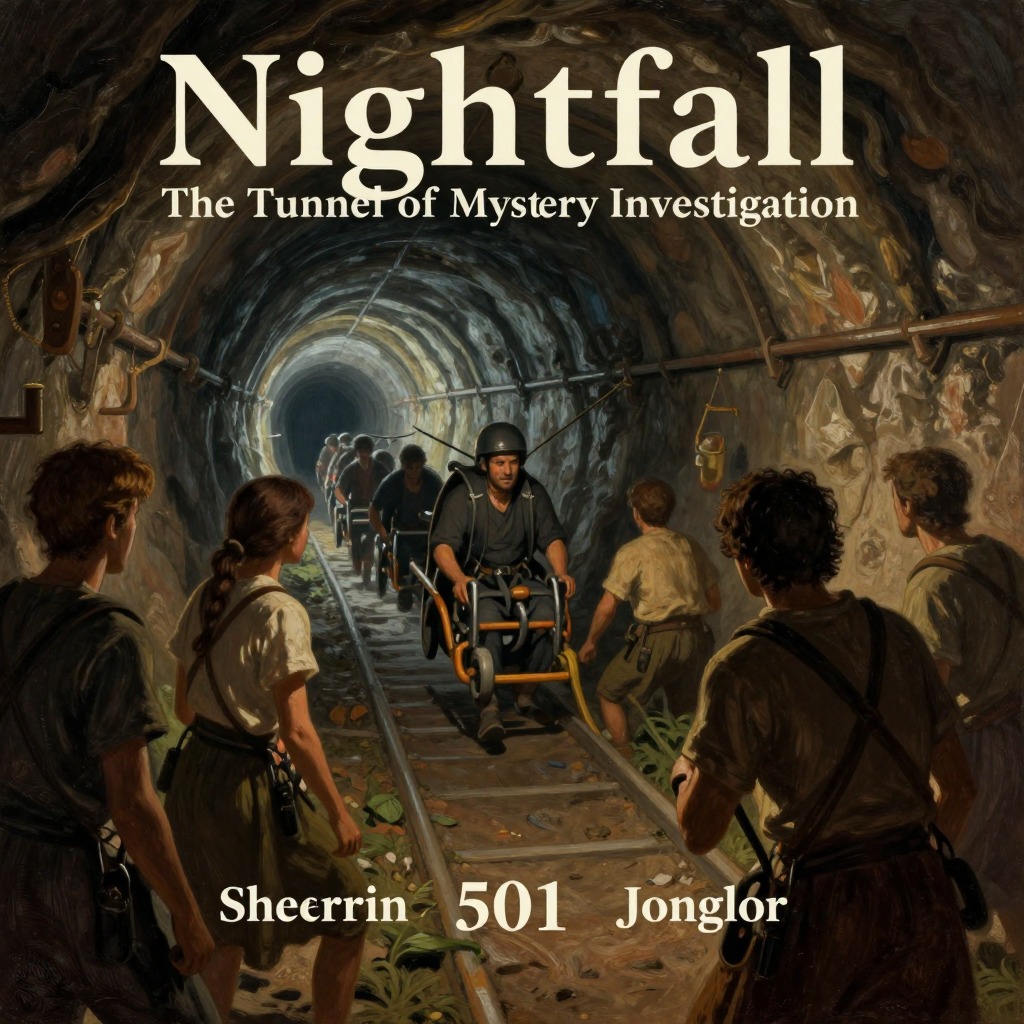
NightfallThe Tunnel of Mystery was the central attraction of the amusement area at the Jonglor Centennial Exposition, a ride designed to give paying customers a simulated experience of total Darkness. The ride consisted of small open cars that carried passengers on a slow, fifteen-minute journey through a mile-long tunnel from which all light had been excluded. The Exposition, which opened only once every hundred years to commemorate the city's founding, was in its Fifth Centennial run, and the Tunnel was its most popular feature. Thousands of people had to be turned away every day, even after reports of harm began to surface. The ride was shut down only when the financial burden of liability insurance and long-term hospitalization for victims became too great for the municipality and its insurers to bear.
Design and Operation
The facade of the Tunnel was an enormous pyramidal structure with a six-sided entrance gate outlined in scarlet and gold. Inside, a series of metal railings contained the lines of waiting customers, leading to a platform much like that in any railway station, where a string of small open cars waited. The cars had slats for seats and were open on top. Each car held six people, though families could ride together. The ride began with music, and the car moved slowly into the tunnel. The Tunnel's engineer, Varitta 312, provided each rider with an abort switch: a small device with a green panel that, when pressed, would cause lights to come on and the car to go quickly to the far end of the tunnel and circle back to the station. The full ride lasted fifteen minutes.
Psychological Impact and Victims
The Tunnel of Mystery exploited what the lawyer Cubello 54 described as one of the three instinctive fears a baby is born with: the total absence of light. The other two are fear of loud noises and fear of falling. Cubello argued that the fascination with being frightened was part of the ride's appeal, comparing it to the fun of riding a roller coaster or jumping at someone and shouting "Boo!" However, the effects on many riders were catastrophic. The first victims included Harrim 682, a longshoreman who won a ticket for himself and his family in a city lottery. He and his family were among the first to ride on the opening day. Harrim, a big, beefy man of about fifty with great slabs of muscle, suffered a total breakdown. He was admitted to the Jonglor Municipal Psychiatric Institute, where he first exhibited acute claustrophobia, refusing to go indoors, and then swung to the opposite extreme, claustrophilia, becoming afraid to go outside because he believed it was dark out there. Other victims included Gistin 190, a schoolteacher, who could not stop sobbing and whose story degenerated into incoherent blurtings, and Chimmilit 97, a high school athlete and perfect physical specimen, who tried to scuttle under his bed at the sight of the afternoon sky. Several people died as a result of their journey through the Tunnel. The hospital director, Kelaritan 99, noted that some victims were completely catatonic, while others needed sedation at least half the time.
Sheerin's Experience and Professional Assessment
Sheerin 501, a psychologist from Saro University specializing in Darkness-related mental disorders, was summoned to Jonglor as a consultant. He initially interviewed victims, including Harrim, Gistin, and Chimmilit, and was profoundly shaken by their conditions. Despite his professional knowledge, Sheerin felt compelled to ride the Tunnel himself to understand the cause of the disturbances. He was given an abort switch but, in a moment of defiance against his own childhood taunts of cowardice, hurled it into the darkness. The fifteen-minute ride was the worst nightmare of his life. He experienced sweating, shaking knees, a throbbing forehead, and the terrifying sensation of tumbling into an infinite abyss. He felt his primordial fears bubbling and hissing in the depths of his soul. After emerging, he was visibly shaken, his legs wobbling and sweat pouring from every pore. He gave a blunt professional opinion to the Exposition's lawyer, Cubello, declaring that it was impossible for anyone to go through the Tunnel without being at grave risk, that even the strongest psyche would take a terrible battering, and that if the ride were reopened, every mental hospital in four provinces would be full within six months. He urged them to shut the Tunnel down for good.
Lingering Aftereffects and Thematic Significance
Even after returning to Saro City, Sheerin suffered lingering aftereffects from his ride. For three or four days, he experienced a touch of claustrophobia, finding it necessary to leave his hotel room or even the building entirely to go for a long stroll in the garden. He began sleeping with an auxiliary godlight in case the battery of the first one should fail, yet his sleeping mind would still become convinced that his room had been plunged into utter blackness, awakening him trembling and sweating. The experience permanently altered his relationship with darkness; he found himself troubled by overcast days and enclosed spaces. The Tunnel of Mystery served as a direct, small-scale precursor to the global catastrophe of the eclipse. Sheerin later used his experience in the Tunnel to explain to the astronomers what would happen when the world was plunged into total darkness: people would go mad, and in their desperate need for light, they would burn anything, leading to the destruction of civilization. The Tunnel demonstrated that even a few minutes of darkness could shatter minds, and that the coming hours of eclipse would be catastrophic. The ride was a manufactured horror that revealed a fundamental truth about human psychology on Kalgash: the species was not adapted to darkness, and the instinctive fear of it was a force powerful enough to destroy the world.