Kalgash Two
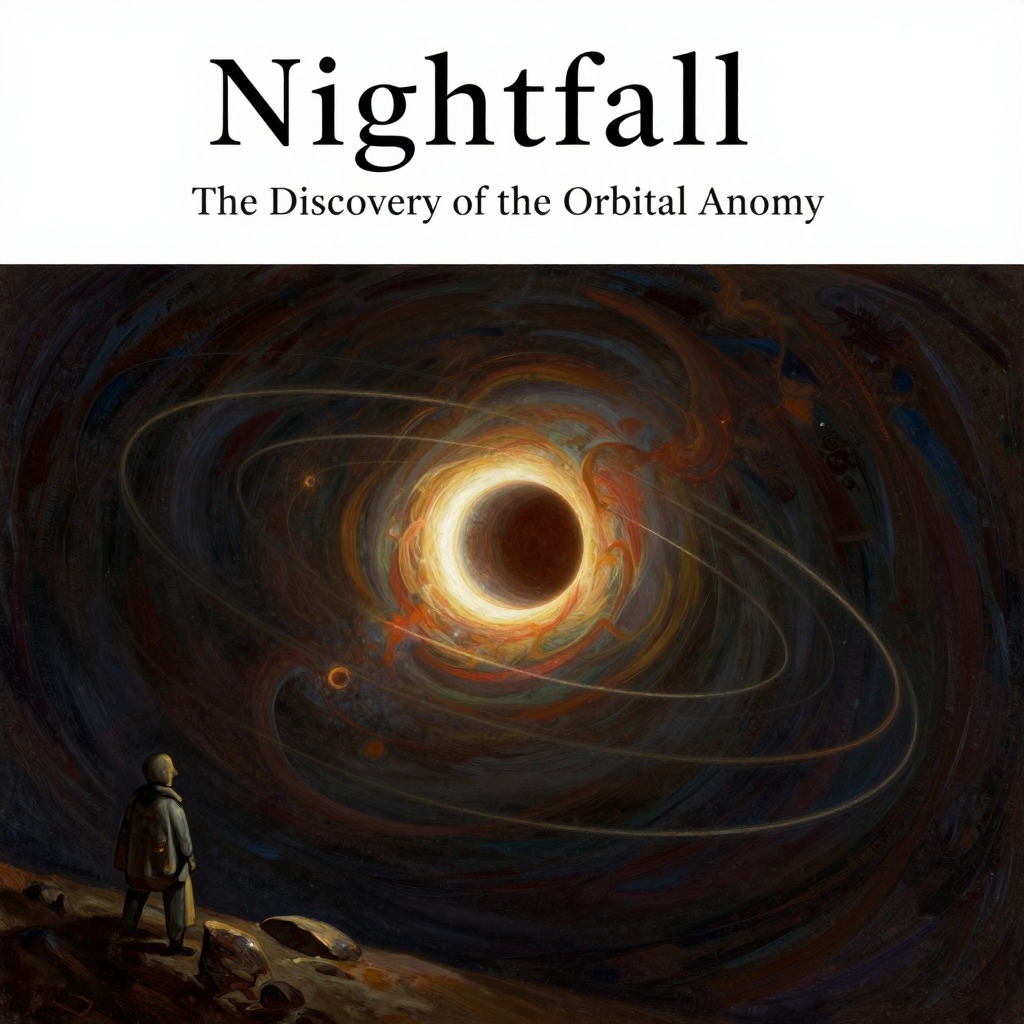
NightfallKalgash Two is the invisible, planet-sized satellite of Kalgash whose existence was deduced by Athor 77 to explain the orbital anomaly discovered by Beenay 25. Its highly eccentric orbit brings it close to Kalgash once every 2,049 years, where it eclipses the red sun Dovim when Dovim is the only sun in the sky, plunging the world into total Darkness and triggering the periodic collapse of civilization.
Discovery and Theoretical Basis
Kalgash Two was not discovered by direct observation but was inferred mathematically. Beenay 25, a young astronomer at the Saro University Observatory, discovered an anomaly in Kalgash's orbit while using the university's new computer to calculate the planet's motion around its primary sun, Onos. The computer's predictions did not match the orbit indicated by Athor 77's Theory of Universal Gravitation. Beenay had two graduate students, Faro 24 and Yimot 70, independently confirm his findings, and they produced the same dismaying result. When Beenay reluctantly brought the problem to Athor, the venerable Observatory director did not reject the theory but instead invoked Thargola's Sword, the principle of parsimony, to argue that it was simpler to search for an unknown factor than to overthrow the entire Law of Universal Gravitation. After days of intense work, Athor produced Postulate Eight: a non-luminous planetary body similar to Kalgash, in orbit not around Onos but around Kalgash itself, with a mass nearly equal to Kalgash's own. This body, which they called Kalgash Two, exerted sufficient gravitational force to cause the perturbations Beenay had observed.
Orbital Characteristics and Invisibility
Athor calculated that Kalgash Two travels around Kalgash on an enormous ellipse that carries it extremely far from the planet for many years at a time. This extreme distance, combined with the fact that it shines only by reflected light and that its surface is likely composed of bluish rock whose reflected light is masked by the eternal blaze of the six suns, makes it invisible to the naked eye and extremely difficult to detect even with telescopes. Thilanda 191, the Observatory's astrophotographer, spent days running a random scan of every quadrant of the universe but found nothing, leading her to doubt Athor's theory. Beenay, however, insisted that invisibility did not mean non-existence, warning that "invisible pie might still be real pie" and that it could come "hurtling out of nowhere and hit us in the face."
The Eclipse Mechanism and Periodicity
Working independently, Beenay and Faro used Athor's orbital data for Kalgash Two and Thilanda's projections of solar movements to calculate the frequency of eclipses. They discovered that Kalgash Two's orbit is aligned so that it can only eclipse Dovim, and only when Dovim is the sole sun in the sky. For this to happen, Dovim must be alone in its hemisphere and at maximum distance from Kalgash, while Kalgash Two must be at its minimum distance. Under these conditions, Kalgash Two's apparent diameter becomes seven times that of Dovim, sufficient to hide Dovim's light for well over half a day, so that no spot on the planet escapes the effects of Darkness. The computer showed that this configuration occurs only once every 2,049 years—the exact length of what the Apostles of Flame call a Year of Godliness. The next such event was calculated to occur on the 19th of Theptar, the very day Mondior 71 had prophesied for the end of the world.
Connection to the Hill of Thombo and the Apostles
The discovery of Kalgash Two's 2,049-year cycle provided a scientific explanation for the archaeological findings of Siferra 89 at the Hill of Thombo. She had uncovered at least seven successive settlements, each destroyed by fire at intervals of approximately 2,000 years, with the most recent fire occurring about 2,050 years ago. Radiocarbon dating confirmed the regularity of these conflagrations. The eclipse of Dovim by Kalgash Two, by plunging the world into Darkness, would drive the population mad, and in their madness they would light fires for light, burning their own cities down. This cycle of destruction and rebuilding had repeated itself countless times throughout Kalgash's prehistory. The Apostles of Flame, through their ancient records, had preserved knowledge of this cycle in the Book of Revelations, though they interpreted it as divine punishment. Athor's secret meeting with Folimun 66, the Apostle's public-relations adjutant, confirmed that the Apostles possessed genuine astronomical data from the previous cycle, which helped validate the Kalgash Two theory.
The Eclipse and Its Aftermath
On the evening of the 19th of Theptar, as predicted, Dovim was the only sun in the sky. The Observatory scientists watched as Kalgash Two, invisible itself, began to encroach upon Dovim's disk, creating a "chip" of blackness that grew until the sun was completely obscured. The total Darkness lasted for hours, and when the Stars appeared—thousands of distant suns suddenly visible in the black sky—the population was driven to mass insanity. The mob that stormed the Observatory, the fires that consumed Saro City, and the collapse of civilization all followed as Sheerin 501 had predicted. Kalgash Two, having done its terrible work, moved on, curving away from Kalgash on its long orbit, not to return for another 2,049 years. In the aftermath, the surviving scientists and the Apostles of Flame, now led by Folimun (who revealed that Mondior was a fictional construct), formed an uneasy alliance to rebuild civilization, with the knowledge of Kalgash Two's cycle preserved as a warning for future generations.