American Crystal Sugar Company
NomadlandAmerican Crystal Sugar Company appears in the book as a large-scale seasonal employer whose sugar beet harvest draws hundreds of RV-dwelling workers to the northern Plains and Minnesota. The harvest offers paid work and a place to park, but its demanding schedule and dependence on seasonal hiring also show how mobile workers rely on temporary jobs to sustain life on the road.
Seasonal Recruitment
During the last week of September, the company brings hundreds of RV dwellers to Montana, North Dakota, and Minnesota for the annual beet harvest. The recruitment connects the company’s need for a concentrated seasonal workforce with nomads’ search for jobs that can be followed from place to place. The book describes no fixed count for the company’s workforce, but the scale of the mobilization is clear: hundreds of workers converge across several states for a harvest that runs on the crop’s timetable.
Work and Compensation
Weather permitting, the harvest operates day and night in twelve-hour shifts. Workers receive a starting wage of $12 an hour plus overtime, along with the standard parking space. That combination makes the job more than a short-term paycheck for people living in vehicles: the work provides a site to stay while they earn, tying employment directly to the practical infrastructure of nomadic life. Yet the long shifts make clear that this arrangement depends on workers’ willingness and ability to undertake intensive seasonal labor.
The Harvest in Drayton
The book’s account of Drayton, North Dakota, gives the harvest a human scale. A sixty-seven-year-old former San Francisco cabdriver works from sunrise until after sunset in temperatures that fall below freezing, helping trucks unload multi-ton loads of beets. His van is both his home and his shelter between shifts; he turned to harvest work after Uber squeezed him out of the taxi industry and he could no longer afford rent. His circumstances place the seasonal job within a wider pattern of economic displacement, though the account does not identify his individual employment arrangement with the company.
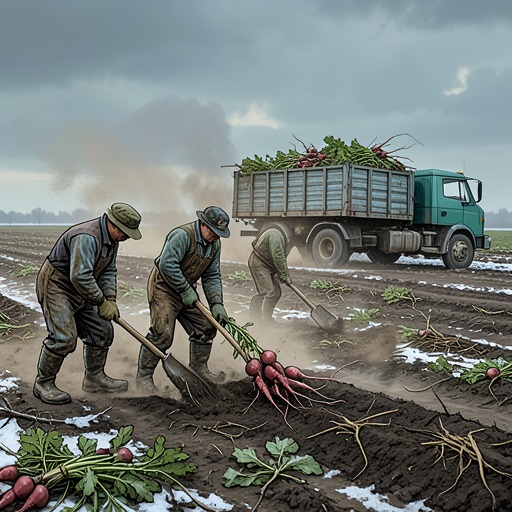
The harvest also involves a large, continuous handling operation. At Drayton Yard, trucks are weighed and directed to a piler, which transfers beets through conveyors and builds them into a storage pile kept near freezing by forced-air ventilation. Workers clear spilled beets and mud, take samples, and clean the machinery during brief shutdowns. The account emphasizes the physical pace and coordination required to keep the operation moving, giving context to the long shifts associated with the harvest without attributing every described task or workplace practice specifically to the company.
Place in the Nomadic Work Economy
The company’s annual hiring is one example of how seasonal agriculture draws people whose homes move with employment. Harvest workers can travel to a job and receive a place to park, but the work remains temporary: when seasonal jobs end, nomads pack up and return to the road in search of another job, a warmer place, or people they know. American Crystal Sugar Company’s role in that cycle is therefore both practical and revealing. It provides wages and temporary parking at a point of seasonal demand, while the workers’ need to keep moving exposes how little security such arrangements necessarily provide.