Express Employment Professionals
NomadlandExpress Employment Professionals is the temporary staffing firm that recruits workers for American Crystal Sugar Company’s annual sugar beet harvest. Its role links the seasonal jobs advertised to itinerant workers with the physical work at the beet yards: the author first encounters the company’s recruitment at a gathering of nomads, later has an application accepted, and arrives in North Dakota to work the harvest. The firm’s place in the narrative is both practical and revealing: it helps bring a distant, mobile workforce to a time-sensitive agricultural campaign, while its public language celebrates the dependability of older workers expected to do demanding labor.
Recruitment and Staffing Role
At the Quartzsite Sports, Vacation & RV Show, commonly called the Big Tent, Express Employment Professionals had a recruitment table alongside employers and concessionaires seeking workampers. Its representative was seeking laborers for the coming sugar beet season. The author was told that an applicant willing to complete the application would be hired, a pitch that made the job appear immediately accessible to people already gathered in Quartzsite and considering seasonal work.
The author took an application, despite having no expectation that trying the job would make him a workamper. He had spent considerable time hearing nomads describe seasonal employment but had not yet seen such a worksite for himself. The application was accepted months later by Express Employment Professionals, which hires workers on behalf of American Crystal Sugar Company. That sequence makes the agency an actual point of entry into the harvest workforce, not merely a presence at a job fair: its recruitment led to the author’s arrival at Drayton Yard during the final week of September.
The Harvest That Draws Workers
The staffing need arose from the concentration of sugar beet production in the Red River Valley, which spans western Minnesota and eastern North Dakota. More than half of the country’s sugar beet fields—about 680,000 planted acres—were in the region described in the book. American Crystal Sugar Company, identified as the nation’s largest beet sugar company, sought workers from elsewhere because the area’s near-full employment made local hiring difficult. It recruited itinerant workers able to bring their homes with them for the autumn season.
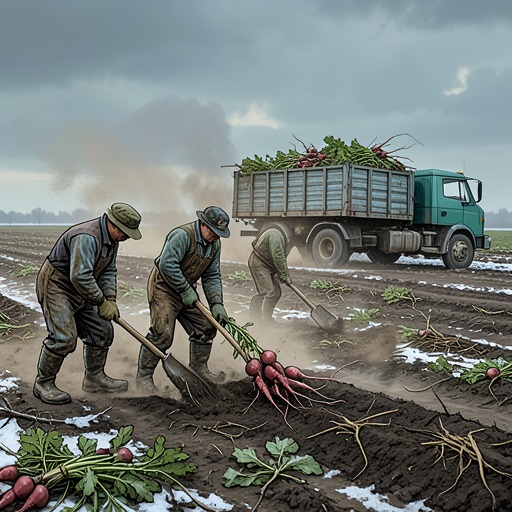
Harvest work followed a compressed and weather-sensitive schedule. The first two weeks of October were a race to remove beets from the fields before the ground froze, and the book describes the operation as a campaign running around the clock. At Drayton Yard, trucks delivered beet loads to a large piler, which carried them by conveyor onto a growing storage pile. The account places the agency’s recruits inside this larger chain of seasonal labor: staffing had to assemble workers in time for a harvest whose pace was set by the crop, transport, and weather.
Older Workers and the Work Ethic Pitch
Express Employment Professionals’ recruitment language presented older workampers as a dependable workforce. During an online recruitment seminar for the beet harvest, Scott Lindgren, a managing partner at the temporary staffing firm, praised their work ethic and reliability, describing them as workers who had spent a lifetime working and could be counted on to finish the job. The appeal was directed toward a population whose age and experience were treated as employment advantages.
That praise also places the agency’s recruitment within a broader pattern in the book: employers seek older mobile workers for seasonal jobs, while their continued employment reflects the limited security available to many retirees. The narrative does not establish that Express Employment Professionals itself set the conditions at the worksite or controlled each worker’s tasks. It does, however, show how the staffing firm’s favorable account of older workers helped frame the people it sought to recruit for the harvest.
From Application to the Yard
After his application was accepted, the author read about the industry and reached Drayton Yard equipped with two pairs of heavy-duty work gloves. The work there involved directing arriving trucks, clearing spilled beets, removing mud, and taking samples. Cleanup was continuous; workers were urged to keep moving, and the machinery and conveyor system made communication difficult. The account describes a hurried, physically demanding job in which workers used shovels, scoops, and sometimes their hands to return spilled beets to the hoppers.
The author’s arrival gives the firm’s recruitment a concrete consequence. An invitation made at the Big Tent became a placement at a processing yard near the Canadian border, where the seasonal urgency translated into strenuous tasks and close supervision. Express Employment Professionals is not portrayed as the sole author of those working conditions, but its staffing function brought the author into the labor system in which they occurred.
Significance in the Narrative
Express Employment Professionals represents the intermediary structure behind a seasonal labor circuit: the company recruits mobile workers on behalf of a major agricultural producer, while the workers travel with their own housing to meet a short-lived demand far from home. Its recruitment table sits among the many job offers available to nomads, but the author’s progression from application to Drayton Yard turns that general labor market into a firsthand account.
The agency’s public praise of older workers gains added significance beside the physical demands of the harvest. Reliability is celebrated as a quality of the people recruited; at the yard, that reliability is tested through repetitive cleanup, heavy equipment, long seasonal days, and a timetable governed by the approaching freeze. The contrast does not erase the appeal of seasonal employment or establish the agency’s control over every detail. Instead, it shows how recruitment promises and workplace realities meet in the bodies and labor of itinerant workers.