United States Gypsum Company
NomadlandUnited States Gypsum Company was both the industrial owner of Empire, Nevada, and the force that sustained its close-knit company-town economy. In 2010, amid a prolonged collapse in demand for wallboard, it shut the factory and set the town’s population on the path to dispersal: workers had to leave not only their jobs but also the homes and community built around them.
Company and Town
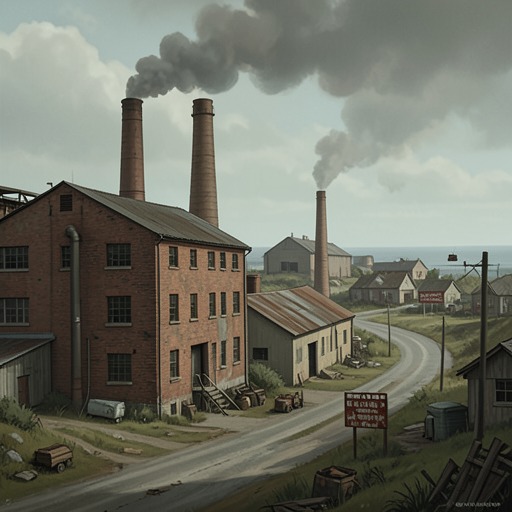
United States Gypsum Company, which made Sheetrock, owned Empire outright. The factory village of roughly three hundred people stood six miles north of the company’s open-pit gypsum mine, where blasting dislodged ore that haul trucks carried to the plant. There, workers pulverized the gypsum, heated it in massive kettles, and formed it into wallboard used in homes across the American West. The mine and plant linked the town’s everyday life to the construction industry beyond the desert.
Empire represented a form of industrial provision that had become unusual. United States Gypsum Company subsidized rents to as little as $110 for an apartment or $250 for a house, and covered television, sewer, trash, and internet service. Factory mechanics could earn up to $22 an hour; equipment operators earned somewhat less. With expenses low and work dependable, a day or two of wages could cover a month’s rent. For residents, the arrangement made living paycheck to paycheck seem remote. At the town’s peak, more than 750 people lived there, and even after modernization reduced the population to less than half that number by 2010, the town retained its reputation for neighborly intimacy and security.
That stability was not simply a matter of wages. Empire’s cottages, public pool, churches, post office, and golf course formed a residential world shaped by the company’s ownership and support. Streets planted with cottonwoods, elms, and silver poplars and residents’ carefully maintained lawns marked a conspicuous patch of green against the surrounding Black Rock Desert. The town’s isolation fostered shared social life, but also meant that residents lived in close view of one another. The community’s security and its dependence on a single employer were inseparable features of the same arrangement.
The Closure
The decisive break came on December 2, 2010, at a mandatory meeting in the community hall. At 7:30 a.m., plant manager Mike Spihlman told the assembled workers that Empire was shutting down and that everyone had until June 20 to leave. The announcement turned the company’s authority over the workplace into an immediate threat to residents’ housing as well. After the first stunned silence came tears; the workers were sent home to tell their families that the town they occupied through their employment would soon no longer be theirs.
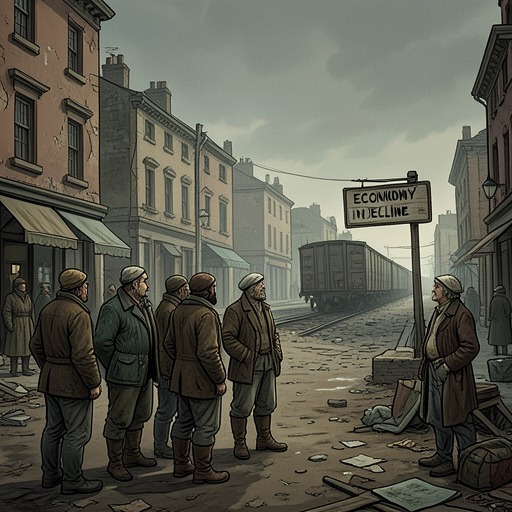
The shutdown reflected a larger business and economic reversal. United States Gypsum Company had lost $284 million by the end of the third quarter of 2010. Its chief executive attributed the decline to weak market conditions and exceptionally low shipping volumes; more concretely, demand for Empire’s product was no longer sufficient. Wallboard manufacturing depended on domestic construction, and the slump following the housing-market collapse had lasted too long. A recession that injured many communities therefore threatened Empire’s existence outright: the company could close its plant, and the town organized around it had no independent economic base described in the account.
The final production stop gave the closure a human scale. Calvin Ryle, the quality-control supervisor and a former general foreman, had begun at the factory on July 1, 1971, and had worked there for thirty-nine years and seven months without missing a day or being injured. Because he held the record for continuous service, he was chosen to halt the production line. With his son, a maintenance mechanic, among the workers, Ryle pressed the stop button and wept. The silence that followed marked more than the end of a manufacturing shift: for him, making wallboard had meant taking part in building the country and earning a living in a place where his children could grow up close to nature.
Displacement and Abandonment
The closure disrupted plans as well as routines. Dan Moran, a former supply-chain manager, had sent out résumés without receiving interest and considered making a living cutting firewood. Monica Baker had returned to Empire from Oahu with two young children because she expected factory work; after the shutdown, she contemplated looking for retail employment in Fernley, including at Walmart or Lowe’s. Her turn toward chain-store work illustrated the wider shift away from manufacturing and toward retail and service jobs, while the immediate loss of her promised employment showed how quickly the town’s assurances had evaporated.
As workers’ families left through June, United States Gypsum Company shut the settlement behind chained gates, security cameras, and no-trespassing signs. The cottages and communal facilities—the pool, two churches, post office, and nine-hole golf course—were left to decay, and even Empire’s ZIP code, 89405, was expunged. The company brought in two dozen goats to keep the weeds down. Inside the factory office, unfinished coffee cups remained on desks and calendars still displayed the shutdown date, details that made the abandoned site appear less like a gradual decline than a daily life interrupted and never resumed.
Significance
United States Gypsum Company’s role in Empire exposes the double edge of the company-town model. Its ownership made stable housing, local services, and steady industrial work possible for generations, but also concentrated control of the town’s livelihood and homes in one corporation. When the wallboard market contracted, the same structure that had buffered residents from ordinary economic insecurity made their displacement difficult to separate from the company’s business decision. By June 2011, Empire had become a gated ghost town rather than a community able to adapt around its factory.
The account sets this disappearing industrial town against a newer labor settlement near Fernley, where itinerant workers lived in vehicles and temporary housing while taking short-term jobs. The contrast is not simply between a prosperous past and a difficult present: Empire’s relative security rested on a single employer, while the newer arrangement offered less stability without the same company-supported town. United States Gypsum Company’s closure thus serves as the hinge between two forms of work and housing, making visible how the loss of manufacturing could erase not just employment but an entire place organized around it. A later view of Empire persisted in Google Maps Street View, where residents still appeared in images from 2009, watering yards and living among parked cars and lawn furniture. The company had emptied the town, but the images preserved the last ordinary surface of a community that no longer existed.