Ferdinand de Lesseps
OrientalismFerdinand de Lesseps is portrayed as the political and imaginative force behind the Suez Canal: a promoter whose diplomatic and financial skill brought an immense engineering project to completion, and whose language framed it as a world-historical reconciliation between Europe and the Orient. In Edward Said’s account, the canal’s opening in 1869 was more than a feat of construction. It marked a decisive transformation in Orientalist thought, as the Orient was no longer imagined as a distant, separate world but drawn into a single world ordered by modern European power.
Background and Return to Egypt
De Lesseps’s connection to Egypt began with his father, Mathieu, who arrived with Napoleon and remained for four years after the French evacuation in 1801, serving as an unofficial French representative. De Lesseps later referred in his writings to Napoleon’s interest in digging a canal. Misinformed by experts, Napoleon had concluded that the undertaking could not be realized; the earlier ambition nevertheless became part of the project’s inherited history.
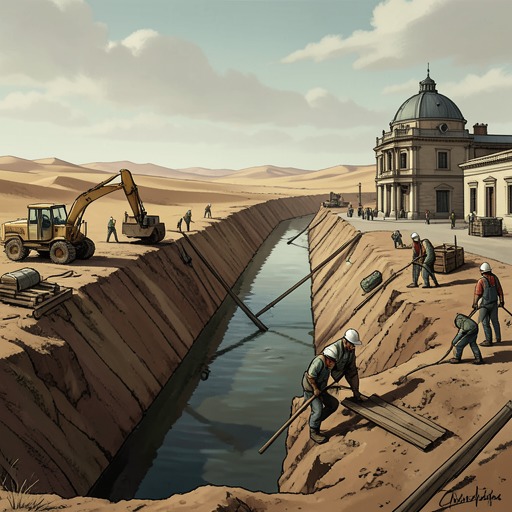
The canal scheme also belonged to a longer succession of unrealized proposals, including French plans associated with Richelieu and the Saint-Simonians. De Lesseps returned to Egypt in 1854 and began the undertaking that would be completed fifteen years later. He had no substantial engineering background. Said instead emphasizes his confidence in his own abilities as a builder and creator, together with diplomatic and financial talents that helped secure Egyptian and European support. In the course of winning that support, de Lesseps also acquired the knowledge needed to carry the project through.
Selling a World-Historical Project
De Lesseps worked to make contributors see the canal not merely as an expensive construction scheme but as a moral undertaking with a place in world history. He called its purpose his pensee morale: the bringing closer of the West and the East, which he represented as serving civilization and the development of general wealth. The investment company he formed in 1858, the Compagnie universelle, gave institutional form to that expansive ambition.
His case for the canal answered objections to its cost and scale with statistics, historical references, and a vision of extraordinary achievement. Said describes de Lesseps citing Herodotus alongside maritime statistics and drawing on Casimir Leconte’s observation that an eccentric life could produce originality, and originality, unusual exploits. In this rhetoric, the canal’s audacity helped justify it: the undertaking was presented as an exceptional feat capable of overcoming the objections of those consulted and improving the Orient.
That claim rested on a pronounced colonial hierarchy. De Lesseps’s case, as Said presents it, treated the canal as a project that could accomplish what Egyptians, Chinese, and Indians were disparaged as unable to achieve for themselves. The language of shared civilization thus worked alongside a claim of European superiority: the Orient was to be connected and improved through the initiative and power of its European promoter.
The Canal as Spectacle
De Lesseps’s speeches, letters, and pamphlets repeatedly cast the pursuit of the canal as collective action moving inexorably toward a final goal. He spoke of what “we” had created, fought for, and achieved, insisting that nothing could stop the effort and that nothing mattered more than realizing “le resultat final, le grand but.” The first-person plural made his personal leadership sound like a common historical mission.
The opening celebrations in November 1869 gave that rhetoric a public stage. A papal envoy’s address on November 16 described the gathering as a great occasion for humanity: dignitaries, flags, and representatives of many peoples assembled at the meeting point of Africa and Asia, with the Cross facing the Crescent. The speech imagined the two ends of the globe drawing near, recognizing one another, and affirming human brotherhood. Its religious and universal language turned the canal’s inauguration into a ceremony of reconciliation, even as the event displayed the reach of the project and the European power behind it.
The celebration also extended beyond the ceremonies themselves. Thomas Cook’s 1869 prospectus presented the canal’s inauguration as the culmination of a centuries-old idea and praised de Lesseps’s perseverance and foresight. The new water route was described as bringing the countries of West and East closer and joining civilizations of different epochs. For Said, this enthusiasm reveals how the canal could be advertised simultaneously as modern engineering, the fulfillment of ancient ambition, and a transformation of the relation between geographical worlds.
Orientalism and the Canal’s Consequences
Said places the canal within a wider sequence of consequences arising from Napoleon’s expedition: imaginative and textual works, scientific projects, and geopolitical interventions. He contrasts the confidence with which Ernest Renan claimed to have recreated the Orient in scholarship with de Lesseps’s more uneasy response to the novelty his project released from the old Orient. Yet both belong to a history in which European knowledge and action made the Orient available for interpretation and intervention. In de Lesseps’s case, the canal joined intellectual ambition to physical and geopolitical change.
The Suez Canal becomes, in Said’s analysis, the logical culmination of Orientalist thought and effort. The Orient had first to be known, then invaded and possessed, and then re-created through scholars, soldiers, and judges who recovered past languages, histories, races, and cultures and used their image of a classical Orient to judge the modern one. De Lesseps’s canal completed this movement in material form: it overcame distance and the Orient’s imagined separation from the West, replacing an image of hostile estrangement with one of partnership on terms shaped by modern European power.
The language of universal brotherhood at the opening therefore carries a double significance. It imagines the West and Orient as joined in one world, but Said stresses that the canal also draws the Orient into a world structured by imperial and administrative interests. After de Lesseps, the Oriental could increasingly be classified not simply as an inhabitant of a distinct region but as a member of a subject race, a category that applied across geography. The canal’s opening thus announces both connection and subordination: geographical distance is reduced, while the distinction that remains is recast in political, demographic, economic, and sociological terms.
Said marks the later reversal of the opening’s imagery in July 1956, when Gamal Abdel Nasser activated Egypt’s takeover of the canal by pronouncing de Lesseps’s name. The ceremony had imagined the West’s arrival in the Orient as permanent; that later act exposed the canal’s continued place in a contested political history. De Lesseps’s legacy is consequently not only the completed waterway, but also the transformation he helped embody: a European project that dissolved the image of separate worlds while making their unequal relations newly visible.