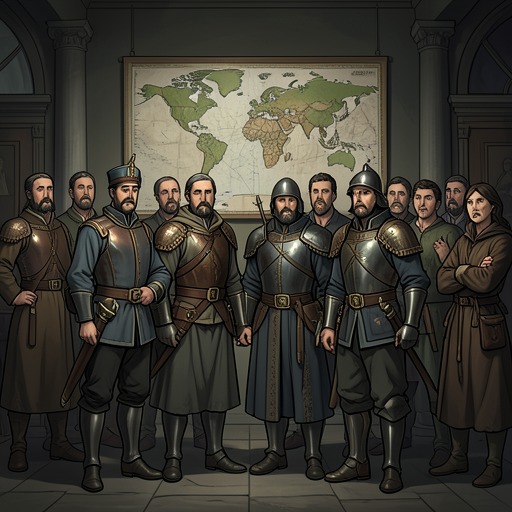
Napoleon’s expedition to Egypt
OrientalismNapoleon’s expedition to Egypt was a turning point in the modern European construction of the Orient: an invasion joined to an ambitious project of scholarship that converted political domination into authoritative descriptions of Egyptian history and society. Although the occupation’s military aims failed, its institutions and habits of representation endured, helping transform the Orient from a subject of European texts into colonial space administered, studied, and claimed by European powers.
Conquest and the production of knowledge
The expedition’s intellectual program presented European learning as a means of restoring Egypt to an imagined former greatness and instructing it in the modern West. Its ambitions extended beyond collecting information: the project sought to give the Orient a defined identity and place in memory, to treat it as an appendage to Europe, and to turn knowledge gathered under occupation into a contribution to modern learning. Egyptians were not consulted as collaborators in this enterprise; they became pretexts for texts whose principal usefulness lay elsewhere.
The project’s methods made its imperial reach visible in scholarly form. The expedition’s work divided and classified what it observed, turning details into generalizations and generalizations into supposedly fixed laws about Oriental nature, temperament, mentality, custom, and type. In the account’s analysis, this transformation made living realities appear available for possession through description. The Description de l’Égypte, enabled by the expedition and reinforced by its institutions, became the monumental expression of that union between Western knowledge and political power.
Whose history the Description records
The Description did not simply add a European account to an existing record. It displaced Egyptian and Oriental history as a coherent history in its own right, replacing it with a narrative that identified itself with world history—understood here as a euphemism for European history. To preserve an event from oblivion, in this framework, was also to make the Orient a stage for European representation. The region was brought into the clarity and authority of modern European science, but on terms that made its history legible through European categories.
That shift also determined what Egypt was made to signify. Scientific observations in the Description could be used to confirm laws of zoological specialization, while descriptions of Oriental customs served as a contrast to European sobriety and rationality. The account even notes that bodily characteristics associated with the preservation of the dead were investigated for possible application to European bodies. Such examples show how the description of Egypt could serve purposes defined beyond Egypt itself: the Orient became both an object of study and a resource for European theories and ambitions.
The difference between the imperial record and an account from the invaded is underscored by the contrast with Abdal-Rahman al-Jabarti. The Description’s massive volumes represented the systematic labor of a corps of scholars backed by a modern army of conquest; al-Jabarti described the French invasion from the position of those who experienced its costs. The French account could claim scientific objectivity, but its position was that of a power seeking to hold Egypt within its imperial orbit. Al-Jabarti’s chronicles expose that position by making visible a perspective the Description ignored.
A model that outlived occupation
The failure of the military occupation did not undo the larger project. Instead, the expedition inaugurated a modern experience of the Orient interpreted within a framework of knowledge and power established in Egypt. The Institut and the Description served as agencies through which that framework could be organized and disseminated. The proposed image of an Egypt restored by enlightened administration, then radiating civilization to its neighbors, gave imperial rule the appearance of a scholarly and civilizing mission.
The expedition’s legacy was institutional as well as conceptual. The book traces the modern imperial context of Orientalism to Napoleon’s invasion in 1798, while emphasizing that the encounter was marked from the beginning by an imbalance between the stronger European power and the people it invaded. The imposing scale of the Description could dwarf the testimony of an individual Egyptian chronicler, but the difference in scale did not make the imperial account neutral. Together, the two records belong to a historical experience shaped by unequal power, not to an eternal opposition between East and West.
Travel, residence, and colonial space
The expedition also established an early pattern for later European residents and travelers in the Orient. Alongside bookish scholarship, residence and direct contact became sources of authority: Anquetil, Jones, and the Napoleonic expedition defined early contours that continued to influence Orientalists living in the region. Yet residence did not mean ordinary participation in local life. Europeans were positioned as representatives of empires whose military, economic, and cultural reach encompassed the Orient. Their personal observations could then be converted into official statements and absorbed into a broader scholarly archive.
In the nineteenth century, European engagement with the Orient gradually changed from textual and contemplative interest into administrative, economic, and military appropriation. The resulting shift was geographical as well as political: travelers and scholars increasingly adopted an intimate, proprietary attitude toward the region, which was penetrated, worked over, and taken hold of. Over time, Western handling turned what had been imagined as alien space into colonial space. The expedition’s importance therefore lies not only in the occupation itself, but in the durable relationship it helped establish between European knowledge of the Orient and European power over it.
Historical significance
The expedition’s account of Egypt illustrates how representations can be made and remade by power while suppressing the histories and varied experiences of the people they claim to describe. The book rejects the premise that such representations reveal an unchanging, authentic Orient; its concern is instead with the historical conditions that allowed one account to dominate and another to be overlooked. Al-Jabarti’s presence in the record makes that imbalance concrete without reducing the history to a simple, timeless conflict between civilizations.
The expedition is consequently presented as more than a failed campaign. It helped make Orientalism a material and institutional enterprise, one capable of surviving its initial military setting and shaping later scholarship, administration, and popular understanding. Against that inheritance, the account insists on distinguishing study grounded in careful understanding from knowledge enlisted in self-affirmation and domination, and on recognizing that the histories of the region were made, contested, and capable of being rewritten.