Ahmed Qurie–Uri Savir Negotiating Partnership
OsloAhmed Qurie–Uri Savir Negotiating Partnership is the play’s central relationship across the negotiating table: two representatives begin by speaking for opposing leaders, then learn to bargain with one another directly. Their partnership helps convert proposals into concrete political exchanges, but its lasting significance is deliberately measured against an unsettled aftermath. Their ability to recognize and remain connected to one another survives; it does not, by itself, secure lasting peace.
Opposing Representatives, Shared Stakes
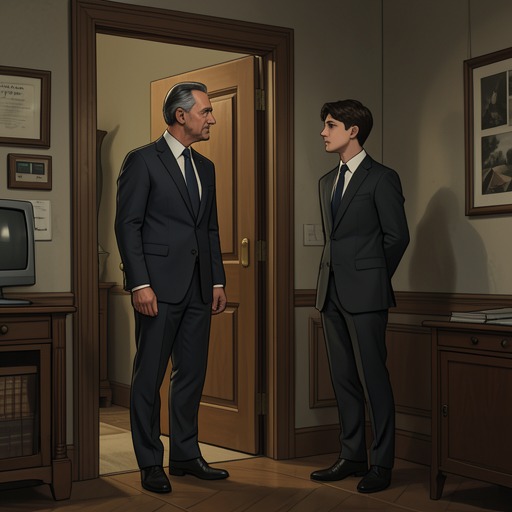
The relationship takes shape through a chain of representation. Uri Savir says he has come at the personal request of Shimon Peres and is speaking for him; Ahmed Qurie answers that he is there at the personal request of Yasser Arafat and speaks for the Chairman. The exchange establishes the authority and limits of their positions: neither is simply negotiating as a private individual, yet each must make the other’s case intelligible across a divide. After the declarations, Qurie extends his hand. The gesture does not settle their differences, but it marks the start of a conversation in which each is acknowledged as the other side’s authorized interlocutor.
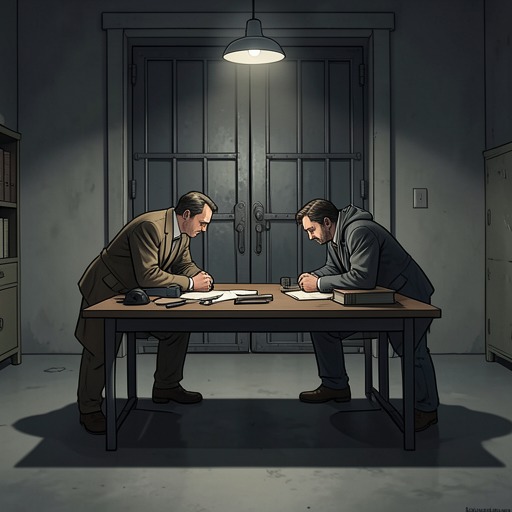
The first negotiating-room arrangement makes that division visible. Savir stands opposite Qurie and Hassan Asfour, while Yair Hirschfeld and Ron Pundak sit behind Savir with pens and paper. Savir picks up the Declaration of Principles (DOP) and asks whether its idea originated with Qurie. The question directs attention not only to the document but to its Palestinian negotiator as an author of proposals. From the outset, their work involves testing what the other side can accept, rather than treating the opposing delegation as an abstraction.
The play places this contact within a broader effort to recognize shared human vulnerability. Mona Juul recounts seeing two boys, one in uniform and one in jeans, facing each other with weapons; she and Terje Rød-Larsen see the same fear in both. That moment prompts Rød-Larsen to ask whether they should try to give the boys a different future. It is not a meeting between Qurie and Savir, but it supplies the moral frame for the channel that brings them together: political enemies may remain divided while still being seen as people caught in the same violence.
Contact Beyond the Negotiating Room
The process depends on an agreed distinction between argument and ordinary contact. Rød-Larsen establishes that the negotiators can disagree in the closed room, while outside it they will share meals, discuss their families, and light the fire. He insists that personal exchange helps them see one another more fully. This rule gives the Qurie–Savir relationship a setting beyond tactical debate: coexistence is not a reward for agreement, but part of the method by which the talks continue despite disagreement.
At Borregaard Estate, the distinction becomes a stage image. Qurie and Savir walk together on the grounds while Rød-Larsen and Juul follow at a discreet distance. In the conversation that follows, Savir expresses admiration for the way Qurie fights, and Qurie returns the compliment by recognizing Savir’s passion. These acknowledgments do not erase their political opposition. Instead, they establish respect as something that can coexist with antagonism, and help make continued negotiation imaginable without requiring either man to abandon his position.
Their closeness also develops within a network of other people’s work and risks. Juul confirms that she and Rød-Larsen were part of the back channel, while directing attention to the Israelis and Palestinians who risked their lives in it. In an earlier scene, Juul takes responsibility for approving arrangements and says she handled paperwork and visas. The play thus sets the pair’s direct bargaining alongside the less visible labor that makes their meetings possible. Its account of the relationship is not that two men negotiate alone, but that personal trust is supported by a wider, fragile diplomatic effort.
Bargaining and Political Exchange
The partnership becomes most consequential when the negotiators move from mutual recognition to reciprocal concessions. Qurie agrees that his side will drop its demand for referring outstanding disputes to third-party international arbitration. Savir answers by agreeing to negotiate the transfer of the Gaza Strip and Jericho. The exchange is specific: each side gives up or qualifies a demand while opening a path toward discussion of something the other side seeks. Their relationship matters here not as a substitute for political agreement, but as the channel through which disagreement can be organized into negotiable terms.
The play also shows the limits and risks of the process around them. After the murder of an Israeli border guard, four hundred Palestinians accused of terrorist links are deported to the freezing rocky ground of southern Lebanon and abandoned without blankets, food, or water. In March 1993, after a Palestinian youth kills two Israelis in Tel Aviv, Prime Minister Yitzhak Rabin seals the Gaza Strip. These events make clear that the talks proceed amid severe violence and political reaction, not in a protected interval outside the conflict. The relationship between Qurie and Savir is therefore repeatedly tested by events that can harden the positions they are trying to negotiate.
Their eventual exchange of concessions is paired with an unusual plan for communicating it. Savir says he will return to Peres and report that Qurie told him to go away; Qurie is to tell Arafat that Savir said the same. Two days later, Rød-Larsen will call Qurie and say that they agree to his demands. The tactic makes room for each negotiator to return to his leadership without presenting the compromise as a simple surrender. The play presents the partnership as both personal and procedural: the men must understand one another well enough to make a bargain, and to manage how that bargain is conveyed beyond the room.
Continuity and Limits
The relationship’s outcome is not equated with the success of the political process. In September 2000, seven years after the Accords were signed, violence erupts again in the Occupied Territories and the Second Intifada begins. The play places that return to violence beside the continued connection between the negotiators: Savir says that he and Qurie, and their daughters, have never been out of touch. Their lasting contact is a concrete continuation of the relationship, but it is not presented as proof that the conflict has been resolved.
That contrast defines the partnership’s significance. Qurie and Savir can move from formal statements of delegated authority to mutual respect, practical compromise, and a continuing personal connection. Their talks help produce political possibilities, but the later violence exposes the distance between reaching an agreement and transforming the conditions that sustain conflict. The relationship endures as evidence that enemies can recognize one another and keep communicating; the play refuses to make that achievement stand in for a settled peace.