Finn Grandal
OsloFinn Grandal is the groundsman at the Borregaard Estate outside Oslo and the husband of Toril Grandal, its housekeeper and cook. In the play’s scenes around the secret talks, he belongs to the estate’s working household rather than the negotiating teams. He carries furniture, stands with Toril in the entrance hall as guests depart, and is present when Ahmed Qurie begins introducing the hosts to another group of visitors. Through these brief appearances, the negotiations acquire a domestic setting: alongside political work conducted behind closed doors, there are people maintaining and welcoming others into the place where it happens.
Identity and Household
Finn is identified by his work at the Borregaard Estate and by his marriage to Toril. The play describes him as a groundsman; Toril is the housekeeper and cook. Both are in their fifties when they enter together carrying furniture. Their roles establish a household partnership within the estate’s larger operation, though the scenes do not detail how they divide their work or assign a particular task to Finn beyond his groundskeeping and the shared actions shown onstage.
The contrast between their occupations is practical rather than dramatic: the groundsman and the housekeeper-cook appear together as the estate’s hosts. Their presence gives the location a life beyond its use as a meeting place. The political visitors arrive with their own business, but the estate also has people who work there, welcome guests, and remain in view as the meetings’ human surroundings. Finn’s characterization rests on this concrete, limited identity rather than on a separate account of his private views or ambitions.
Work in the Meeting Space
When Toril and Finn enter carrying a heavy armchair and a large rug, they bring objects associated with the ordinary furnishing of a room into a scene of political preparation. The stage direction shows them beginning to arrange the furniture; Terje Rød-Larsen stops when he sees them. The action is small, but it shifts attention from talk about diplomacy to the physical work of making the room usable. Finn participates in that work alongside Toril, and the weight and size of what they carry make their contribution visible rather than merely implied.
The estate’s rooms are not simply a neutral backdrop. As the guests conduct their discussions there, someone must furnish and maintain the spaces in which they meet. Finn’s appearance ties the formal negotiations to this material setting without suggesting that he takes part in drafting their terms. Mona Juul recounts that the negotiators worked for two days and nights, almost without stopping, over a joint draft of the Declaration of Principles. In that account, waffles, cigarettes, and coffee mark the repetitive rhythm of work behind closed doors. The play does not assign the preparation of those refreshments to Finn, but his role at the estate places him within the household that surrounds this sustained diplomatic activity.
Hospitality and Departure
Finn is again visible in the entrance hall as the four guests stand in winter coats, holding suitcases, and exchange farewells with him and Toril. Their luggage and coats register a transition out of the estate: the visitors are preparing to leave the place where they have been meeting. Terje Rød-Larsen tells them to make sure they leave nothing behind and asks for no traces. The departure thus carries the discreet, concealed character of the talks into a final practical instruction, while Finn and Toril remain present as the guests’ hosts.
Toril’s question to Hassan Asfour about whether he enjoyed the previous night’s venison gives the farewell a more intimate register. The exchange connects a particular meal to the visitors’ stay and places hospitality beside the urgency of departure. Finn is present in the farewell scene, but the text gives this line to Toril; it does not give him a corresponding speech or specify his response. His role is conveyed through his shared presence with her, not through an independently stated opinion about the visitors or their work.
The Hosts Among New Visitors
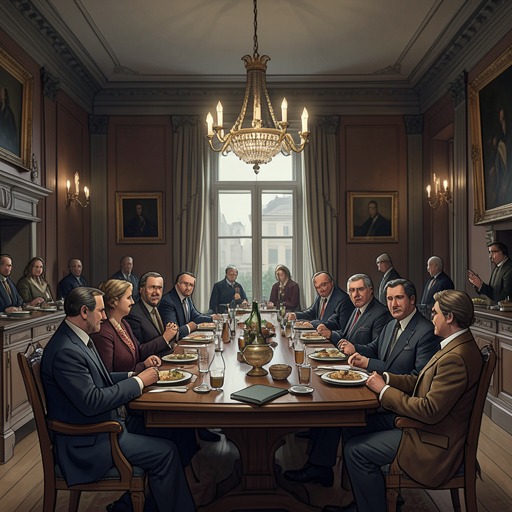
The next morning, at the estate’s reception room, Finn stands with Toril in the entranceway as Ahmed Qurie, Hassan Asfour, Uri Savir, Yair Hirschfeld, and Ron Pundak occupy opposite sides of the room. Qurie gestures toward the couple and begins introducing them to Savir, Hirschfeld, and Pundak as the hosts. Finn’s place in the scene links the new arrivals to the same household setting in which the earlier group had been received and seen off.
Across these moments, Finn’s appearances form a modest pattern of continuity: he enters with Toril to arrange the room, stands with her during a departure, and is present when Qurie turns the hosts into part of a new greeting. The political work changes its immediate participants, but the estate’s domestic framework remains visible. Finn is not presented as a mediator or a source of diplomatic decisions; the significance of his part lies in showing the labor and hospitality around the talks, and in keeping the Borregaard Estate legible as both a place of negotiation and a working household.