Toril Grandal
OsloToril Grandal is the housekeeper and cook at the Borregaard Estate outside Oslo, and a host within the play’s secret-meeting setting. Married to Finn Grandal, the estate’s groundsman, she appears not as a negotiator but as one of the people whose practical labor makes the gathering possible. Carrying furniture, serving food, and receiving visitors, she gives the diplomatic space a domestic life that sits beside, rather than disappears into, the political work taking place there.
Identity and Setting
Toril is identified by her occupation and marriage: she keeps house and cooks at the Borregaard Estate, while Finn works its grounds. The play locates them at the estate outside Oslo, making their home and worksite the setting for meetings between people otherwise divided by political conflict. The details are spare, but they establish that the negotiations occupy rooms maintained by people with their own daily responsibilities, not an abstract diplomatic venue.
That distinction shapes Toril’s presence. She is introduced through tasks tied to the material room: she enters with Finn carrying a heavy armchair and a large rug, and later passes plates of waffles to the men gathered there. The furniture and food are not incidental decorations in her scenes; they are the visible work through which the house becomes usable as a meeting place. The play lets the labor of preparing that space remain in view alongside the negotiations conducted within it.
Work in the Meeting Room
Toril’s first substantial stage action is shared with Finn. Together they carry in the armchair and rug, a coordinated effort that places them in the room while its political occupants are speaking. Their entrance makes the estate’s domestic arrangements part of the scene’s action: the room is still being set, even as the conversation concerns diplomacy. Toril’s role is practical, but the timing gives that work a place in the dramatic composition rather than leaving it offstage.
Later, as she serves waffles, Terje Rød-Larsen gestures for her to take the lead. The moment briefly shifts attention from the men’s discussion to Toril’s activity and expertise. She does not join the political argument; instead, she directs the room’s attention to the food and the method by which it is made. Her authority in this scene is grounded in a different kind of knowledge, one that is precise, practiced, and transmitted through family.
The Waffle Recipe
Toril describes the waffles as her mother’s recipe, passed down from her mother before her. She calls it simple but precise, then explains its sequence: separate the eggs, beat the yolks until light and frothy, and add vanilla, sugar, butter, buttermilk, flour, and cardamom. The whites are beaten separately and folded in before the batter is cooked hot and swiftly. The specificity of the instructions makes the recipe more than a hospitable gesture; it is a piece of inherited knowledge that Toril can articulate and enact in the meeting room.
The cardamom is identified as the secret, while the rest of the method depends on order and care. This emphasis on measured steps gives the scene a quiet counterpoint to the political discussions around it. The negotiations are difficult, public in their consequences, and shaped by competing claims; Toril’s explanation concerns a small, repeatable procedure passed between generations. The contrast does not make her work a solution to the political conflict. Rather, it shows another form of continuity and exactness occupying the same space as the uncertain diplomatic effort.
Host and Dramatic Function
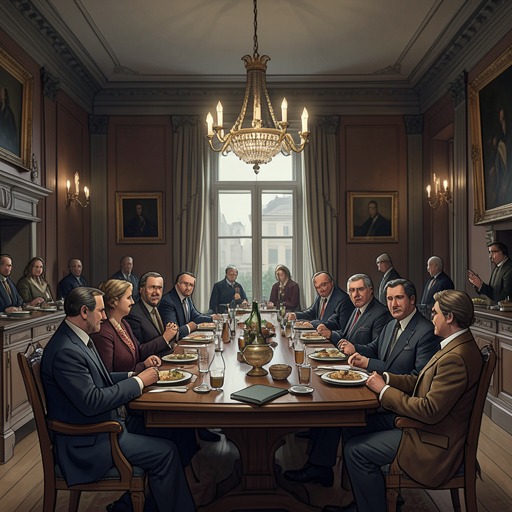
At the reception room the next morning, Ahmed Qurie gestures toward Toril and Finn as they stand in the entranceway and invites the others to meet his precious host and hostess. The introduction confirms their place in the gathering as more than anonymous staff: they are recognized as the people receiving the visitors at the estate. The scene makes their hospitality part of the participants’ shared setting, while keeping Toril’s and Finn’s work distinct from the negotiations themselves.
Across these appearances, Toril is characterized through concrete action rather than an extended account of her private life. She helps arrange the room, serves the food, explains its inherited recipe, and stands with Finn to welcome the assembled visitors. The play’s juxtaposition is significant: behind a clandestine political meeting are the ordinary arrangements that let people sit down together at all. Toril does not determine what the negotiators decide, and the evidence does not give her a separate political objective or a later resolution. Her contribution is instead legible in the room’s readiness, the food placed before its occupants, and the hospitality through which the meeting becomes a gathering among people.