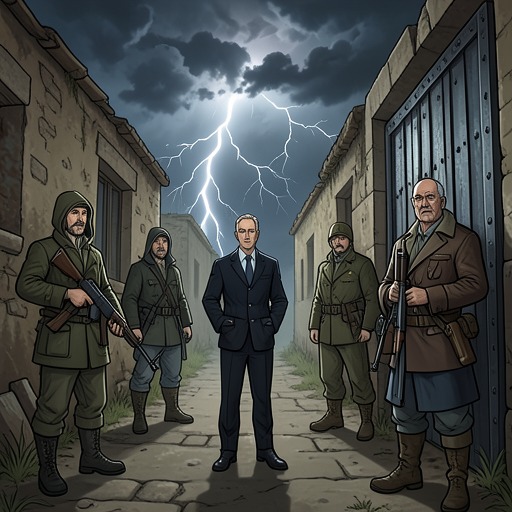
Yair Hirschfeld
OsloYair Hirschfeld is an Israeli professor of economics whom Yossi Beilin selects for the secret Oslo Channel. In the play, he helps turn a discreet, unofficial encounter between Israelis and Palestinians into sustained work on a joint Declaration of Principles (DOP). His part in the process brings a practical difficulty into view: a draft may sound constructive to its authors and still fail to answer the other side’s specific offer.
Identity and Introduction
Hirschfeld is introduced as a professor of economics in his forties, unkempt and sloppily dressed. That stage description sets him apart from the more formal Palestinian delegates when the first group meets at Borregaard Estate. The contrast is visible, but the play does not use his clothes to explain his politics or his negotiating style; his role emerges through the work and the exchanges around the draft.
Yossi Beilin chooses Hirschfeld as the man he is sending into the proposed channel. The decision places him within an Israeli initiative that is deliberately different from formal government-to-government declarations: Terje Rød-Larsen proposes intimate discussions between people, held in an isolated place where the participants can meet and talk. Rød-Larsen offers to oversee the model and arrange the location. Hirschfeld enters as Beilin’s chosen representative, not as the person who designs the channel.
The Unofficial Channel Begins
At the reception room of Borregaard Estate, outside Sarpsborg, Hirschfeld stands with Ron Pundak opposite Ahmed Qurie and Hassan Asfour. Mona Juul dates the official opening of the unofficial Oslo Channel to January 1993, and explains that the events to follow unfold within nine months. That compressed period gives Hirschfeld’s work a defined setting: a small, secret diplomatic process moving quickly alongside the public talks.
The initial drafting sessions are strenuous and improvised. For two days and nights, the participants work almost without stopping, amid repeated waffles, cigarettes, and coffee, without a road map. Hirschfeld and Pundak hammer out a joint draft of the DOP with their Palestinian counterparts. The draft is described as radical and without precedent because it recognizes that each side has grievances; its language records not a settled agreement, but an effort to find a way toward one. Hirschfeld’s contribution is therefore collaborative: the text takes shape through sustained contact among people whose positions remain distinct.
Drafting and Disagreement
The limits of that collaboration become clear when Qurie and Asfour read copies of a document while Hirschfeld and Pundak wait. Qurie asks where the direct reply is to the Palestinian side’s concrete offer to take control of Gaza. Hirschfeld answers that the draft written by him and Pundak clearly puts forward their own specific proposals. Qurie rejects that account, calling the proposals eloquent generalities. The scene turns on a disagreement about what counts as a response: Hirschfeld sees the draft as specific, while Qurie judges it against the particular offer on the table.
This exchange gives Hirschfeld’s role a tension beyond simply helping to produce text. The draft is a joint undertaking, yet agreement to write together does not ensure agreement about whether the resulting language addresses a partner’s demands. The gap between the authors’ sense of specificity and Qurie’s insistence on a direct answer makes the wording itself part of the negotiation. The play does not resolve that clash through Hirschfeld’s argument; instead, it leaves the competing assessments audible.
The Negotiating Stakes
Other discussions in the play show how concrete the unresolved questions behind such drafts are. In a later exchange with Uri Savir, Qurie seeks a direct response to proposals concerning Gaza; Savir says Israel is willing to discuss much of the document but first wants demands he considers impossible removed. He states that Israel will not negotiate over the sovereignty of Jerusalem. When Savir says Israel is willing to relinquish control of Gaza, Qurie makes acceptance conditional on the simultaneous transfer of control of Jericho. These exchanges clarify the political terrain on which the early drafting occurs, but the supplied scenes do not establish that Hirschfeld is present in them.
A subsequent bargain further demonstrates the distinction between setting terms and finding an exchange: Qurie agrees to drop the demand for third-party international arbitration over outstanding disputes, while Savir agrees to negotiate the transfer of Gaza and Jericho. Later, Joel Singer offers to make the back channel the official channel on behalf of Prime Minister Yitzhak Rabin and the State of Israel. These developments trace the process beyond Hirschfeld’s directly shown drafting work; they should not be mistaken for actions or decisions attributed to him personally.
Narrative Role
Hirschfeld represents the early Israeli participation through which a secret channel begins producing a shared written proposal. His appointment by Beilin, his pairing with Pundak, and the two-day-and-night drafting effort make the channel legible as work conducted by people rather than as a single public pronouncement. At the same time, Qurie’s criticism prevents the draft from standing as an uncomplicated triumph: a document can recognize mutual grievances and still be judged inadequate when it does not answer a concrete offer.
The play gives Hirschfeld no stated private history, explicit account of his motives, or concluding fate in the supplied scenes. His significance rests instead on his place in the drafting process and on the disagreement over what that process has achieved. Through him, the Oslo Channel’s promise and limitation appear together: sustained, unofficial conversation can produce a common text, but the text remains subject to the parties’ competing tests of precision and responsiveness.