General Staff of the Armed Forces of the United States of America
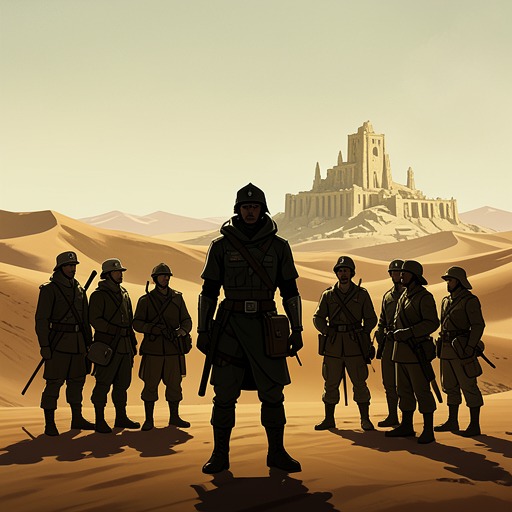
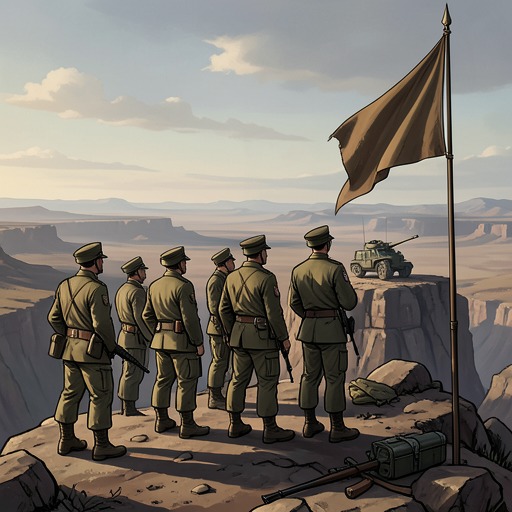
OzymandiasThe General Staff of the Armed Forces of the United States of America is the expedition’s principal military sponsor and the institutional force behind its search for strategically useful discoveries. By financing most of the mission and defining useful results as weapons and materials, it shapes the expedition from the outset; when Ozymandias is found, that same priority converts an archaeological discovery into military property and brings the expedition to an abrupt end.
Funding and Mission
The General Staff supplied 70 percent of the expedition’s budget and expected its military contingent to produce results: new weapons and sources of strategic materials. The expedition was sent to investigate worlds a survey mission had passed over quickly, but its two branches had sharply different assignments. Dr. Leopold’s archaeologists were to study dead civilizations; Colonel Mattern’s men were to search for fissionable material, alien weapons, lithium, tritium, and other resources useful to the military.
The archaeologists’ place on the mission reflected public pressure as much as the expedition’s stated research purpose. Purely military expeditions had become unpopular in America, so five researchers were added as a concession to the national conscience. The narrator acknowledges that, measured against national security, their work could appear to be dead weight. Mattern likewise treated his soldiers as the expedition’s essential personnel and the archaeologists as ballast.
Strategic Context and Authority
The General Staff’s priorities were set against renewed tension between Earth’s divided powers. The expedition feared that the Other Hemisphere might return to space after a century of quiescence, making the discovery of military resources a matter of strategic competition. The mission was therefore not simply a survey of lost societies: its archaeological and military branches worked under unequal expectations, with the military search regarded as the more urgent purpose.
That institutional imbalance did not initially give Mattern unrestricted control. The military’s Public Liaison branch had ensured that the archaeological group retained some rights, including a limiting clause Dr. Leopold could invoke to resist an immediate departure from the dead planet. Those protections established a real, if narrow, sphere for research. They did not, however, settle who would control a discovery once it was classified as a security asset.
Ozymandias and the Reclassification of Knowledge
The find first appeared to vindicate the archaeologists’ work. Ozymandias was an ancient machine built to guide visitors through the Thaiquen ruins; after listening to the expedition’s speech, it learned enough English to converse and became a walking source of historical information. It described a civilization that had flourished for 300,000 years and preserved details of cities that had otherwise crumbled. Dr. Leopold saw a storehouse of archaeological data that could sustain years of research.
The same capacity for preserving information admitted a different institutional interpretation. Mattern claimed that Ozymandias held extensive knowledge of ancient Thaiquen weapons, including the superweapon that had left the planet without life. He argued that the machine’s military information could make America impregnable. The dispute was not over whether Ozymandias was valuable, but over which kind of value would determine its custody: an irreplaceable historical archive for the archaeologists, or a source of strategic intelligence for the military.
Seizure and Consequences
Invoking security, Mattern announced that Ozymandias had been taken aboard the ship and placed in sealed quarters under top-level security. He declared the expedition over and ordered an immediate return to Earth with the machine. Leopold had tried to designate Ozymandias part of the archaeological group’s preserve, but Mattern answered with a competing claim: the robot belonged to the military because its knowledge could serve military purposes.
The decision exposes the practical limits of the archaeologists’ formal protections. Once the find was classified as strategically useful, their right to study it could not prevent its removal or the termination of the mission. The General Staff’s influence thus reaches beyond the expedition’s budget and original tasking: through Mattern’s security authority, military priorities determine which knowledge will be preserved, who may control it, and when the search for the past must stop.