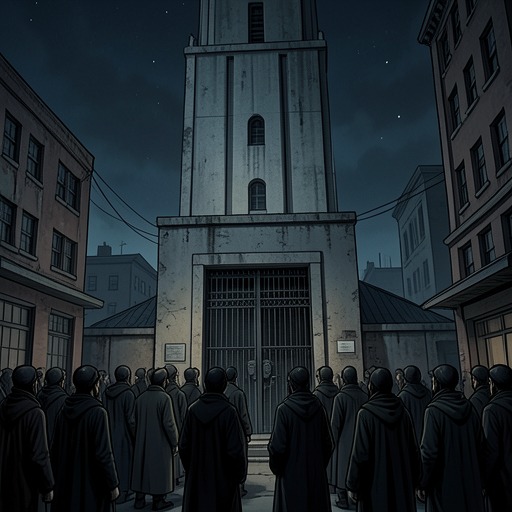
Aishidi’tat legislature
PeacemakerThe Aishidi’tat legislature grew out of the agreements that joined regional associations, guilds, and the aiji under a shared political order. First convened in Shejidan as the railways connected the west, it developed into a place where regional lords and guilds had to negotiate common rules. Its authority depended not only on central rule, but on maintaining a balance among regions and institutions that retained their own interests and powers.
Origins in the railway project
Before the Foreign Star appeared, eleven regional associations agreed to build a railroad from Shejidan westward without going to war over it. As construction continued toward the coast, elected aijiin managed the project: rather than leading armies, they coordinated the guilds, clans, and sub-clans needed to secure routes through different districts and honor agreements sealed by individual clan lords.
The Assassins’ Guild began in this setting as a small group empowered to protect the aijiin from attacks by assassins serving individual lords. The railway’s success led to further projects and larger associations. When three powerful lords sought to alter an agreement and divide the railroad into administrative districts, the Guild supported the aiji in holding them to their commitments. That dispute made the political purpose of the emerging system concrete: cooperation could bind even powerful parties to arrangements that served a wider public, including clans that collected no tolls but benefited from trade.
As lords, guilds, and trades were increasingly required to meet in Shejidan and reach agreement with the aiji, the legislature and the Aishidi’tat began to take shape, though they did not yet bear those names. The developing order replaced some patterns of regional alliance and conflict with institutions organized around continuing common purposes. Shejidan grew as a town without a lord of its own, and guilds and smaller clans based there supported the aiji’s authority.
Representation and the balance of regions
The legislature’s membership expanded beyond the central region. The aiji declared that lords from outlying clans and regions should sit equally in the legislature and have a say in the laws of the Aishidi’tat. He also divided the continent into defensive districts that became provinces, each with its own lord and representation. Those arrangements added votes to important regional associations, helping balance Shejidan’s influence and making the new structure more acceptable to regional lords.
This design joined inclusion to political compromise. Outlying lords were given seats, while the provinces adjusted the distribution of votes; neither measure erased the interests of the regions or made their consent automatic. The legislature could provide a common forum, but its decisions remained subject to the competing priorities of its members.
The legislature and guild autonomy
The aiji also sought to preserve the guilds’ ability to operate across regional and clan lines. Because the guilds had worked across those boundaries during the War, he proposed that their membership and assignments should be based on qualification rather than clan origin, kinship, or regional association. Authority over membership would rest with guild masters. The guild heads favored the arrangement, which became an internal rule for the guilds even though some regional associations remained apart from the system.
The Assassins’ Guild negotiated a further rule in private conference with the aiji: its members could neither seek nor hold political office or lordship. In exchange, the Guild received statutory protections against political pressure. Lords could not summon its records; its members would testify only before their own Guild Council; and the Guild alone could investigate and deal with the disappearance or death of one of its members under its own rules. The legislature’s political order thus did not simply absorb the Guild. It recognized a separate jurisdiction, with privileges that supported Guild independence but also made the boundary between public authority and institutional autonomy consequential.
That division mattered because the Guild’s charter governed actions with direct implications for civil order. A Filing of Intent had to be entered in the state registry before action could be taken against a person or institution, except in defense against an illicit attack. The procedure required an official record and Guild review; the Guild Council could seek depositions, consider whether there was adequate cause, and pursue settlement before approving a filing. This was not a legislative procedure, but it operated within the wider order that the legislature and the aiji helped sustain.
Disputes, votes, and political limits
The legislature’s power was visible in the way political authority depended on votes. When Valasi made his bid to rule in Shejidan at twenty-seven, he gained sufficient legislative support, and Ilisidi finally conceded to him. The episode made the legislature more than a gathering place: its vote could help settle who held the aiji’s authority.
Its limits were equally clear when Ilisidi later returned to Shejidan with Tabini and sought election as aiji. She argued that the Aishidi’tat’s complex affairs, growing traffic with Mospheirans, industrial pollution, and unresolved postwar arrangements called for renewed attention and tougher negotiations with Mospheira. The legislature balked at her proposals. Regional interests opposed reopening parts of the postwar treaty for fear that their own arrangements would also be reopened; the Marid rejected her proposed solution to west-coast problems, while concern about smoke reaching the Gan peoples had little support beyond Dur. Ilisidi therefore continued as aiji-regent through the remainder of Tabini’s minority rather than winning election as aiji.
The legislature’s role also sits within a larger contest over lawful authority. During the later crisis in the Assassins’ Guild, the possibility that Tabini might have to uphold his allies only by decree and by the power of the aijinate threatened the Guild’s legitimacy: the case needed to be proved before the Guild membership and Council, not imposed solely by political force. When an incendiary fire followed, Shishogi was found dead and the records had suffered but survived; a man carrying several notebooks from the office was intercepted. The episode underscored that institutions depended on preserved evidence and recognized procedures as well as on the ruler’s power.
The Aishidi’tat legislature is therefore presented as one part of a layered political settlement, not as an authority that displaced every other one. Its origins in railway agreements, its provisions for regional representation, and its accommodations with autonomous guilds all converted practical cooperation into durable rules. Yet votes, regional resistance, and the separate jurisdiction of the Guild continued to shape what central authority could accomplish.