Aishidi’tat
PeacemakerAishidi’tat is a continent-spanning political association whose defining achievement is the creation of durable cooperation across clans and regions. It began with the practical task of building a railway without going to war, then acquired legislative and guild institutions that could enforce agreements and settle disputes. Its history is not a simple passage from fragmentation to unity: the association repeatedly had to manage the tensions its own growth created, from regional resistance and the War of the Landing to a coup that originated within the Assassins’ Guild.
From railway coalition to political association
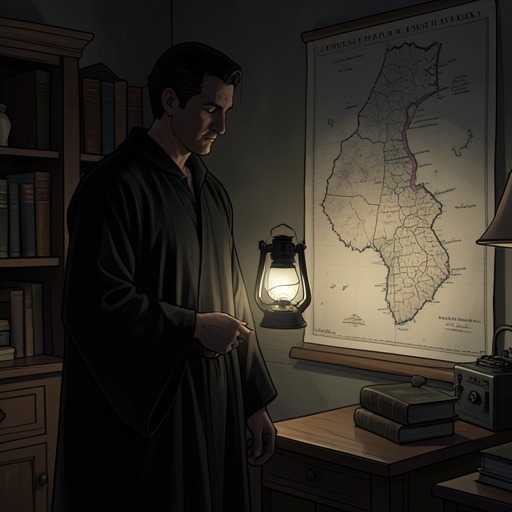
Before the arrival of the Foreign Star, eleven regional associations agreed to build a railroad from Shejidan westward. The agreement marked a change in political practice: associations that had often formed around trade or regional convenience and then broken apart in conflict now cooperated on a shared project. The railway continued even as the omen associated with the Foreign Star occupied the attention of lords and clans for a year.
The project needed authority able to secure the route and uphold promises made by individual clan lords. Aijiin, once elected as war leaders for particular purposes, were chosen to manage the work. Their authority concerned the coordination of clans, sub-clans, and guilds rather than command of armies. A small group that protected these leaders from rival assassins developed into the Assassins’ Guild, an institution whose reach, like the railway’s, crossed local divisions.
The success of the first line encouraged further projects and wider associations. A decisive test came when three powerful clan lords tried to revise the agreement and divide the railway into administrative districts. The Assassins’ Guild backed the aiji in holding them to their commitments. The arrangement benefited even the dissenting clans: although they collected no tolls, their people gained from trade. In this history, order did not depend on preserving every boundary or local advantage. Associations of common purpose could connect places and interests that ordinary trade alone had not joined.
Institutions that crossed boundaries
The railway helped shift political authority toward Shejidan. Lords, trades, and guilds increasingly had to meet there and reach agreements with the aiji, who ruled the western association. This was the beginning of the legislature and of Aishidi’tat, though the association did not yet bear that name. Shejidan grew into a town governed by the aiji rather than by a local lord. Smaller clans, especially those engaged in crafts and trade, prospered there and supported the order that made their prosperity possible. Guilds also settled in the city; a lord who needed their services had to deal with members whose primary man’chi was to their guilds and the aiji, not to the lord’s clan.
The War of the Landing enlarged this political framework. After the human arrival provoked attacks and counterattacks, coastal associations responded, and the aiji in Shejidan took command of the war. The campaign absorbed western clans that had remained outside Aishidi’tat and eventually brought the Marid into it as well. The aiji’s strategy was to push the humans off the continent and onto Mospheira, where the largest human population already lived. The island also offered a place of refuge for tribal peoples, while the remaining mainland human forces could be isolated in smaller areas. The conflict ended in an agreement that became the Treaty of the Landing, the basis for subsequent dealings with humans.
After the war, the aiji argued that the association formed for defense should remain intact in case more humans arrived from the heavens. Its membership and representation were reorganized to sustain that wider purpose. Outlying clan and regional lords were to sit equally in the legislature in Shejidan, with a voice in the laws of Aishidi’tat. The continent was also divided into defensive districts that became provinces, each with its own lord and legislative seat. Those seats added votes for regional associations and helped balance Shejidan’s influence.
The guilds, whose work during the war had crossed regional lines, were encouraged to continue doing so in peacetime. Membership and assignment were to depend on qualification, not clan origin, regional association, or kinship. The guild masters gained control over those decisions, and the principle became an internal guild rule rather than a statute imposed on the regional associations. The Assassins’ Guild accepted an additional restriction: its members could neither seek nor hold political office or lordship. In exchange, it received protections against political pressure, including control over its own records, member testimony, and investigations into the disappearance or death of its members. The design joined political neutrality to institutional independence, making the Guild a powerful enforcer of the order while also limiting ordinary political oversight of it.
Unity under pressure
Aishidi’tat’s expansion never erased disagreement about its direction. The Marid joined the association but retained its own guilds, and the East was not yet permanently included. Some regional associations also remained apart from the guild system. The association was held together less by uniformity than by agreements that linked distinct interests: regional representation, common infrastructure, guild services, and a legislature where disputes could be addressed without war.
That balance became more difficult as human contact and the space program accelerated political change. The arrival of another human presence in the heavens, Tabini’s decision to name Bren Cameron a lord of Aishidi’tat, and the transfer of part of the space station to atevi control unsettled an older political agenda. Technology and new agreements with ship-humans arrived quickly; Atevi on the mainland and humans on Mospheira became allies. Those developments also raised questions about who held authority over affairs in space. Tabini anticipated opposition to the alliance and placed key people at the station, beyond the reach of assassination, before sending Ilisidi, Cajeiri, and Bren Cameron on the distant mission.
The association’s cohesion was tested again when Tabini was overthrown and Murini’s government took power. The initial account blamed a discontented Kadagidi lord, Marid backing, and a coalition of unhappy lords, supposedly acting amid declining public approval of Tabini. The later investigation overturned that explanation: neither public discontent with the economy nor dissatisfaction with Tabini’s government had caused the coup, and Murini had not devised it. Its origin lay inside the Assassins’ Guild, where a faction had seized the government and installed a ruler who should never have held office.
The faction had been pursuing a quieter agenda for decades, exacerbating regional quarrels and resisting approaches to humans. Its opposition to rapid change sharpened when the human alliance and the space program disrupted that long strategy. After Murini’s defeat, the conflict continued against Guild forces that had been misled by forged orders. The deception did not make every participant blameless, but it showed that the crisis could not be reduced to Murini’s supporters or to ordinary regional opposition. The Guild, created to protect political agreements and enforce order, had fractured within itself.
Restoration and continuing stakes
Murini’s two years in power had turned public opinion against him. Citizens across the continent had begun organizing in small groups to consider how to remove him. When Tabini returned alive with Ilisidi and Cajeiri at his side, their report of success in the heavens met widespread support. A Shadow Guild attempt against Tabini, Ilisidi, and Lord Tatiseigi was stopped, though Lord Tatiseigi’s grounds and a bedroom were damaged. After the attempt failed, Murini and his closest staff fled toward the Marid, and his government disintegrated.
Restoring the association therefore required more than restoring Tabini’s rule. The aiji-dowager and Tabini pursued Murini, but the subsequent fighting exposed a splinter of the Guild and the false orders under which many of its members had acted. Ilisidi recognized that wrongdoing within Aishidi’tat could not all be attributed to Murini. The former leadership of the Assassins’ Guild eventually returned, offering a basis for rebuilding confidence in an institution whose independence had become both a safeguard and a vulnerability.
The political consequences extended beyond the Guild. Evidence concerning the Kadagidi and Ajuri raised the possibility that Tabini might dissolve both clans, while Ilisidi was stirring factions toward vengeance. The crisis also put the Guild system itself at risk and brought the possible inclusion of two tribal peoples into the political calculation. Tabini framed the recovery of the Guild as a way to defuse the wider conflict, but Bren Cameron was not certain that the dispute would simply evaporate. The organization’s restoration was thus tied to the harder question of whether law and association could contain retaliation without turning institutional failure into collective punishment.
In the continuing space crisis, Aishidi’tat’s reliance on cross-boundary coordination again becomes practical rather than ceremonial. Tabini arranges for Ilisidi to assume control of the Bujavid guard, transport station, and spaceport if he is incapacitated. Bren Cameron describes a plan that would keep communication between the station and the ground from depending on a system that hostile forces could cut off; Lord Geigi has fortified the spaceport and can act if the household or the port is threatened. Tabini also sends Bren Cameron and Ilisidi to investigate what the ship-folk have disclosed, and sends Cajeiri to learn about humans and the new knowledge of space. These measures show how far the association’s responsibilities have widened from the railway: the institutions that once linked clans across land must now help protect political authority and participation in the heavens.
Aishidi’tat’s history makes association itself a form of political infrastructure. Railways, legislative seats, provinces, guild rules, and shared security bind people who do not share a single clan or local interest. Those connections have helped prevent disputes from returning to war, but their survival depends on institutions remaining credible and on authority being negotiated across the boundaries they were built to cross.