Guild in exile
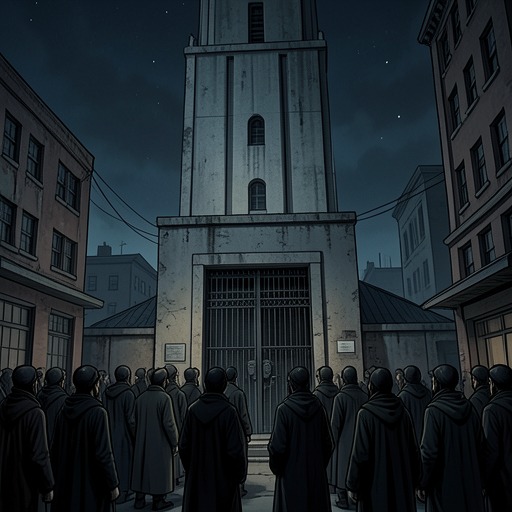
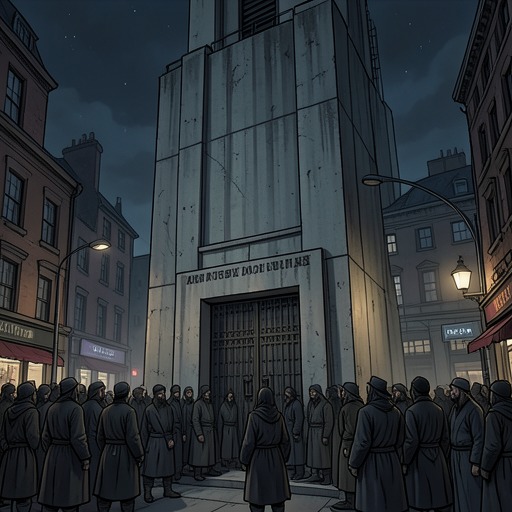
PeacemakerThe Guild in exile is the network of senior Assassins’ Guild members who went underground during Murini’s coup, remained officially dead, or claimed retirement rather than submit to the Guild leadership established afterward. Their return turns a hidden dispute over authority into a direct challenge within the Council Chamber: they come not simply to replace officeholders, but to recover records, prove violations, and restore the Guild’s standing as an institution governed by law.
Identity and Survival
When Murini came to power, some senior Guild members disappeared from public life; others were listed as dead despite surviving, and some of the most senior members formally claimed retirement. The group’s aliases, the Missing and the Dead, describe these different means of withdrawal. Their absence was not evidence that they had ceased to act: some had operated the network that helped restore Tabini, while others remained out of sight and refused repeated orders from the post-coup leadership to return to duty.
Their separation from the Guild’s official structure lasted beyond Murini’s defeat. The conflict became a prolonged contest of wills between the returning leadership and elders who would not answer its summons. Personal disagreements contributed, and the exiles did not agree with the current Council. Their distinct position mattered because they remained Guild members with experience and authority, yet could not simply be treated as an available force under the Council’s command.
Principles and Political Judgments
The exiles’ opposition to the Council rested on their view that the Guild had departed from its own governing traditions. Jago identifies neutrality in disputes as the Guild’s cornerstone and points to a cascade of alleged breaches: unfiled attacks on civilians, violations of Guild code, and the Council’s refusal to bring charges in several cases, including Haikuti’s. The exiles had watched the Guild purge itself twice and regarded the current leadership’s conduct as a threat to the law it was supposed to uphold.
Their record was not presented as free of error. Before the coup, they had supported Shishogi’s demands and rejected computers as a human gift. They later reconstructed how decisions about appointments to particular offices had helped create the conditions for the coup and Murini’s rule, and recognized that their earlier rejection of computer technology had been a serious mistake. Their critique therefore included an accounting of their own past judgment, not only accusations against current officials.
They were also uneasy about the direction of events beyond the Guild. They had not favored the space program and feared Lord Geigi. They distrusted the appearance of dependence on the Eastern Assassins’ Guild, though Jago distinguishes this concern from personal distrust of Cenedi. These reservations did not erase their commitment to legal order: while Murini ruled, they had worked with humans on Mospheira to restore the law. They had never favored Tabini because of his association with humans, but came to support him as part of their effort to restore the Guild itself.
Contact and Decision to Return
The exiles did not initially communicate through Cenedi, whose Eastern Guild affiliation made him an unsuitable intermediary for this matter. Instead, they maintained contact with Jago and her associates after the group returned from Najida Peninsula and after the Council’s attempt to arrest the retirees. Before Jago’s party went dark, it sent a message using Bren’s name that requested a boat to Najida Peninsula; the request was code. A subsequent face-to-face meeting in the lower corridors confirmed direct contact, while preserving the exiles’ refusal to deal with Cenedi on the issue.
Jago’s account makes clear that their return demanded personal as well as institutional sacrifice. They were leaving their identities for a second time, abandoning families and breaking off marriages. They nevertheless gave their word to come back, investigate the records, and restore the law. Jago also states that eight members of the old Council had agreed to return to active duty; Tabini specifically excludes Daimano from that group. The exiles’ return was thus a deliberate re-entry into danger and public responsibility, not merely an appeal for recognition from the sidelines.
The Case Against the Sitting Council
Jago describes the current Guild Council as three individuals: one compliant with the other two and, in her assessment, more a failure than a problem. The other two had pushed through Office of Assignments recommendations without debate, including recent appointments of chief officers in Dojisigin Marid. In the western trouble, their delay in moving forces was so consequential that Tabini himself took the field, his presence overriding the normal process of querying the Council.
The exiles also objected to the Council’s decision to send a mission to arrest two senior retirees when assistance was needed for Tabini’s action in the south. The diversion prolonged the confrontation, left one unit dead, and resulted in the retirees being officially outlawed. That status had little practical force where no other Guild operated, but it remained on the books and could give the Shadow Guild a pretext to reach them. Despite the Council’s orders, the Missing continued to ignore the Council while maintaining their connection with Jago’s group.
The fight over the records made the Council dispute more than a contest for seats. Jago warns that a direct assault on Guild Headquarters could kill innocent members who lacked the information needed to choose sides, destroy valuable records, and warn the Office of Assignments to dispose of the evidence. Shishogi might destroy records if he believed he was about to be dismissed. Because the Guild enforces the law, proof of the Council’s own violations was essential: a victory imposed only by Tabini’s decree and the power of the aijinate would not restore the Guild’s legitimacy in the eyes of its membership.
Return to the Council Chamber
The exiles’ return is announced at the Council doorway by Banichi, who identifies them as returning at the aiji’s order and in his service. The armed members inside are given a choice: assist, stand down, or fire and then face the returning Guild. When one member recognizes Banichi, the unit senior orders an immediate retreat. The confrontation does not resolve itself through a frontal assault; the announcement of the exiles’ return changes the calculation inside the room.
Once Bren and his aishid reach the bottom of the aisle, the armed gathering begins to spread through the tiers of desks. A senior woman lays her rifle on the long desk, and a gray-haired man takes the central seat with a pistol before him; another rifle rests against the desk. The identities and offices of those taking the three principal seats remain uncertain, since the leadership had changed its seating arrangements when outsiders were present.
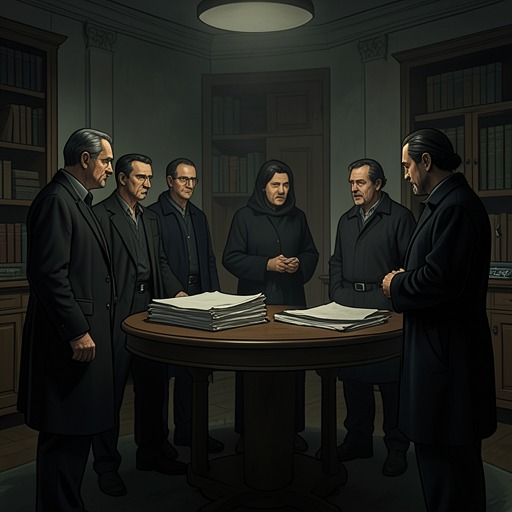
The exiles then claim seats in the chamber. Some resume their former places; others take seats they have elected for themselves, producing a complete change from the Council constituted the previous year. A gray-haired man takes the recording secretary’s seat and opens the massive book that had remained shut through the tumult outside. Smoke is still perceptible, and shouting continues beyond the chamber doors. The return therefore culminates not in an abstract declaration of restored authority but in a visible reoccupation of the Guild’s institutional space, accompanied by the opening of the record on which its legal case depends.