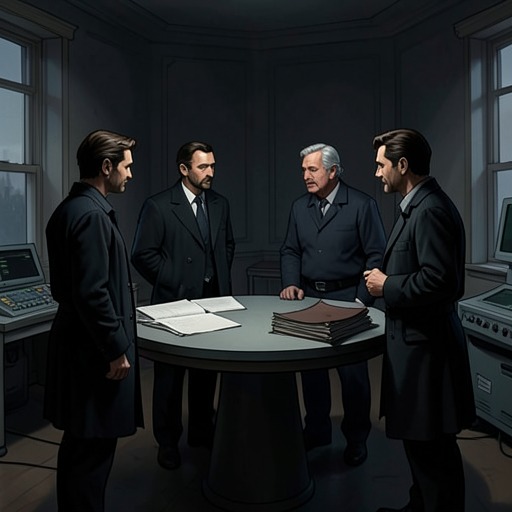
Guild system
PeacemakerThe Guild system comprises institutions that can work across clan and regional boundaries, and whose authority helped turn cooperation over shared projects into a durable political order. It grew from artisan organizations and railway-era alliances into a system with independent control over recruitment and assignments; the Assassins’ Guild became both an enforcer of law and a check on political power. Its autonomy can uphold impartial rules, but the crisis surrounding Shishogi shows how control of personnel and records can also place the system’s legitimacy at risk.
Origins in the Railroad
Guilds had existed within regional associations before the first railroad, but the project changed their political reach. Eleven regional associations agreed to build a line from Shejidan westward. As construction continued toward the coast, Aijiin were elected to manage the project: their task was not to command armies, but to coordinate guilds, clans, and sub-clans and uphold the agreements sealed by individual clan lords.
The Assassins’ Guild began in this setting as a cross-clan body charged with protecting those Aijiin from attacks by assassins serving individual lords. The railroad’s success led to further projects and larger, overlapping associations. When three powerful clan lords sought to alter their agreement and divide the railway into administrative districts, the Guild backed the Aiji against them. Its support helped preserve the project and demonstrated that an institution operating beyond clan boundaries could enforce commitments between powerful parties.
The railroad and the Aiji’s authority in Shejidan drew associations, lords, trades, and guilds toward a common political center. This development formed the basis of the legislature and the Aishidi’tat before those institutions had acquired their later names. The growth of Shejidan and the prosperity of smaller clans were connected to the railway and to the guilds’ decision to settle in the city. Lords seeking guild services consequently had to deal with members whose primary man’chi was to their guilds and the Aiji in Shejidan, rather than solely to a clan lord.
Autonomy, Membership, and Political Limits
After the War, the Aiji proposed that guilds operating across regional lines should continue to do so in peacetime. Membership and assignments were to be determined by qualification, without regard to a candidate’s clan, kinship, or regional association. Authority over those decisions passed to guild masters. The heads of the guilds saw advantage in the arrangement, and it became a rule through internal guild regulations, even though it was not enacted as a statute. Regional associations and provincial or clan authorities had little practical power to overturn it if they wanted guild services.
The Assassins’ Guild accepted an additional restriction: its members could neither seek nor hold political office or lordship. In exchange, the Guild received statutory protections against political pressure. A lord could not summon its records, its members testified only before its own Guild Council, and the Guild alone could investigate and deal with the disappearance or death of one of its members under its own rules. The resulting arrangement gave the Guild substantial independence while making it responsible for maintaining its own standards.
Cross-clan recruitment had effects beyond administration. People from different clans, regions, and philosophies worked together in guilds and even in the domestic staffs serving clan lords. The contact brought ideas and skills together, encouraging invention and innovation; the resulting exchange helped reduce one major cause of wars. Clan feuds became less frequent and more often bloodless, while associations built around common purposes grew more influential than temporary alliances that could dissolve into conflict.
Law and the Assassins’ Guild
The Assassins’ Guild’s role as an autonomous institution is most visible in its legal process. A legal assassination begins with a Filing of Intent: a Document of Intent is entered in the state registry, recording the dispute in a sealed, ribboned document kept in the archive. Any answer is filed in the same way. The process then requires public notice of the Guild Council’s impending action and an opportunity for depositions from both sides. The Council first considers whether there is adequate cause for a filing, then debates its merits and whether a remedy short of lethal action is possible. It may hear testimony from Guild members employed by either side and impose further delay while seeking a settlement. Only after those measures fail can the Council approve the filing by vote and set a date after which action may be taken.
The filing requirement applies before action against a person or institution, except when a defender responds to an illicit attack. In that circumstance, force used on the spot is legal if the attack involves movement within arm’s length or the first use of a distance or stealth weapon. More broadly, violence against a fellow citizen is forbidden to anyone other than a Guild Assassin, apart from specified defenses of self, employer, household, clan property, or national treasure. A violator may be outlawed and become subject to lethal Guild action without a time limit, though an outlaw may surrender to the Aiji’s judgment in consultation with the Guild.
For private citizens without regular bodyguards, the filing procedure can impose costs as well as delay. A complainant must engage the Guild from the date of filing; a defendant notified of the filing must either cede certain disputes or hire Guild protection, ordinarily for ninety-nine days. That burden can be expensive for an ordinary citizen to maintain, although pro bono filings sometimes occur. Lethal force is therefore a possibility built into the system, but the procedure makes it less common in practice: depositions, a formal acknowledgment that a wrong may exist, a vote, and repeated opportunities for settlement create a cooling-off period.
Assignments and the Power of Records
The Guild’s authority also rests on the Office of Assignments, which determines where its personnel serve. For forty-two years, Shishogi recommended units for short-term work, including assignments to carry out a private citizen’s filing or defend one side of a dispute. He also recommended long-term placements: filling a vacancy in a unit, assigning a high-level unit to guard a lord, house, or institution such as the Bujavid, and placing plain-clothes Assassins as servants on supposedly defensive duties. He appointed the investigators serving the Guild Council, who examined the truth or falsehood of filings.
Shishogi was the tenth holder of the office in the modern Guild’s history. He had outlived his clerks and secretaries without replacing them, and his cramped office was crowded with untidy stacks of files and records. Its pre-computer filing system had become a Guild joke, but Shishogi himself was an experienced, senior authority and a walking store of personnel knowledge; the Council had seen no urgent reason to replace him. The contrast between disorderly files and his command of personnel points to the office’s practical power: assignment decisions could shape security and service across the political order.
The Guild did not ordinarily release the names of its officers, but Shishogi’s identity became known. He came from Ajuri, the same minor clan as Haikuti and Cajeiri’s mother, and the clan once ruled by Cajeiri’s recently deceased grandfather, Komaji. His influence raised questions about how many members of the current administration owed him personal favors, what resources remained at his disposal, and whether people fearful of investigations into their conduct under Murini might want records buried. Shadow Guild activity had already demonstrated that assassination remained a real threat. In that climate, the integrity of personnel records was not a clerical concern: it could affect the safety of units in the field and the possibility of proving political wrongdoing.
Crisis and Institutional Legitimacy
When Shishogi’s position came under threat, the immediate danger was that he might destroy records. The Guild’s opponents feared that a bloody confrontation with innocent members could let the wrong side prevail or deprive them of proof. Their case depended on the Guild’s own evidentiary and legal standards: if Tabini had to uphold them only by decree and the power of the Aijinate, the Guild would no longer possess the legitimacy that comes from demonstrating its case before its own membership and Council.
Exiled Guild members offered a possible route back to lawful authority. They had worked with humans on Mospheira during Murini’s rule to restore the law. They had not favored Tabini because of his association with humans, but they were prepared to support him now in order to restore the Guild. Having given their word, they were leaving their identities for a second time, leaving families and breaking off marriages to return, investigate the records, and reclaim the institution. Under the charter and the current Guild rules, only Tabini and Ilisidi could enter the Guild building and demand the Council’s attention regardless of its agenda. Ilisidi wished to do so, but her Eastern identity raised the prospect that the returning exiles would resist her intervention.
The Guild system’s strength and vulnerability thus arise from the same design. Its independent rules, personnel, and proceedings allow it to enforce law without simply serving a lord’s interests. But that independence makes internal legitimacy, trustworthy assignments, and preserved evidence indispensable: authority imposed from outside may restore immediate control, yet fail to restore confidence in the institution. The railway once showed how guilds could hold powerful parties to agreements and create cooperation beyond clan boundaries; the later crisis tests whether the Guild can apply that principle to itself.