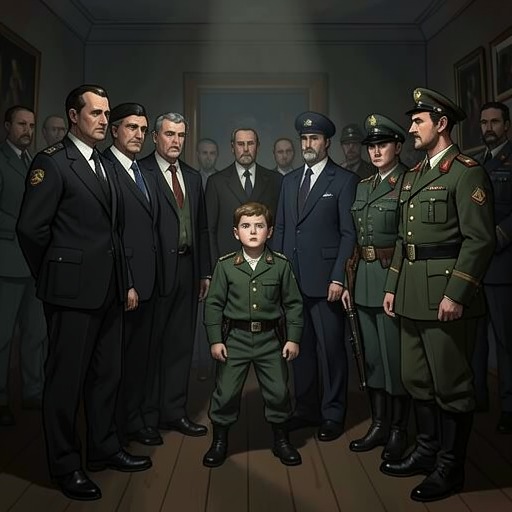
Kadagidi estate recording
PeacemakerThe Kadagidi estate recording is a contemporaneous visual account of the armed confrontation at the Kadagidi estate, presented as evidence that the visit began as a private attempt to resolve an assassination threat and turned violent when a Guild unit opened fire. Its significance lies not only in what the images show, but in who made them, how they were reviewed, and the fragile institutional trust the recording was meant to help restore.
Origin and purpose
The recording was made by the ship-aiji’s guard, whose custom was to record an exchange whenever its members deployed. The stated purpose was evidentiary: to establish what happened. That practice proved consequential when Bren Cameron and his party went to the Kadagidi estate. Bren later explained to Lord Topari that a recording of the action and the Kadagidi response existed and was available for viewing.
The visit, as Bren presented it, was intended to remain private and conciliatory. Two Dojisigin Marid Guild members had confessed to being coerced into lying in wait for Lord Tatiseigi in an unFiled assassination attempt. Because Lord Tatiseigi’s guests had been endangered, Bren and a ship-aiji went to speak privately with Lord Aseida, who had helped the two assassins gain access to the Atageini house. Bren said that an apology to Lord Tatiseigi, the dowager, and the heir could have settled the matter without a public confrontation. The recording was therefore evidence not merely of a firefight, but of the response to an attempted peaceful resolution.
Presentation to Lord Topari
Bren arranged to show the recording to Lord Topari, presenting him as the first person to ask about the facts and as a member of the Conservative Caucus entitled to information being shared with others. The meeting was framed as discreet political consultation; the railway and its southern route could plausibly account for the two lords’ business, while the Kadagidi matter remained unannounced. Bren also stressed that Guild administration had changed and that information was being passed to various houses.
The viewing was staged with a viewer rather than a television. Jago operated the device, and Algini dimmed the lights as an enlarged image appeared on the wall. The recording began at the point when the aiji’s guard started filming. Lord Topari watched in reflected light, grim and apprehensive; the first images were shadowed, then showed the interior of the bus as Jase’s guards put on their helmets. His expression and his question about whether the material would be entered in evidence made clear that showing the images did not itself settle their political or legal status.
What the images show
The sequence presented to Lord Topari moves from apparent quiet to sudden gunfire. Targeting squares flicker over shadows inside a building that appears transparent. Another Guild unit emerges onto the porch. Its unit-senior calls out to Banichi, raises a rifle, and fires. Jago then advances the image slowly, making the brief, violent sequence legible frame by frame.
In the slowed images, Banichi is seen firing second. Haikuti moves backward as Banichi spins and falls; at the same time, bullets strike the bus. A flash of fire and white cloud interrupts the view. Jago identifies the explosion as a grenade thrown by the other side, after which a more intense blaze envelops the porch. Jase’s guard then fires. In the following image, Bren’s bodyguard and the dowager’s men run past the camera toward the porch, now shattered and obscured by smoke. The recording thus preserves both the attackers’ initial fire and the immediate armed response, while also showing the damage to the bus and porch.
Bren’s legal argument and corroborating records
Bren used the sequence to explain why he considered the action lawful. In his account, the guards had been proceeding ordinarily, and the Kadagidi guard had not panicked simply because the ship-folk guards were present. The decisive change came when the second unit moved toward a door unknown to Bren’s guard, and the Kadagidi Guild senior emerged and opened fire on Bren and his guard. Bren said that his Guild senior took the fire and returned it; the grenade on the porch prompted Jase’s guard to use its weapons. The recording gave Lord Topari a visual basis for that account, rather than requiring him to rely on Bren’s assertion alone.
Bren did not present the footage as the sole evidence. A document delivered to the Guild contained the confessions of the two Dojisigin Marid assassins, and the confessions had already been filed. Bren said that the estate had also yielded evidence connecting its Guild unit to the upheaval in the south. The assassins’ account traced their routing from Murini’s people in the Marid through the Kadagidi house to an attack on the Atageini. A separate interview with Lord Aseida had been recorded while he was being transported to Lord Tatiseigi’s house to give his account to the dowager. The distinction matters: the estate recording showed the armed encounter, while the confessions, extracted evidence, and Aseida interview supplied related information about the wider affair.
Guild review and political significance
Bren told Lord Topari that the recording was to be filed with the Guild that day, while the confessions were already on file. He offered Topari the opportunity to see what the Guild Council would see, and said that the records would be available to Guild members and ultimately to members of the legislature. The proposed process placed the recording within an evidentiary chain: Guild experts could review it, the Guild Council could consider it, and information could then pass through Guild channels.
That process carried particular weight because confidence in the Guild had recently been badly shaken. Lords and bodyguards had once relied on information circulating under Guild seal, but discoveries of serious leaks had grown into a deeper fear that the Guild’s integrity itself could not be trusted. The characters hoped the problem had been fixed. If the Council could review the recording and communicate a judgment discreetly, the matter might be resolved without a legislative investigation and public escalation. Bren’s account also envisioned a possible quiet retirement for Lord Aseida if the Guild ruled against him and he stayed out of trouble; this was a hoped-for outcome, not a result established by the viewing.
The recording therefore serves at once as a record of violence and as an attempted instrument of institutional repair. Its two simultaneous camera angles, witnesses, and accompanying documents gave the Guild material it could assess, while the careful first showing to Lord Topari brought a skeptical political observer into that process. The images could support a finding about what happened at the estate; whether the Guild could once again make such a finding trusted beyond its own walls remained a larger question.