Red Train
PeacemakerThe Red Train is the aiji’s personal locomotive and a working relic of Shejidan’s railway history. In this operation, its familiar prestige makes it useful as cover, while its slow, deliberate progress carries Bren Cameron’s party toward the Assassins’ Guild Headquarters and leaves the train blocking ordinary traffic. Its journey links the city’s older infrastructure to a political crisis unfolding around the Guild.
Design and Place in the Railway
The Red Train is the oldest locomotive still in service and belongs to the aiji. Its standard formation consists of just three cars: two baggage cars and a passenger car for the aiji’s use. The black engine, brass embellishments on its driving wheels and side rail, and red panels along its flanks make it instantly recognizable in the city. It is not merely an old train but a public sign of high rank: anyone who sees it might suppose that Tabini, a member of his family, or another senior official is traveling.
Its age determines where it can go. The modern transcontinental cars that run from Shejidan’s main station are too long to negotiate the curves of the Bujavid tunnels and the old city route. Shorter cars and smaller engines still serve the Bujavid and the warehouse-to-market circuit, running on tracks laid for the city’s older railway system. The Red Train’s vintage, unusual in ordinary service, therefore makes it suited to routes that newer trains cannot manage.
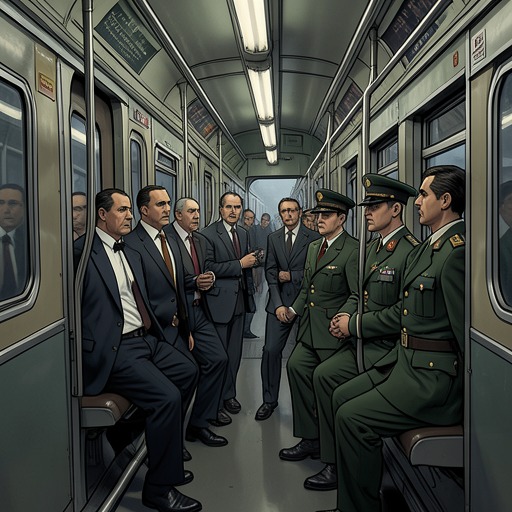
The passenger car also preserves the character of an earlier age of travel. Its rear seating is well padded, and a small bar is stocked with crystal, linens, and even ice. The old-fashioned gold lamplight and gilt-and-velvet comforts offer a striking contrast to the operation taking place around them: inside the carriage, the party can sit and wait; outside, the train is being carefully threaded through a route where every switch matters.
A Conspicuous Cover for a Covert Journey
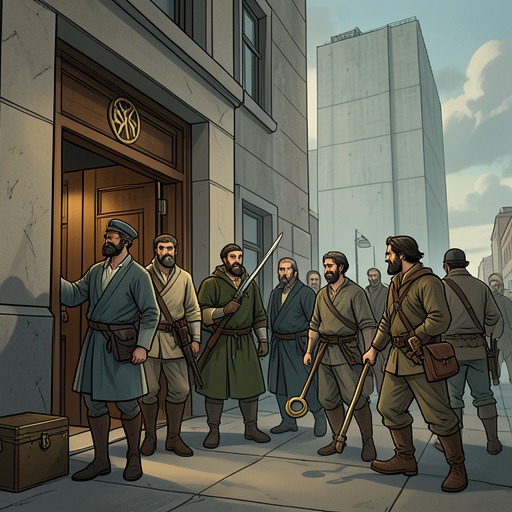
The operation uses the train’s prestige but gives the Transportation Guild a practical explanation for its movement. Ilisidi’s men and Lord Tatiseigi’s men enter the Guild’s Bujavid office with an order that the train should take the old mid-city spur to collect artworks for Lord Tatiseigi’s special exhibit at the Bujavid Museum during the Festivity. The explanation has a real basis: large crates from Lord Tatiseigi’s estate are already in the system for a freight pickup after midnight. What the Guild operators are not told is that those crates contain spare wardrobe left behind at Tirnamardi.
This plausible errand gives an exceptional journey an ordinary administrative shape. The Red Train is to leave its expected track, cross onto the eastern route, and then take the ancient line toward the freight yards and the center of the city. To the public, its appearance already suggests that an important person is on the move. To the Transportation Guild, the freight pickup supplies a reason for the detour. The cover depends not on making the train inconspicuous, but on making its conspicuous movement seem explainable.
The route is also a sequence of risks. Two switchpoints must work: the first takes the train from the Bujavid track to the eastern track; the second directs it onto the old central-city line. If the operation has leaked, the second switch could fail to send the train toward the old freight depot spur. Bren Cameron watches the route with the rest of the party, knowing both where they are on the tracks and what story has been given to the Transportation Guild. When the train jolts onto the southbound track, the successful change of line brings a moment of relief.
The Crew and the Stop at the Guild
The crew consists of three elderly men on the aiji’s staff: the engineer, fireman, and brakeman. They are veteran railroaders, largely retired from ordinary working life, who have occasionally witnessed history and have once or twice been under fire. During the coup, they survived by boarding another train and riding north to the coast; they could not save the Red Train, which served Murini for a time. Now both the locomotive and its crew have returned to the service to which they belong.
The crew is not told the full extent of the present mission. Their orders are specific: take an unfamiliar route, bring the venerable engine to a halt at a prearranged point in front of the Assassins’ Guild Headquarters, and remain there regardless of what happens. They are to report a mechanical breakdown to Transportation Headquarters, only two streets away. That explanation extends the operation’s use of plausible appearances from the planned freight pickup to the train’s eventual obstruction.
Aboard, the party keeps quiet and checks its equipment as the train follows the curves down the Bujavid hill. Banichi’s locator briefly shows green lights before going dark again; Jago confirms that the switches are set, and Banichi acknowledges the timing. Bren counts the turns, follows their position by the track, and holds his briefcase and the heavy seal ring he wears. Because finesse is meant to prevent shooting for as long as possible, these objects and the composure to use them matter as much as the armed protection around him.
The train slows as it enters the old city, then creeps along the track that crosses the broad cobbled plaza once claimed by the Guilds as the last available land in old Shejidan’s heart. It finally stops there. Banichi and Jago lead Bren toward the carriage door, with Tano and Algini waiting at the other end; from a particular street lamp, the approach to the doors is measured as sixty-one paces, followed by seven steps. The train’s stop marks a transition from the carefully managed railway journey to the party’s precise approach on foot.
Obstruction and Aftermath
The Red Train’s role does not end when the party leaves it. It remains mid-track outside the Guild operation, blocking the normal mail train and freight deliveries headed uptown. The supposed breakdown thus has a practical consequence for the city: railway service is interrupted while events unfold at the Headquarters. The antique engine, selected partly because it can traverse the old route, becomes an obstacle on the same system it has just used to carry the party there.
Later, the train is back in its berth and no longer obstructing the line. Mail moves again, freight deliveries resume, and day-shift employees can take trains home while night-shift workers travel into the city. The restoration of traffic provides a concrete measure of the interruption’s end. At the same time, councils from the Transportation Guild, the Merchants’ Guild, and the Scholars’ Guild are reportedly meeting in emergency session to learn what has happened inside the Assassins’ Guild. The Red Train’s temporary obstruction therefore sits within a larger disturbance: its tracks return to use, but the city’s institutions are still trying to understand the crisis.