Lord Geigi, Lord Regent in the Heavens: His History of the Aishidi’tat
PeacemakerLord Geigi, Lord Regent in the Heavens: His History of the Aishidi’tat is a retrospective account by Lord Geigi, accompanied by commentary from Lord Bren of Najida, paidhi-aiji. Its significance lies in the meeting of two records: an Atevi account of political change and a human-informed explanation of the ship that altered the world’s relationship to space. Together, they place the arrival of the Foreign Star against changes already developing on the mainland, then connect that first contact to later decisions, conflict, and return.
Identity and Form
The work is identified by its full title and credited to Lord Geigi, with commentary by Lord Bren of Najida, paidhi-aiji. The distinction between account and commentary matters: the passages carry more than one perspective, and mark Bren’s contributions separately. Rather than presenting the history as a single undifferentiated voice, the text makes room for explanation from someone who understands human affairs and can interpret the ship-folk’s history for an Atevi readership.
The surviving material is divided into sections marked with Roman numerals. Its opening movement begins with what the Atevi had achieved before the Foreign Star appeared; a later section shifts into Bren’s account of Phoenix and its original mission. Subsequent passages return to political events and the consequences of the voyage. This alternation gives the history a layered character: the reader encounters the world’s transformation both as a local political story and as part of a much larger human expedition.
The World Before the Foreign Star
The account begins by insisting that the Atevi were not simply waiting for outsiders to bring them into a new age. Before the Foreign Star appeared, they had already reached the age of steam. They had also begun, philosophically and politically, to move beyond the clan structure that had contributed to repeated ruinous wars. The history therefore establishes an existing trajectory of technological and political change, rather than treating contact with humans as the sole source of transformation.
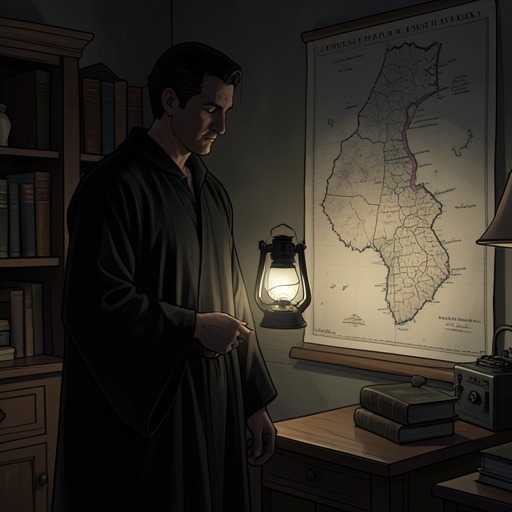
That movement toward cooperation takes a concrete form in the plan for a railroad from Shejidan to the west. Eleven regional associations agreed to build it without going to war over the undertaking. The number and the proposed route give material shape to the account’s larger claim: regional groups could coordinate across established divisions and pursue a shared project without repeating the violence that had shaped earlier relations. The railroad agreement also supplies an important contrast to the upheavals that follow. The mainland was already changing, but the arrival of the Foreign Star introduced a new and destabilizing scale of change.
Phoenix and the Wider History
In Bren’s commentary, the Foreign Star is identified as the human starship Phoenix. Its original purpose was to establish a station around a distant star. The ship carried the knowledge, machinery, seeds, and plans needed to create a temporary orbital base for four thousand colonists, who would construct and operate a station core and outer structure. A second ship was expected to follow with equipment for eventually bringing people down to a world and building a habitat there.
The expedition did not proceed as planned. The ship-folk believed that an accident had shifted Phoenix far from its intended course. They tried to determine their location by looking for navigational reference stars, but those stars were not where they expected them to be. Bren’s explanation gives the ship’s arrival an origin grounded in disorientation and failed expectation, rather than a deliberate plan to enter the Atevi world. It also clarifies the imbalance between the two societies: Phoenix carried extensive technical resources, while the meaning and consequences of its appearance had to be worked out in a world already governed by its own political arrangements.
Political Decisions and the Kyo Encounter
The history connects the revelation of the ship-folk’s deception to Tabini’s decision to investigate space. Tabini had already pushed the citizenry’s patience to its limits; learning what the ship-folk had confessed made him angry and suspicious that neither the Atevi nor Mospheirans had received the truth. He charged Bren, who knew humans, and Ilisidi, who would not be put off with lies, to discover the actual situation. He also sent his son, both to learn and to understand humans under the guidance of the woman who had taught Tabini himself.
The account characterizes this departure as a desperate gamble: those making the decision did not know the scale of the universe, the limits on communication across the distance, or how difficult and dangerous the undertaking would be. The later encounter with the Kyo shows how much depended on the people aboard Phoenix. The Kyo regarded the human station as an invasion and were prepared to destroy it; neither side initially had a working concept of negotiation with outsiders. Cooperation between Atevi and humans, Bren’s skill as translator and diplomat, Ilisidi’s standing, and the presence of Tabini’s young heir helped make communication possible. A Kyo who had come to communicate with the heir was particularly important to the exchange. The parties learned what the other wanted and agreed that the Reunioners would be removed from Kyo territory. Phoenix carried out that removal partly by force and partly with the population’s agreement; the library was stripped, and the population was transported away.
Return and Historical Consequence
The return passages bring the expedition’s political stakes back to the mainland. When Phoenix came back to the world, Ilisidi learned that Tabini had been overthrown. Lord Geigi urged an immediate departure, fearing that Earth-based telescopes would reveal the ship at the station and that their enemies on the planet would infer who might be aboard the returning shuttle. The shuttle he had kept ready carried Ilisidi, Tabini’s son, and Bren to Mospheira. With Mospheiran assistance they crossed to the continent, then travelled through Taiben with Taibeni help and continued into Atageini territory.
These episodes give the history a return structure without making the journey a simple homecoming. The voyage had produced new knowledge, a negotiated removal of the Reunioners, and an encounter with the Kyo; meanwhile, the political order at home had changed during the travelers’ absence. Lord Geigi’s account thus binds the history of the Foreign Star to the immediate problem of Tabini’s overthrow. Its paired voices and changes of scale make that connection legible: the history of contact is also a history of decisions made under uncertainty, and of the consequences those decisions carry back into Atevi politics.