Chiaki’s apartment
PiercingChiaki’s apartment is the central setting for the decisive shift in Sanada Chiaki and Kawashima Masayuki’s encounter: a meticulously maintained home becomes the site of concealed drugging, a violent struggle, and a discovery that changes how Chiaki understands the man beside her. Its ordered rooms and carefully tended objects stand in sharp contrast to the crisis that unfolds within them, while the apartment’s domestic routines—making soup, washing dishes, arranging belongings—become part of the action rather than a pause from it.
Setting and Arrangement
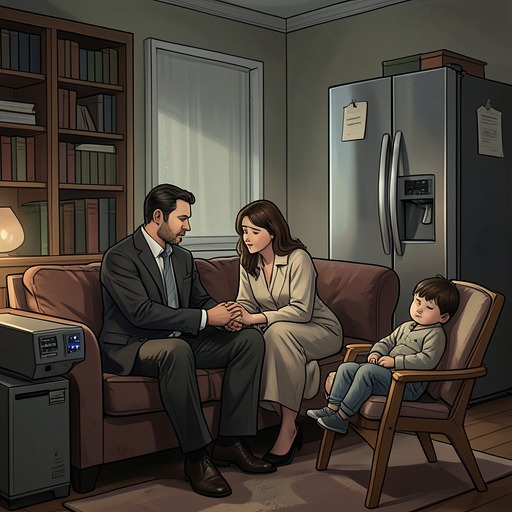
Kawashima takes in the apartment while seated at its two-person dining table, whose polished blond-wood surface reflects his image. He sees a space organized with unusual precision. The cosmetics on the dressing table are grouped by size and shape; the L-shaped sofa and audio rack sit at carefully measured distances from the coffee table; and the bookcase and audio rack contain items suited to their purposes rather than a scattering of everyday possessions. Small odds and ends are stored in translucent cases outside the kitchenette. There are no stray papers, open snack packages, or discarded tissues to interrupt the room’s order.
That discipline extends into the kitchenette. After making soup, Sanada Chiaki washes the bowl with very hot water and no soap, examining it against the light and repeating the cleaning when she sees even a slight mark. She then applies the same method to the enamel pan. To Kawashima, the apartment seems more like an immaculate model home than a lived-in place. The exception is the bed: its turned-back duvet reveals wrinkled sheets, whose irregular folds offer a striking contrast to the smooth surfaces and orderly placement elsewhere. The apartment is not merely clean; its arrangement makes disorder unusually conspicuous.
A Domestic Routine Becomes a Turning Point
Sanada Chiaki’s decision to prepare soup is shaped by her fear that Kawashima may leave. She remembers their earlier walk together and the taxi ride amid the lit skyscrapers, and worries that he will be disappointed and go. She responds by slipping Halcion into his food. The drug is concealed in a spice bottle labeled thyme, though the contents are crushed tablets; she adds extra curry powder because she fears the bitter taste might give away what she has done.
She mixes approximately two tablets into Kawashima’s serving. He eats the soup and two buttered rolls, unaware of the addition, and describes the meal as good. The apartment’s ordinary kitchen objects thus carry a concealed purpose: the bowl, pan, spice bottle, and meal belong to domestic routine, but here they also enable Sanada Chiaki to control what happens next. She expects the Halcion to affect him within about thirty minutes and to leave him asleep within an hour, though she knows that it may first increase a man’s sexual desire. Her plan is therefore driven both by her fear of his leaving and by her wish to avoid a renewed encounter that could recall painful memories.
As she cleans, Kawashima notices the room’s meticulous order and tries to understand Sanada Chiaki’s sudden change in manner. He also becomes increasingly suspicious that she has read his notes and inferred his plan. Twenty-five minutes after she carries away the empty bowl, he sees her watching him from the kitchenette and checking the time. His suspicion grows from specific details she appears to know, including that he is staying at a different hotel and did not contact her for the purpose he had presented. The apartment’s silence and carefully cleared surfaces provide a setting in which his attention fixes on what is missing from her explanations—and on the notes in his bag.
Altered Perception and Confrontation
After the Halcion takes effect, Kawashima experiences the room as trembling and his surroundings as closing in around him. The scene presents these sensations through his drug-affected perception; Sanada Chiaki, still in the apartment, initially does not appear to notice what he feels. He imagines himself being drawn into darkness and hears the voice of a woman from his past or the girl he once intended to kill. His disorientation is not a change in the apartment’s physical arrangement but a rupture in his ability to interpret the space around him.
Sanada Chiaki hears him call for Yoko, and the name provokes a sudden change in her response. She takes a manual can opener from the kitchen drawer and attacks him as he struggles to get up. The fight overturns the chair and scatters the drawer’s contents, breaking the apartment’s earlier visual order. The drug’s effects and the conflict coincide: Kawashima’s altered state shapes his perceptions, while Sanada Chiaki’s actions arise from the immediate encounter and the emotional force of hearing him call for someone else.
Kawashima eventually restrains Sanada Chiaki with the cord from the espresso machine and tries to make her believe that she can endure pain by refusing to acknowledge it. His insistence recalls his own rules for surviving pain and abuse, but in the apartment it becomes part of an attempt to control her. The kitchen and its appliances, previously associated with the preparation and cleaning of food, are drawn into the confrontation. The room’s ordinary functions do not protect either person from the violence taking place within it.
Discovery and Aftermath
Once Sanada Chiaki frees herself, she does not call the police. She searches Kawashima’s overnight bag and finds his notebook and a separate package containing a large knife. Reading the notebook from beginning to end does not settle whether its contents describe an actual crime or fantasies. It does, however, displace her earlier image of Kawashima as a man who might have come to rescue or worship her: she concludes that he may be a murderer or someone pretending to be one, but that he has treated her as a body to rent. The apartment becomes the place where she reads the evidence that forces this reassessment, even though the notebook leaves uncertainty about his intentions.
After sleeping, Sanada Chiaki wakes in the early daylight hours and finds Kawashima still unconscious, more than ten hours after he ate the soup. She puts away the cooking scissors and other utensils, disposes of the severed espresso-machine cord, and leaves the blood-caked can opener and the dishcloth in the sink to be washed later. Blood and coffee stain the carpet; she considers vacuuming but does not want to wake him, and recognizes that the carpet will need cleaning. The mess is specific and practical, a visible consequence she must manage inside the home whose surfaces she had previously kept so exact.
Kawashima’s wallet identifies him by name, and a photograph behind his driver’s licence shows him with Yoko, who is holding a newborn baby. Sanada Chiaki recognizes the woman as the person he had called for while drugged. She puts the ice pick, knife, wallet, and notebook together on top of his overnight bag. The arrangement gathers the objects that connect the night’s struggle to the plan she has just read, turning the bag into a compact record of what she now knows about her guest.
Significance of the Apartment
The apartment holds two sharply opposed forms of order. Sanada Chiaki’s precise cleaning and arrangement make the space appear controlled; the concealed Halcion, Kawashima’s notes and weapons, and the struggle expose how little that surface order can guarantee. The contrast is not simply between cleanliness and mess. Ordinary objects acquire new consequences as the scene develops: a spice bottle hides tablets, a meal becomes a means of incapacitating a guest, and an espresso-machine cord becomes part of the confrontation.
The apartment also contains competing understandings of the encounter. Sanada Chiaki has remembered intimacy and fears abandonment, while Kawashima is preoccupied with his plans and with whether she has deciphered his notes. Afterward, the notebook and photograph make those different understandings harder to sustain. The apartment’s transformation—from carefully arranged home, to site of conflict, to scene of cleanup and discovery—gives physical shape to the collapse of trust between them, without resolving what Kawashima intended to do or what their connection will become.