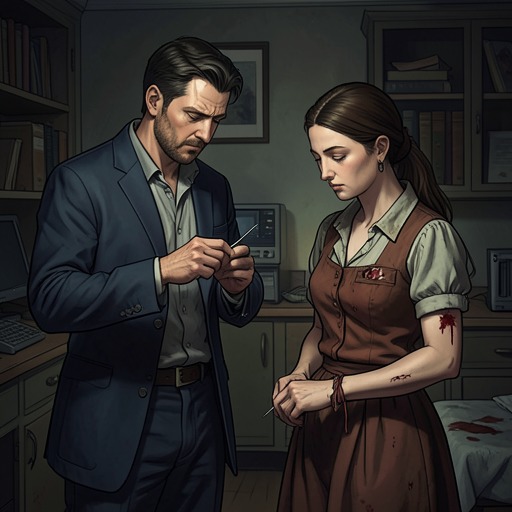
Kawashima's ice-pick stabbing of his former lover
PiercingKawashima’s ice-pick stabbing of his former lover is a formative act of violence that he remembers only in fragments. At seventeen, he became involved with a woman much older than himself; after she rejected him one night, his fear that she would leave became entangled with a need to punish himself and keep her close. The attack ended their shared life, but not its hold on his memory: he later dreamed of the ice pick and the apartment where it might have been left, while remaining unable to recall what happened immediately afterward.
Relationship and Background
Kawashima met the woman when he was seventeen and lived with her for nearly two years. She was nineteen years older, and strangers sometimes mistook them for mother and son. She worked as a stripper in Gotanda when they met, and during their time together changed clubs many times. The age difference and their domestic closeness formed the setting for an attachment Kawashima experienced as both painful and indispensable.
Their household was unstable. The woman brought men she had met at work back to the apartment and presented Kawashima as her younger brother. After the men left, she would attack him for not intervening, sometimes demanding that he fight or kill them; when he eventually did rough some of them up, she also berated him for jeopardizing her employment. Kawashima viewed her behavior with anger, yet believed that he alone could care for her and that she would therefore never leave him. That conviction helps explain the stakes he attached to her rejection, without making the later violence inevitable or excusing it.
The Night of the Stabbing
The episode took place after Kawashima returned to the apartment late at night, having sniffed thinner with a friend. His memory of the evening was already uncertain. A kerosene heater was burning, with a pot of water on top, while his former lover sat at a mirror removing her makeup. He tried to embrace her from behind. She pushed him away, and when he tried again, she rejected him more forcefully and objected to the fumes on his breath.
Kawashima understood her anger through the relationship’s established pattern of punishment and abandonment. He thought that he deserved punishment, and that if she was angry but did not punish him, she might leave. He acted against himself and showed her what he had done. She called him foolish and went to shower. Rather than reading her departure as temporary, Kawashima became convinced that she would leave the apartment and not return. His attention narrowed to the need to prevent that separation before she finished showering.
What followed was a sudden break in his awareness. Kawashima later recalled an abrupt sensory disturbance and then the ice pick in his hand as he entered the shower area and stabbed her. The narrative gives the act plainly but leaves its mental transition difficult to explain: fear, self-punishment, and the impulse to stop her departure converge, while the continuity of his memory fails. The scene is not presented as a considered plan. Its violence occurs within a relationship in which he had come to treat her continued presence as something he could not bear to lose.
Uncertain Aftermath and Recurrent Memory
Kawashima could not remember clearly what happened after the stabbing, including whether the police came. His former lover survived and returned from hospital, but she never spoke to him about the incident. He was not taken in for questioning. He moved out without being asked; when he returned to the apartment in the following weeks, she refused to see him, and eventually she moved away. The account leaves the formal circumstances of the aftermath unknown to Kawashima rather than resolving them through a clear explanation from her or the authorities.
The missing memory returned in dreams. Again and again, Kawashima saw the ice pick fall onto the bathroom floor and roll beneath the tub; in the dream he searched for it and burned his hand at the water heater. Sometimes he woke convinced that his hand was actually on fire. He believed the ice pick might still be under the bathtub, and imagined that one day he would go back to look. The object thus became a focus for a past he could neither fully remember nor regard as finished.
Later Recall and Significance
Years later, while walking to an all-night convenience store, Kawashima noticed a woman smoking at a window and began recalling his former lover. As the memories gathered, his heartbeat returned to normal; inside the store, however, an ordinary exchange between the clerk and arriving customers brought back his familiar sensation of being separated from his own body. The recollection therefore sits beside a larger pattern in which childhood experiences of abuse and dissociation return in the present. It does not establish that those experiences caused the stabbing, but it shows how the past remains active in his bodily and emotional life.
The episode also marks a limit in what Kawashima can tell Yoko. When he decided to disclose the secrets he had kept from her, he excluded the stabbing, both because his memory of it was vague and because he feared that telling her might drive her away. His later marriage to Yoko and the near-disappearance of his old panic did not erase the episode; its return belongs to the renewed crisis that had begun ten nights earlier. The stabbing matters not only as an act of violence against a former lover, but as a concealed and unresolved memory that complicates Kawashima’s sense of the safer life he had built.