Kawashima's intrusive fear of harming Rie
PiercingKawashima Masayuki’s intrusive fear of harming his daughter Rie begins with a thought he cannot resolve and develops into a nightly ritual at her crib. Its importance lies in the change from dread of an unwanted possibility to a dangerous attempt to master that dread through violence against another person. The story distinguishes the fear that he might harm Rie from the later decision to plan an attack, while showing how the first becomes entangled with the second.
The thought begins
Ten nights before the scene at Rie’s crib, Kawashima had finished bathing her and handed her to Yoko, who was waiting with a towel. As Yoko dried the baby and spoke to her, Kawashima sat in the warm bath, smiling at them. The sudden thought that he might stab Rie with an Ice pick interrupted this ordinary family moment. He became uncertain of himself and did not register Yoko’s calls until she had tried several times to get his attention. When he came back to the moment, he described himself as daydreaming, but his skin had turned to gooseflesh despite the warm water.
The thought unsettles him in part because it concerns a child he is caring for, rather than a threat he can locate outside himself. As Yoko’s pregnancy advanced and fatherhood became real to him, he had worried that the baby might inherit his insomnia, which had troubled him since elementary school. He understood sleep as essential to a newborn and feared the prospect of an infant who could not sleep. His concern for Rie’s wellbeing thus predates the violent thought; the thought does not arrive as an expressed wish to hurt her, but as a possibility that terrifies him precisely because he cannot dismiss it.
A nightly check at the crib
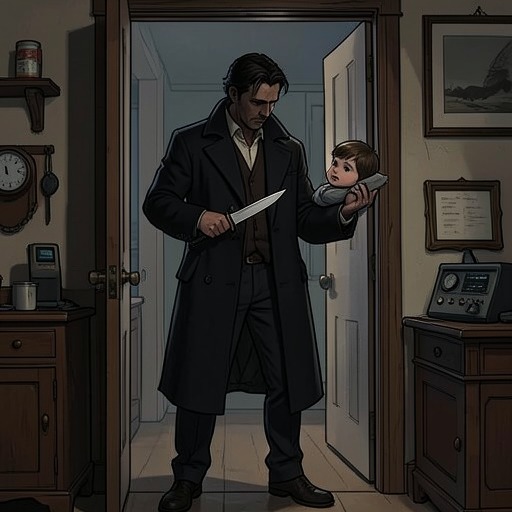
After the image of the Ice pick appeared, Kawashima could not get it out of his mind. He tried repeatedly to reassure himself that he would never stab Rie, but the reassurance did not settle the doubt. Instead, each night he found himself unable to go to bed until he had stood over her crib with the Ice pick, checking that he would not harm her.
The narration gives this ritual a precise setting and duration. Well after midnight, Kawashima shades a penlight with his palm so that it illuminates Rie while the rest of the bedroom remains dark. He silently confirms that she is asleep, then looks back at Yoko, whose regular breathing tells him she has not woken. This has become a repeated pattern: he has watched over the baby for ten consecutive nights while Yoko sleeps. The quiet domestic scene is therefore also a private test that he cannot finish simply by telling himself he is safe.
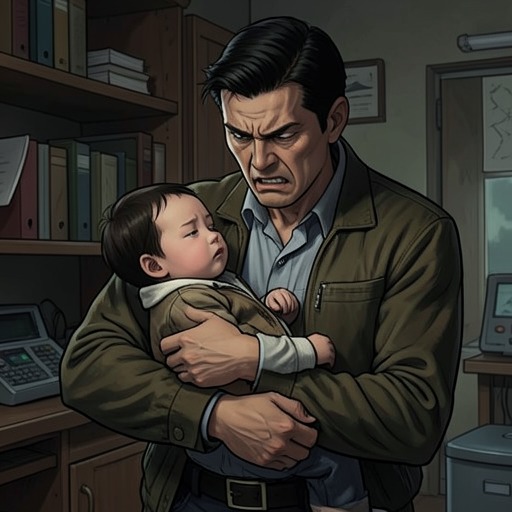
Kawashima’s response includes physical symptoms of acute distress. The fear is associated with sweating, exhaustion, prickling pain, and, at times, a white mist that clouds his vision. He tries to calm himself by recalling his decision not to stab Rie and by repeating that everything will be all right. These efforts offer him a way to endure the immediate anxiety, but they do not prevent the thought from returning or end his nightly checking.
From fear to a proposed solution
The decisive turn comes when Kawashima’s other self interprets his earlier experience of violence as evidence that stabbing someone else can overcome his fear. That voice connects the recollection of a woman he had stabbed with the temporary calming of his heartbeat and presents another attack as a way to relieve the anxiety about Rie. Kawashima absorbs this reasoning as a revelation. The shift is not that he has discovered that Rie is in danger from someone else; rather, his effort to answer uncertainty about his own thoughts is redirected toward a planned assault on another person.
After this turn, he begins to treat violence as a problem to organize. He decides that his intended victim must be a prostitute and weighs the location, the possibility of witnesses, and the risk that the victim might escape. He considers how to avoid identification and detection, including whether the victim would have a pimp or an office likely to report her missing. He also plans to restrain and gag her, reasoning that an attack would require control over the circumstances and the victim. The elaborate planning marks a consequential contrast with the earlier nightly scene: the Ice pick that had been present as the focus of a feared possibility is now incorporated into a deliberate plan against someone else.
Planning, control, and interruption
Kawashima’s planning extends to the setting and the people who might notice him. He rejects a love hotel because staff or a caller from a sex business might check on the room, and because its narrow entrance could impede escape. He considers regular hotels, where a registration card and the front desk could expose him, then tests how little attention he might attract. At the Keio Plaza Hotel, he arrives by hotel bus at the scheduled time on a busy Friday, when wedding guests and other gatherings crowd the lobby. The reception congestion allows him to check in with little scrutiny; he carries the Ice pick and other belongings in an ordinary-looking overnight bag.
These preparations show how far the original fear has moved from an involuntary thought. Kawashima now searches for predictability, trying to reduce the risks of a crime by anticipating staff behavior, witnesses, and police investigation. Yet the plan depends on circumstances he cannot fully control. At the hotel, after avoiding an elderly couple in the corridor, he sees Sanada Chiaki stagger out of room 2902. Her unexpected appearance interrupts his movement through the corridor and prompts him to hurry toward her once the couple has gone. The encounter illustrates the instability of his carefully managed setting; the available evidence establishes the interruption, not a resolution of his fear about Rie.
The episode’s central contrast is between Kawashima’s repeated efforts to confirm that he will not harm his daughter and his later effort to make another person the object of violence. The night ritual briefly gives form to his fear, but it does not dispel it. As his thinking changes, the same Ice pick shifts from an instrument he dreads using against Rie to an element in a calculated plan. The narrative therefore treats the fear and the planned attack as connected developments, not as identical states: the first is an unwanted and recurring doubt, while the later scheme involves deliberate preparation and a chosen target.