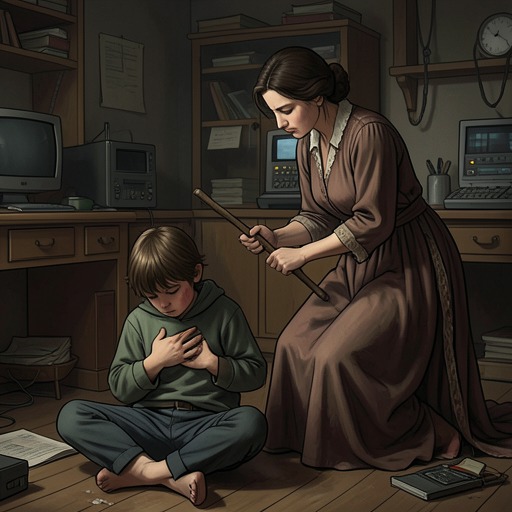
Kawashima’s rules for enduring abuse and pain
PiercingKawashima’s rules for enduring abuse and pain are a survival code Kawashima Masayuki recalls from childhood and later tries to pass on to Sanada Chiaki during a violent confrontation. Their central practices are to avoid apologizing or asking forgiveness, to endure an attack without treating it as defeat, and to look the other person in the eyes once the danger has passed. Later, Kawashima adds a technique of concentrating and believing pain can be made to disappear. The rules emerge as both a remembered source of protection and an instruction imposed on someone else in a moment of danger.
Origins and remembered voice
The rules return to Kawashima Masayuki as an internal voice while Sanada Chiaki is attacking him. He recognizes it as the voice that protected him when he was a child, and recalls its advice not to apologize, however much it hurts, because an apology would bring further punishment. The voice also counsels against asking forgiveness and says to wait until the attack is certainly over before looking into the other person’s eyes. In this framing, survival depends not on preventing harm but on enduring it without surrendering a sense of self.
The voice is not presented as an independent speaker. Kawashima Masayuki experiences it as coming from within himself, a voice he can trust because it has helped him through childhood. He says he has heard it less since meeting Yoko, though it had returned at the disposable-diaper shelf and again when he noticed Sanada Chiaki’s bandage. The confrontation brings the remembered advice into sharp focus: what had been a recurring, half-available presence becomes a guide to interpreting the immediate danger.
The rules of endurance
The first rule is a refusal of apology and forgiveness-seeking. In Kawashima Masayuki’s remembered logic, apologizing does not reconcile him with the person harming him; it risks inviting more punishment. The second rule concerns timing: do not mistake an ongoing attack for its final moment, but wait until it is over. Only then should he look into the other person’s eyes. The gaze gives endurance a measure of agency. If he can meet the other person’s eyes afterward, the voice tells him, he has not been defeated.
These instructions define endurance as something more than passive submission. They do not promise that suffering will stop, nor do they offer a means of changing the person responsible. Instead, they establish a narrow standard of survival that Kawashima Masayuki can control: withholding an apology, waiting, and choosing where to direct his attention once the immediate threat recedes. The distinction is significant because his childhood leaves him with few apparent choices, while the rules preserve a small but consequential judgment about what counts as defeat.
Pain, belief, and instruction
During the later confrontation, Kawashima Masayuki turns the remembered code into direct instruction for Sanada Chiaki. He tells her to believe that the pain is absent and not to doubt that belief, and gives her a way to direct her gaze by focusing as if looking at a three-dimensional image. He presents conviction and concentration as the secret to enduring what is happening. This extends the earlier rules: the internal voice had taught him how to withstand abuse, while he now tries to teach Sanada Chiaki a mental method for bearing pain.
To explain why he trusts the method, Kawashima Masayuki recounts experiences of abuse by his mother, including being subjected to painful punishment and intimidation. He connects those memories to the present by presenting what he learned in childhood as practical knowledge. His speech is impaired and fragmented, but Sanada Chiaki registers details from the account and nods when he asks whether she understands. Her gesture shows that she has heard him; it does not establish that she accepts his explanation or that the technique works.
Sanada Chiaki’s response and the rule’s limits
Later, while trying to escape, Sanada Chiaki recalls the instruction to believe she will not feel pain and to focus beyond what she sees. She attempts to follow it by staring at the ceiling, but cannot find a point beyond it on which to focus. The advice therefore reaches her as an immediate task, not as a reassuring principle she can readily make her own. Her effort is evidence that she remembers what Kawashima Masayuki said, not proof that she can control her pain or the danger around her.
The scene also places the rules under pressure through Kawashima Masayuki’s conduct. He invokes methods that helped him survive childhood while restraining Sanada Chiaki and directing her attention during the crisis. His account of endurance thus has two different positions: it is a resource he once used to withstand abuse, but in this encounter it becomes instruction delivered by the person controlling her. The rules may offer an inward means of surviving what cannot immediately be stopped; they do not make the present circumstances safe or undo the unequal power between them.
Narrative significance
The rules connect Kawashima Masayuki’s past to the confrontation without turning his childhood experience into an explanation that excuses his present actions. Their recurrence reveals how a private survival voice can shape his understanding of both pain and defeat. The voice steadies him after he is attacked, and he interprets his fading sense of pain as evidence of its power; Sanada Chiaki, by contrast, attributes his apparent painlessness to Halcion. The competing interpretations leave the method uncertain even as its psychological importance to him is clear.
The sequence also distinguishes remembering a rule from being able to use it. Kawashima Masayuki’s childhood voice returns with unusually clear authority, while Sanada Chiaki can recall his instructions but struggles to perform them. The advice about looking someone in the eyes belongs to a moment after an attack has ended; the later focus technique is offered in the midst of danger. Together, these rules show the limits as well as the force of the coping knowledge Kawashima Masayuki has carried forward: it can give suffering a private structure, but it cannot by itself end the threat or guarantee safety.