Hush! Be comforted!
Piranesi“Hush! Be comforted!” is a phrase of reassurance that first takes shape in Piranesi’s encounter with the Statue of the Faun, then recurs as he tries to trust the House despite his forgotten past. The movement from a gesture he once read as warning to one he understands as comfort marks a fragile change in how he responds to his own uncertainty.
The Faun’s Gesture and Piranesi’s Crisis
After reading entries that seem to expose how much he has forgotten, Piranesi recoils from the journal and walks away, troubled by the possibility that he had been mad when he wrote them. Words he cannot make sense of—Perugia, Nottingham, and university—echo in his mind as he feels pressure from ideas approaching consciousness, which might bring either further madness or understanding.
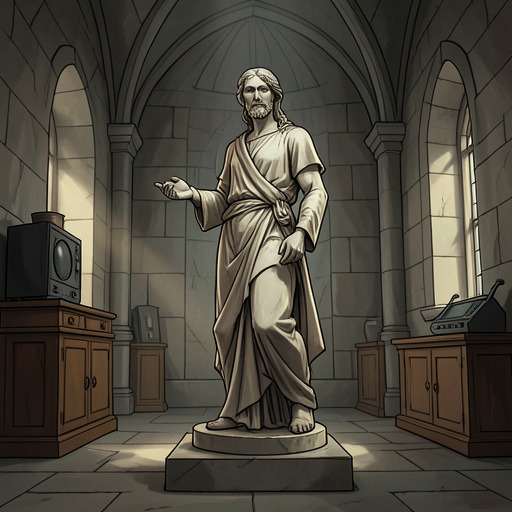
He then finds the Statue of the Faun, whose calm, faintly smiling face and finger pressed gently to its lips have long seemed to warn him to be careful. This time, the gesture means something different. Piranesi climbs onto the plinth, throws himself into the statue’s arms, and clings to its neck and fingers. He weeps for his lost sanity, his sobs rising painfully from his chest. In that bodily embrace, the silent gesture becomes a reassurance he can receive before he can resolve what his memories mean.
A Reassurance Taken Up Within
The words “Hush! Be comforted!” give language to the comfort Piranesi finds in the Faun’s gesture. The phrase does not explain whether he is mad, what his past entries mean, or why he has forgotten so much. Instead, it meets the immediate force of his distress: the statue’s familiar presence allows him to feel safe while uncertainty remains.
The reassurance later recurs in Piranesi’s internal exchange about whether he trusts the House. He answers yes, then considers that if the House has made him forget, it must have done so for a good reason. He admits that he does not understand that reason, but the answer he gives himself is that understanding is unnecessary: he is the House’s beloved child and can be comforted. The phrase thus shifts from a response associated with the statue to a principle through which Piranesi sustains trust in the House.
Meaning and Limits
The expression’s comfort depends not on recovered knowledge but on accepting that its absence may have a reason. That acceptance does not remove Piranesi’s confusion; he explicitly remains unable to understand why the House might have caused his forgetting. The phrase therefore offers consolation without proof or explanation, allowing reassurance and unresolved uncertainty to coexist.
Its recurrence also changes the force of the Faun’s gesture. What Piranesi had read as a warning becomes a sign of comfort, and the later self-address carries that interpretation into his relationship with the House. The phrase is both a response to the acute grief of confronting possible madness and a means of continuing to trust when his own memory cannot provide security.