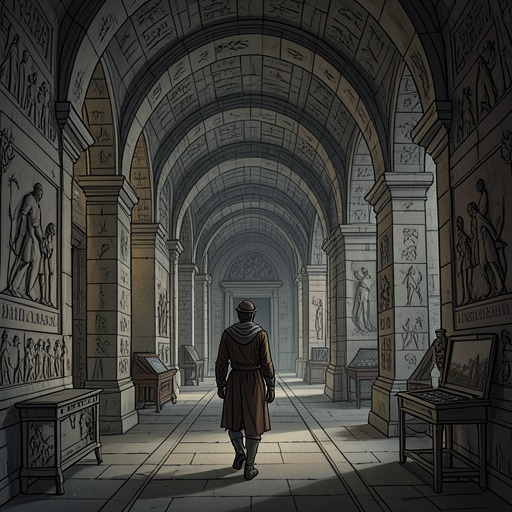
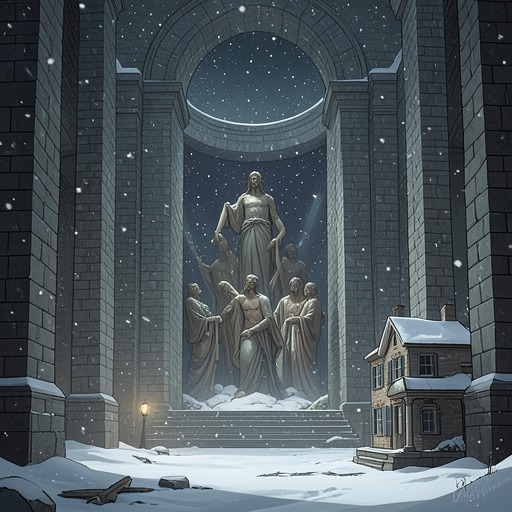
The Beauty of the House is immeasurable; its Kindness infinite.
PiranesiThe Beauty of the House is immeasurable; its Kindness infinite. is a recurring expression through which Piranesi joins aesthetic wonder to trust in the House’s care. First attached to a description of the world after the Joining of Three Tides, it returns when he confronts the House’s role in his forgetting and again in his final account of life beyond it. The refrain’s meaning therefore gathers force across changing circumstances: it begins in wonder, becomes consolation under the pressure of memory, and persists as a measure of what the House has meant to him.
First Appearance and the House’s World
The expression appears after the Joined Tides have swept through the surrounding halls. Piranesi hears them strike the walls with thunder and cracking sounds; in the Ninth Vestibule, the waters rapidly recede until they barely cover the plinths of the First Tier of Statues. When he opens his hand, he finds a marble finger from a distant statue, left there by the tides. The phrase follows this account in a journal entry titled “A description of the World,” dated to the seventh day of the fifth month in the year the albatross came to the south-western halls. Its placement makes the maxim an answer not to calm scenery but to a world of immense, shifting forces: the House’s beauty and kindness are affirmed amid the tides’ overwhelming passage.
Trust Amid Forgetting
Later, Piranesi considers studying his journal to understand what has happened to him, but acknowledges that reading it can trigger painful emotions and nightmarish thoughts. He intends to proceed cautiously, taking in only small portions at a time. The Other and the Prophet have both told him that the House causes madness and forgetfulness; reasoning that two learned authorities agree, he accepts their conclusion that the House is the cause of his forgetting.
The refrain then takes the form of an inward exchange. Piranesi asks himself whether he trusts the House and answers yes. He reasons that if the House has made him forget, it must have done so for a good reason, even though he cannot understand what that reason might be. The assurance that he is the House’s beloved child comforts him without explaining the loss or removing its distress. In this context, the expression is neither proof that the House has not harmed him nor a solution to the mystery of his memory: it is the belief through which he lives with what he cannot know.
Return Beyond the House
The sentence appears again near the end of Piranesi’s account, after he describes walking through a city park and recognizing people as figures represented in the House’s statues. A woman passes with two children; one holds a wooden recorder, recalling a statue of two laughing children, one carrying a flute, in the twenty-seventh southern hall. Outside the park, snow lies over a hotel courtyard, where orange paper lanterns tremble against racing grey clouds. The refrain follows this scene in which ordinary people and urban surroundings call the House back into view.
Its recurrence after Piranesi has entered the outside world preserves the expression’s double force. The House is associated with his forgetting and with painful memories, yet he continues to regard it as beautiful and kind. The repeated line does not erase that tension. Instead, its movement from a tide-marked journal entry, through an intimate attempt at self-comfort, to the close of his account makes devotion to the House one of the continuities connecting his life inside it with his life beyond it.