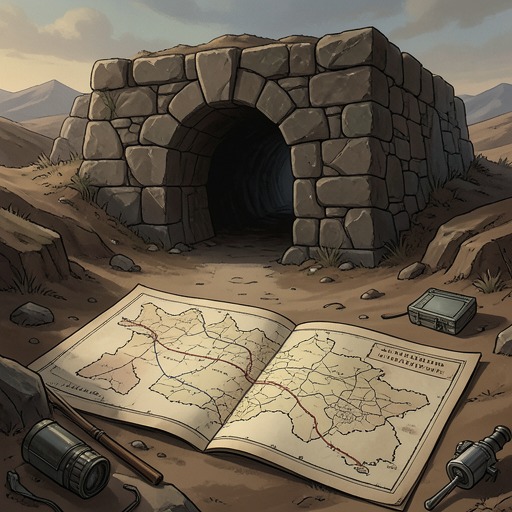
The world was constantly speaking to Ancient Man.
Piranesi“The world was constantly speaking to Ancient Man.” is the defining sentence of Laurence Arne-Sayles’s theory of an animate world, and its later reappearance in Piranesi’s journal turns that theory into a question about historical loss: Piranesi cannot understand why the sentence is written in the past tense when the world still speaks to him.
Arne-Sayles’s Theory of a Speaking World
In notes for a talk scheduled for the alternative-ideas festival Torn and Blinded in Glastonbury, 24–27 May 2013, Arne-Sayles argues that the Ancients related to the world as something that interacted with them. Their experience was not simply a human interpretation imposed on passive surroundings. A river carrying travellers was, in some sense, aware of bearing them and had agreed to do so; constellations were not merely patterns for organizing the stars but vehicles of meaning and an unending flow of information. The sentence gives this reciprocal perception its most concise form: the world speaks, and human beings can receive what it says.
Arne-Sayles’s more radical claim is that this dialogue occurred in reality, not only in the minds of the Ancients. The world was genuinely intelligible and articulate, and reality could be persuaded. Nature might bend to human desire or lend people its attributes: seas could part, people could become birds and fly or foxes and hide, and castles could be made from clouds. The examples extend the sentence beyond metaphor. If the world speaks, it can also answer and change.
Disenchantment and the Past Tense
Arne-Sayles explains the silence of the modern world as a historical transformation. The Ancients eventually stopped speaking and listening to the World; it did not merely fall quiet in response. The world itself changed, and the energies or powers that had communicated with humanity—whether named spirits, angels, demons, or something else—departed because they no longer had a place or purpose. Arne-Sayles therefore describes disenchantment as an actual event in the world, rather than simply a change in human belief.
Piranesi’s journal preserves the theory but resists its chronology. After rereading the account, he notes that it corresponds closely to what the Prophet said. Yet one sentence puzzles him: “The world was constantly speaking to Ancient Man.” He does not understand why it is in the past tense, because the World still speaks to him every day. The difference is not a rejection of the sentence’s central idea; it is a refusal to accept that its truth belongs only to antiquity.
The Sentence in Piranesi’s Journal
The sentence’s return makes it a point of friction between Arne-Sayles’s historical account and Piranesi’s lived understanding. In Arne-Sayles’s notes, the claim introduces a lost relation between humanity and the world. In Piranesi’s journal, it becomes evidence that the supposed loss may not be complete: he treats the World as an active interlocutor in the present.
That disagreement sits within Piranesi’s effort to read his old journal entries. He says he can remain calm before their obscure language and has begun, almost unconsciously, to read them as the writings of an oracle or seer imparting knowledge in a strange, difficult form. He considers whether he was in an altered state of consciousness when he wrote them, but the theory leaves unanswered how he entered that state and why he began the practice despite thinking of himself as a scientist. The sentence thus links his unsettled account of his own writing to the larger question of whether the world’s voice is a vanished historical possibility or a present reality.