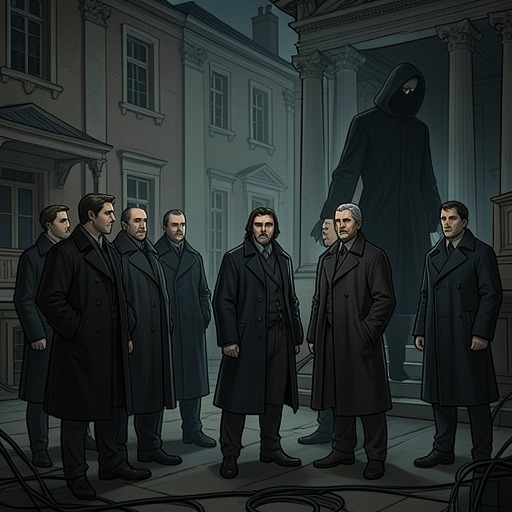
Chancellery
PleasureThe Chancellery is the royal house and governing center of Shadowdweller society, charged with turning victory in civil war into a durable political order. Under the twin heirs Malaya and Tristan, its authority is strong but not uncontested: the Senate can shape public pressure, succession rules expose the monarchy to demands over marriage and heirs, and the Sanctuary’s independent religious authority makes political control more complicated than royal command alone. The Chancellery’s postwar task is therefore both to rule and to make a divided society sufficiently cohesive that its authority can endure.
Identity and Position
The Chancellery is identified with the Shadowdweller royal house. During the civil war, Malaya and Tristan are the twin imperial heirs and the principal hope for the survival of their political cause. Their protection is organized around that shared responsibility: they stay in separate parts of a manor, each guarded by a designated bodyguard, so that an attack on one will not automatically expose the other. The arrangement makes the institution’s vulnerability plain. The heirs are not merely members of a royal family; their survival is treated as a condition for the society’s future leadership.
The Chancellery also exists alongside, rather than above, the Sanctuary. The Sanctuary is the Shadowdwellers’ religious house, and its laws and authority operate independently of both the royal household and common law. Acadian’s attempt to bring her daughter close to Magnus’s religious throne illustrates why that separation matters: control of the monarchy alone does not confer control over the city’s religious life. The account presents power as divided between institutions, with political unity dependent on more than the royal family’s command.
War, Security, and Political Consolidation
The civil war’s danger reaches directly into the heirs’ refuge when enemies discover the manor where Malaya and Tristan are hidden. Guin calls for help as fighting erupts nearby, and the twins follow the escape plan prepared for exactly this contingency: they are not to waste time searching for one another, but to reach safety separately. If one survives, the cause may still survive. This defensive logic reveals a Chancellery whose continuity has been protected through contingency planning as much as through formal authority.
After the fighting, the twins face a different problem: how to bind the population together without reopening the conflict. A broad pardon for acts committed during the war gives former opponents a clean slate, but it also limits what the monarchy can prosecute afterward. When Malaya asks why Acadian cannot simply be punished for what she did to Trace, Tristan identifies the abuse as a war crime and explains that the postwar amnesty prevents a trial for those wartime acts. Malaya considers treason and sedition instead, but recognizes that these charges require proof. The Chancellery’s pursuit of Acadian must therefore work within the settlement that helped reunify the people, even when that settlement obstructs justice for particular victims.
The Senate and Royal Authority
The relationship between the Chancellery and the Senate is neither straightforward parliamentary rule nor an absence of political pressure. During a debate over the marriage law, Malaya recites its wording accurately rather than allowing the Senators to catch her unprepared. The rule, she argues, is 1,846 years old and belongs to a time of rival clans and territorial enemies; with the twins securely established and direct challengers defeated, its original rationale no longer applies in the same way. Her command of the law turns an attempted imposition into a public demonstration of royal competence.
Malaya nevertheless offers to open the law to modernization rather than declare the debate closed. The Senate welcomes this opening because it allows the issue to become public discussion and gives the royal household a measure of the population’s opinion. The twins retain strong autonomy from both Senators and citizens, but they cannot disregard public sentiment altogether. In practice, the Chancellery’s authority includes deciding what to hear and what to enact, while accepting that the political consequences of refusing demands may spread beyond the Senate chamber.
Succession Law and the Marriage Debate
The old royal marriage law links a female ruler’s marriage to the security of the monarchy. It requires a proper mate to secure succession and strengthen her position against men or enemies who might see her as vulnerable to overthrow. The Senate presents this rule as a means of avoiding unrest, and later argues that arranged marriages historically helped preserve peace and advance Shadowdweller society. Its representatives bring Malaya a booklet of historical examples, set a one-year period for her decision, demand an heir, and propose that guardians be named in case catastrophe strikes the royal household. They also submit a list of men whom they consider suitable husbands.
Malaya’s response defends the Chancellery’s right to decide. She drafts a revision that makes the requirement gender-neutral: if an heir is considered essential, a monarch of either sex should bear responsibility for providing one. Her proposal would not impose the law until a ruler reached sixty without having chosen a partner, and it would leave final authority over the choice with the royal household. The Senate may offer advice, but Malaya rejects its claim to determine who is worthy of marriage. The proposal is presented for discussion, not as an enacted settlement, and the Senate’s attempt to gain power through succession policy remains a live political conflict.
Personal Choice and Institutional Stakes
The marriage debate becomes inseparable from Malaya’s relationship with Guin, whose fifty years of service have made him both her protector and a witness to the demands placed on her private life. The possibility that she might accept a Senate-approved marriage has already driven him away from her side for a time. When Malaya tells him she will publicly stand by her choice if he says he loves her, she offers marriage and the possibility that his children could become royal heirs. Guin asks whether she means to marry him and bear children for the throne; Malaya confirms that she does, and he embraces her.
The moment gives the succession dispute an intimate counterpoint to its institutional language. The Senate frames marriage as a means of securing the crown, evaluates candidates, and presses for an heir on a timetable. Malaya’s offer instead makes her own choice central, while still acknowledging that children could inherit the throne. For the Chancellery, succession is never only a private matter: it is a source of security, a point of pressure from the Senate, and a test of whether royal authority can accommodate personal commitment without surrendering the household’s right to choose.