“These things are there”
PossessionThe expression “These things are there” opens a passage in Randolph Henry Ash’s “The Garden of Proserpina,” published in 1861. Its quiet assertion makes the garden’s elements—tree, serpent, golden fruit, woman, water, and grass—seem already present, giving the poem’s mythic landscape the force of a found place rather than a merely imagined one.
Appearance in the Poem
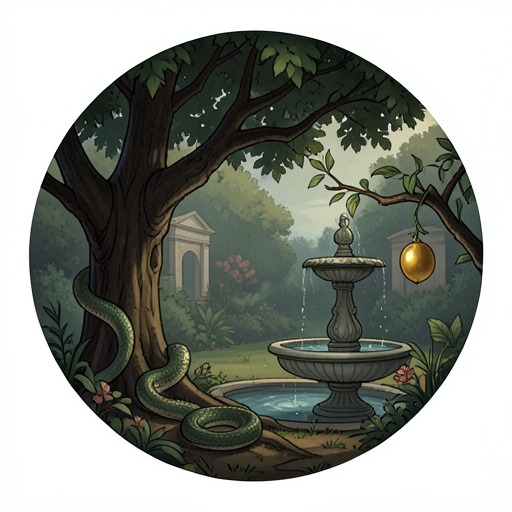
The phrase begins a short catalogue: the garden and its tree, a serpent at the tree’s root, fruit of gold, a woman beneath the boughs, running water, and a grassy space. The sequence moves from the broad setting to particular figures and objects, then to the water and ground that give the scene its physical shape. The opening line does not explain how these things came to be there; it simply asserts their presence.
That declarative form matters. “There” points toward a place the poem treats as available to perception, while “these things” gathers the scene into a set of recognizable, concrete elements. The wording makes the garden legible through things that can be named, without settling whether its reality is geographical, imaginative, or mythic.
Mythic Setting and Dispossession
The excerpt places a serpent beside a tree bearing golden fruit and a woman in its shade, combining familiar mythic imagery in a single garden. Its later lines bring in Herakles, who comes to dispossession and theft. The garden is therefore not only a scene of abundance: the poem also frames it through the possibility that what is there may be taken away.
The movement from the garden’s apparently stable inventory to Herakles’ arrival introduces a tension between presence and possession. The fruit is named as golden, but the poem’s reference to theft makes its value inseparable from vulnerability. The supplied passage establishes this contrast without specifying the full circumstances or consequences of Herakles’ act.
Attribution and Significance
The poem is attributed to Randolph Henry Ash and dated 1861. In this brief passage, the phrase functions as an opening declaration and as a principle of presentation: the reader first encounters a world made of things, then a mythic action that threatens their possession. The expression’s force lies in that double movement, from the certainty of presence to the prospect of loss.