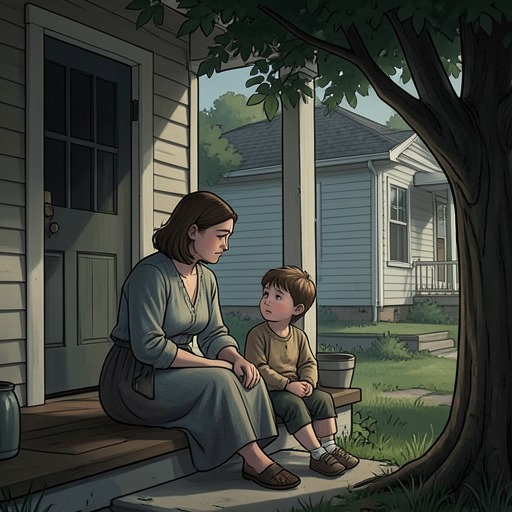
Queenie Jenkins and Sylvie
QueenieQueenie Jenkins and her mother Sylvie share a relationship shaped by early closeness, years of abuse within the family, and a later effort to rebuild trust without pretending that the damage never happened. Queenie’s memories initially frame Sylvie through her vulnerability and silences; counseling and a conversation about Queenie’s name allow her to see both the mother who once made a world with her and the woman who survived a life marked by violence. Their reconnection is practical as well as emotional, expressed through money, food, apology, and Sylvie’s support for Queenie’s counseling.
Early closeness and the arrival of Roy
Queenie recalls that she and Sylvie lived together in a tiny house in Mitcham before Roy moved in. They were intensely attached: Queenie remembers a shared world in which she could not go anywhere without her mother, and Sylvie could not go anywhere without her. In a later reflection, Queenie remembers that they wore matching outfits until she was eight. This intimacy gives their subsequent distance its force; the relationship did not begin in indifference, but in a closeness that Roy’s arrival disrupted.
Queenie describes Roy as mean from the start. He mocked her for not understanding his thick Jamaican accent and called her a bounty. When she tried to avoid his attention by not speaking to him, he shifted to other forms of cruelty: breaking her belongings, telling Sylvie that Queenie had insulted him or stolen from her, and making Queenie sleep in the car. Queenie recalls that her mother gradually stopped talking with her about anything beyond school routines, while the adults spoke to one another instead. From Queenie’s perspective, the household’s emotional world narrowed as Roy’s influence grew.
Roy later made Sylvie sell the small house, took the money, and bought another home for the family. Queenie remembers the new house by its garden and the demand that it be kept spotless. The move is part of a larger pattern in her account: decisions about the family’s home and daily life were controlled by Roy, while Queenie and Sylvie’s earlier private closeness receded. Roy’s abuse affected their relationship not only through his direct treatment of Queenie, but by diminishing the communication between mother and daughter.
Violence, separation, and delayed understanding
As Queenie explains to her therapist, Janet, Roy also cheated on Sylvie. His weekend absences were apparent to Queenie, while Sylvie said little, unwilling to disturb the relationship. When Sylvie eventually challenged him, she returned to the flat with a black eye and a split lip. Queenie’s memory of seeing the injuries is physically charged: as she tells Janet, her nails pierce her palm. The account makes clear that Sylvie’s silence was not evidence that nothing was happening; it existed alongside violence that Queenie saw but could not control.
For a time, Queenie lived mainly by herself in a flat, and Sylvie visited from time to time. Queenie insists to Janet that she could take care of herself, even as she tries to convince herself that the arrangement was fine. The account does not present this separation as a clean break between mother and daughter: Sylvie still came back, but Queenie’s childhood had already been shaped by Roy’s abuse and by the loss of the close companionship she remembers from the small house.
Years later, Queenie begins to reconsider the way she has understood her mother. When she tells Sylvie that she could do anything, Sylvie quietly answers that she is not like Queenie. Darcy Betts then asks why Sylvie chose the name Queenie. In response, Sylvie recalls growing up in a large Victorian house where her bedroom was beneath the attic, and looking out of its window imagining that someone would rescue her. She had loved stories of beautiful, delicate princesses; when she met Queenie’s father, she saw him as a prince who would rescue her. Sylvie adds that she did not know he was married when they met. Her memory reveals the hopes she carried into adulthood, without erasing the harm that followed.
The meaning of Queenie’s name
Sylvie explains that holding her newborn daughter changed the image of power she had inherited from fairy tales. Queenie gripped her finger, and Sylvie understood her as stronger and braver than the delicate princesses she had admired. She named her Queenie because she imagined a daughter who would grow up to be a queen. The name therefore carries Sylvie’s hope for her child: not a promise that Queenie would be untouched by harm, but an early declaration of her strength and worth.
Queenie’s response is a recognition of how much she had failed to see. She understands that the small, meek woman sitting in the armchair is also the mother who raised her, once stayed close enough to dress alike with her, and told her she was strong enough to be a queen. Queenie now sees Sylvie as someone men had battered mentally and physically until she struggled to find her voice. This does not turn the past into an uncomplicated story of devotion. Instead, it lets Queenie hold Sylvie’s tenderness and vulnerability together, and recognize that the mother she loves has also been harmed.
Reconnection through care and support
When Sylvie visits Queenie at her grandparents’ home, the aftermath of her situation with Roy remains present. She tells Queenie that he will not go to prison, and says she had been glad simply for the matter to be over. She gives Queenie a folded check, explaining that it can help with a deposit and several months’ rent so Queenie can find a place of her own rather than continue paying her way through manual labor. Sylvie moves to pat Queenie’s shoulder, then withdraws her hand and whispers an apology. The small, interrupted gesture conveys both her wish to comfort her daughter and her caution about doing so.
Queenie initially refuses the money, saying that Sylvie needs it more and describing her accommodation as a hovel. Sylvie corrects her: she is living in a hostel, has friends there, and feels safe. She calls it her port in the storm. The exchange shows that the practical support runs both ways. Sylvie offers Queenie the means to establish a home; Queenie, in turn, learns that her mother has built a refuge of her own and has relationships that help sustain her.
At dinner, Queenie apologizes for not asking how Sylvie is and reflects that children can forget their parents are people too. Sylvie explains that eating has become difficult: food seems to catch in her throat, and the prolonged process of seeing Roy has left her living on tea. Queenie suggests imagining a bird in the stomach, with its fluttering eased by feeding it. The image comes from Queenie’s own way of making sense of anxiety and eating, and she offers it as an attempt to care for her mother. Sylvie eats more, tells Queenie that she is caring, and Queenie recognizes that quality as something she may have inherited from her.
Sylvie also affirms the significance of Queenie’s decision to seek counseling. She tells her daughter that she has changed the family’s history by becoming the first person to attend counseling without being disowned by her parents, calling that achievement bigger than being the first Jenkins to go to university. Queenie jokes uneasily that she may also be the first in the family to be fired, but Sylvie answers with her own family knowledge of job losses and asks what happened at work. Her response treats counseling not as shameful but as a meaningful change, and keeps their conversation open even as Queenie faces difficulties of her own.
A relationship still being repaired
The renewed closeness between Queenie and Sylvie is neither instant nor complete. Queenie hides her disappointment when Sylvie’s visit does not immediately make her feel better, and their exchanges carry the weight of years when Roy’s presence separated them. Yet Queenie’s effort to forgive, her apology for not asking after her mother, and her readiness to offer care at dinner mark a change in how she sees Sylvie. She no longer sees only the mother who could not protect her from Roy; she also sees a person shaped by fear, longing, and survival.
Sylvie’s contribution to that change is not a single explanation or a perfect repair. It comes through telling Queenie how she chose her name, acknowledging difficulty with an apology, sharing money she could use herself, and recognizing the courage involved in counseling. Together, these moments recast their bond as something they can continue to make: an inheritance of affection strained by violence, but not exhausted by it.