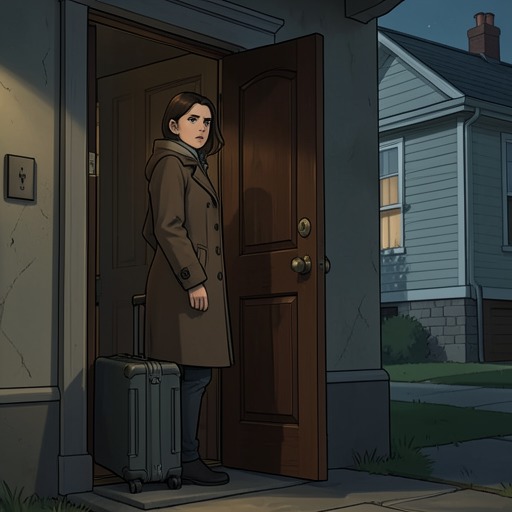
Queenie Jenkins and Veronica
QueenieQueenie Jenkins and Veronica have a close but often strained grandmother-granddaughter relationship in which care is expressed through food, hands-on attention, and family loyalty, while emotional suffering is frequently met with demands for endurance. Veronica’s own history helps explain her belief that hardship must be borne rather than treated, but the relationship changes as Queenie Jenkins’s need for help becomes impossible to dismiss. Its movement is not from conflict to perfect agreement: it is from care constrained by inherited ideas about strength toward a more practical, openly affirming form of support.
Early Bond and Everyday Care
Veronica’s care appears in ordinary family routines as much as in moments of crisis. In a childhood memory at a Jamaican bakery, she chats easily with the shopkeepers, buys a large assortment of baked goods, and has Queenie Jenkins help carry the bag. The exchange is warm and familiar, though Veronica also objects when the shopkeeper’s remark about her not being around forever strikes her as morbid. This early scene establishes both the closeness of their shared world and Veronica’s discomfort with openly dwelling on loss.
As an adult, Queenie Jenkins returns to her grandparents’ home when her life is unsettled. The house is a place of family authority and practical refuge: Veronica asks after Tom by referring to him as Queenie Jenkins’s former friend, and the question makes clear that she has noticed the separation. Yet her way of addressing it is blunt rather than consoling. Veronica tends to frame private distress through a direct question or a practical response, not through a long conversation about feelings.
That directness can make Queenie Jenkins feel unseen. When Veronica detects that something is wrong, Queenie Jenkins initially denies it, then mentions a headache. Veronica rejects that explanation and guesses that the problem concerns the white man Queenie Jenkins has been seeing. She urges her granddaughter not to remain sad, drawing on her own experience of becoming pregnant with Maggie at fourteen. The advice reveals concern, but it also reduces Queenie Jenkins’s particular pain to a hardship that should be overcome. Veronica’s care and her dismissal of distress are intertwined: she notices, asks, and tries to intervene, but expects resilience to do much of the work.
Heartbreak and Veronica’s Hidden Past
The most intimate exchange between them takes place during a bath. Veronica enters to wash Queenie Jenkins’s back, insisting on a form of care she had provided when her granddaughter was a baby. Queenie Jenkins resists being treated like a child, but eventually lets Veronica scrub her back. The physical gesture makes room for a conversation that Veronica’s usual brisk advice has not allowed: she tells Queenie Jenkins that she, too, knows heartbreak.
Veronica recounts that her future husband, Wilfred, got her pregnant at fourteen and then disappeared, leaving her in Jamaica with Maggie and her grandmother. During that absence, she fell in love with Albert, a kind man who helped her carry sugarcane and cared for both her and Maggie. Their relationship was secret because Veronica feared shaming her grandmother again. Albert made her a gold necklace bearing the initial V, and Veronica remembers him as funny, generous, and attentive. When Wilfred returned after finding work in London and saving money in a bedsit in Mitcham, he took Veronica and Maggie with him. Veronica never learned what became of Albert because no one knew about their relationship.
This disclosure complicates the stern advice Veronica gives Queenie Jenkins. Her account shows that her own life included abandonment, a concealed love, and an unresolved loss; her insistence that people must learn to live with heartbreak comes from experience, not from an absence of it. But the story also makes the difference between their generations visible. Veronica offers her past as evidence that Queenie Jenkins can survive pain, while Queenie Jenkins needs that pain to be recognized as real before survival can feel possible.
Veronica’s tenderness continues after the bath. When Queenie Jenkins wakes from a nightmare, unable to call out at first and then falling from the bed, Veronica comes quickly into the room. She recognizes the episode as a nightmare, points her granddaughter toward the glass of water beside the bed, and returns to her own room. The response is brief, but it joins practical care with attentiveness: Veronica knows what has happened without requiring Queenie Jenkins to explain it.
Conflict over Therapy and Family Duty
That attentive bond does not prevent a serious conflict when Queenie Jenkins seeks professional help. After a nurse refers her for psychotherapy, a letter bearing a National Health Service heading brings the issue into the household. Veronica tells her to close her dressing gown around Wilfred, then confronts her about the referral. Queenie Jenkins tries to explain that she feels ill, has a weight on her chest, and has lost her job. Veronica counters with the pain she herself has carried and imagines how her own mother would have reacted to psychotherapy. She treats seeking help as a source of shame and insists that Queenie Jenkins is not going.
Veronica’s response draws on the family’s history as well as her own habits of endurance. She points to Sylvie’s circumstances after Roy abused her and took her money, arguing that Sylvie has not sought psychotherapy either. She also tells Queenie Jenkins that she lost her job because she could not hold herself together. The exchange places family suffering and responsibility at the centre of the disagreement: Veronica sees Queenie Jenkins as living under her grandparents’ roof and believes she must keep going; Queenie Jenkins is trying to say that she cannot recover simply by being told to be strong. Veronica’s authority in the home makes the conflict consequential, not merely a difference of opinion.
The disagreement is especially sharp because Queenie Jenkins has already been suspended after Ted Noman’s complaint. Gina explains that the workplace cites the complaint, Queenie Jenkins’s existing warning, her lateness and distraction, and her failure to complete work responsibilities. These pressures help explain why Queenie Jenkins is in crisis, but they also show the limited space available to her: at work her conduct is being judged, while at home her request for treatment is initially rejected. Veronica’s attempt to enforce resilience therefore adds to the strain even as it comes from concern about family survival and respectability.
Support in Crisis and Return to Work
Veronica’s position is not fixed. When Queenie Jenkins has a difficult turn during therapy, Janet contacts her grandmother as next of kin. Veronica is on her way to collect her, and Janet arranges a cab so she will not have to navigate public transport. Janet calmly tells Queenie Jenkins that she is an adult who chose therapy and that her family appears to have accepted it. Veronica’s arrival makes support concrete: despite the earlier confrontation, she comes when Queenie Jenkins needs help getting home.
At Queenie Jenkins’s twenty-sixth birthday, Veronica gives her an unsealed envelope containing twenty pounds and recalls how much hair she had as a baby. Her attention to the small rituals of family life sits beside her insistence that Sylvie attend the birthday gathering. Although Queenie Jenkins asks whether her mother has been invited, Veronica says she will not withdraw the invitation: Sylvie remains her daughter and Queenie Jenkins’s mother, whatever mistakes she has made. This decision shows Veronica maintaining family ties without pretending that the past has been uncomplicated.
When Queenie Jenkins prepares to return to work, Veronica adjusts the lapel of her coat and tells her she looks smart. She compares her granddaughter to her own mother, a proud woman who first came to visit her, and urges Queenie Jenkins to make her proud. The encouragement carries pressure, but it is also an unmistakable recognition of the return as a meaningful step. Veronica has not become an advocate for therapy in every respect; rather, she increasingly meets Queenie Jenkins’s recovery through acts of accompaniment, care, and expectation that she can move forward.
Recognition and Significance
The relationship’s later warmth is reinforced by the wider family. As Queenie Jenkins prepares to leave her grandparents’ home, Wilfred admits that he had feared she would end up like Sylvie after seeing the fear and resignation in her eyes. He recognizes that she did not let those circumstances take her, and calls her full of fight. Diana then reassures Queenie Jenkins that her own mother’s pride is genuine. These acknowledgments do not erase Veronica’s earlier opposition to treatment, but they place her care within a family beginning to name what Queenie Jenkins has endured and what she has managed to do.
Veronica’s relationship with Queenie Jenkins is therefore defined by a productive tension between protection and control. She notices distress, feeds and tends to her granddaughter, responds to a night terror, comes to collect her, keeps her connected to Sylvie, and expresses pride in her return to work. At the same time, Veronica’s own history has taught her to treat endurance as the proper answer to pain, and that belief first makes Queenie Jenkins’s request for psychotherapy a source of conflict. The bond matters because its care is real without being uncomplicated: affection is present before understanding catches up, and support can take the form of both a closed door and a hand adjusting a coat before Queenie Jenkins goes back out into the world.