Queenie Jenkins and Sylvie’s Mother-Daughter Relationship
QueenieQueenie Jenkins and Sylvie’s Mother-Daughter Relationship is marked by an absence that neither woman can simply undo: Sylvie knows she left her daughter alone, while Queenie protects herself by refusing her mother’s attempts at comfort. A Christmas visit brings their distance into the same room as Sylvie’s remorse. Queenie hears that remorse, and is moved by it, but does not yet turn it into reconciliation.
Family Background and Separation
Queenie Jenkins sees a sharp contrast between her own appearance and Sylvie’s. Sylvie is light-skinned, with long, soft, loose curls, hazel eyes, and a small, delicate frame. Queenie is darker, with nearly black eyes, and resembles her father. Family members had whispered that, after Sylvie was born, Wilfred accused Queenie’s grandmother of having an affair. The account offers this as family history and rumor, not as an established explanation of Sylvie’s appearance.
The deeper fracture is not appearance but separation. Sylvie later admits that she left Queenie alone and regrets having been controlled by Roy. She explains that after Queenie’s father left, she feared being alone and believed Roy was the answer to that fear. Another family member describes Roy as manipulative. Sylvie’s explanation gives context to her choices, but does not erase their effect on Queenie: she understands that she abandoned her daughter and that both of them still live with the consequences.
A Christmas Encounter
The estrangement is set against Queenie’s efforts to remain connected to Tom. In the week before Christmas, she repeatedly tries to reach him: she asks to meet so she can give him his present, leaves a gift at his office after he does not respond, and asks whether she may call his mother on Christmas Day. When no reply comes, she spends Christmas with her grandmother, who is glad to have her back after three years away. The family’s attendance at midnight mass places Queenie among relatives, but does not make the gathering easy or intimate.
At the crowded church, Queenie arrives with Diana, Maggie, Wilfred, and her grandmother. Sylvie appears late and awkwardly takes a place at the end of their bench. Queenie makes room for her, but the exchange stays quiet and restrained: Sylvie expresses surprise at seeing her there, and Queenie answers while facing forward. When Queenie finally looks at her mother, she registers their physical differences in detail. The scene lets recognition happen without suggesting that familiarity has returned.
Care, Touch, and Withdrawal
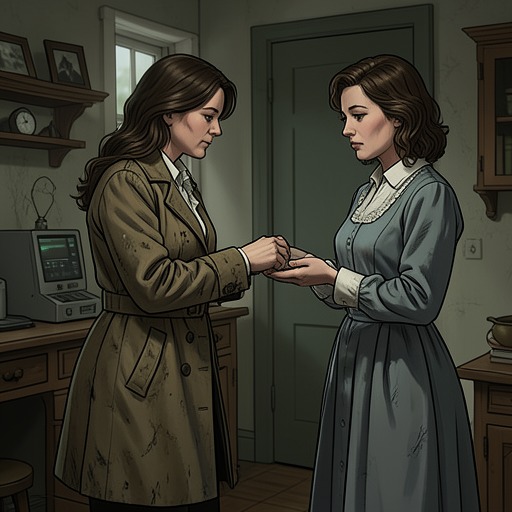
The following day, Sylvie comes to Queenie’s bedroom because she wants to speak with her properly. She asks how Queenie is doing and tries to touch her leg. Queenie sharply moves away, and Sylvie immediately withdraws her hand and apologizes, acknowledging that Queenie dislikes being touched. The small exchange makes their difficulty concrete: Sylvie reaches toward her daughter, but Queenie experiences even a gentle gesture as something she must refuse. Sylvie does not insist on contact.
Sylvie tries a different form of care by telling Queenie that it is permissible to suffer and be in pain. Queenie answers that she is fine, calls her mother by her name rather than a familiar maternal address, and turns toward the window so she cannot see how much that choice hurts Sylvie. Sylvie recognizes the performance, telling Queenie that this robotic manner is unlike her. The scene sets Sylvie’s growing ability to see past Queenie’s composure against Queenie’s determination not to be seen in that moment.
Sylvie’s Remorse and Queenie’s Response
Later, Queenie overhears Sylvie and Maggie talking in the front room. Maggie describes Queenie as tough; Sylvie objects, thanks Maggie for looking after her when she could not, and insists that Queenie is good at pretending. She says that she let her daughter down and should have been a better mother, imagining that Queenie might then have been better able to care for herself. Maggie urges her to move forward with Queenie and rebuild their relationship, reminding her that their former closeness has not necessarily vanished. Sylvie’s fear that it may have vanished shows that she cannot assume forgiveness simply because she now wants to repair the bond.
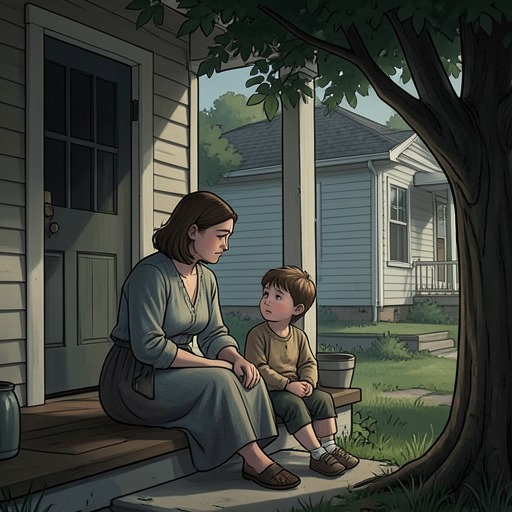
In a further part of the conversation, Sylvie explains that fear of being alone after Queenie’s father left made her vulnerable to Roy’s influence. She weeps over having abandoned her daughter and says she loved Queenie. Wilfred then draws Queenie away, telling her the conversation is for the adults. Queenie refuses to feel sorry for Sylvie, reasoning that her mother made mistakes and that both of them must live with them. But she wipes away her own tears before returning upstairs. Her response holds anger and feeling together: hearing Sylvie’s regret affects her, without cancelling the injury or obliging her to comfort her mother.
An Unresolved Bond
The relationship’s Christmas scenes offer neither a clean reconciliation nor a simple rejection. Sylvie’s remorse is explicit, and her attention to Queenie’s distress is more perceptive than Queenie’s guarded answers allow her to show. At the same time, Sylvie’s understanding comes with an admission of past failure, not a repair already completed. Queenie’s retreat, her use of Sylvie’s name, and her refusal to feel sorry preserve the boundary between hearing an apology and being ready to forgive.
The narration makes that tension especially clear by letting Queenie overhear her mother’s private confession rather than turning it into a direct exchange between them. The reader hears Sylvie name her guilt, while Queenie is pulled away before she can respond. Her tears reveal that the conversation has reached her, but they do not settle what she will do with what she has heard. Their bond remains defined by both love and abandonment, with the possibility of rebuilding raised by Maggie but not yet realized.