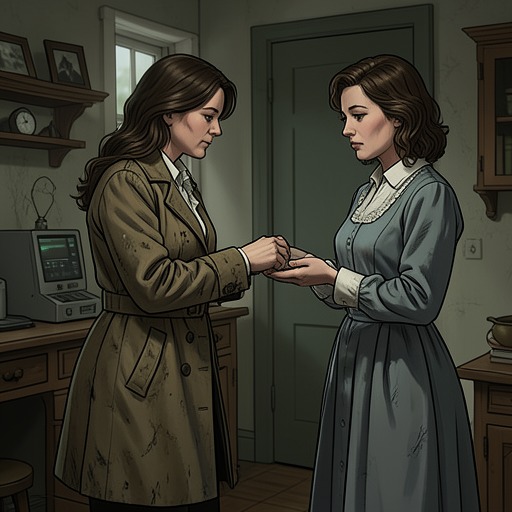
Queenie and Sylvie reconnect at the birthday party
QueenieQueenie and Sylvie reconnect at the birthday party when a story about Queenie’s name turns a tense family gathering into an opening for renewed understanding. The event matters less as a complete reconciliation than as a change in how Queenie sees her mother: Sylvie’s account restores a history of tenderness and hope that Queenie’s present-day view of her had obscured.
Arrival and unease
The reunion begins after Queenie and her cousin Diana return to her grandparents’ house. The conversation on the walk has centered on Diana’s complaints about her religious upbringing, but inside, Queenie notices three extra pairs of shoes and hears voices from the front room. Darcy Betts emerges carrying a bright pink birthday balloon, and Maggie follows with a gift bag. Then Sylvie appears, holding a cake with candles, only half of them lit.
The welcome is affectionate, but it does not immediately feel easy. Queenie’s stomach tightens, and she wants to retreat to the attic she remembers as a safe place. The contrast is significant: a room prepared to celebrate her birthday brings not simple pleasure but the pressure of attention and family closeness. Sylvie is present, yet Queenie initially responds to that presence by wanting distance.
The gathering also takes place within a wider period of strain. After her separation from Tom, Queenie had been drinking at a party while Darcy Betts and Fran gathered friends to create an OkCupid profile for her, despite her reluctance. In another encounter, she tried to avoid returning alone to an empty bed and set limits for a casual fling, but the situation did not respect those limits. At work, Ted Noman’s complaint led to Queenie’s suspension, while Gina criticized her lateness, distraction, and difficulty completing assigned work. These episodes establish a life in which intimacy, safety, and a sense of competence have all become unsettled; they do not explain the birthday scene away, but clarify why welcome and attention can feel difficult to receive.
The story behind her name
Darcy Betts asks Sylvie why she chose the name Queenie. Sylvie answers by recalling her own childhood wish to be a princess. She describes growing up in a large Victorian house, where her bedroom was near the attic, and says that when she was young she imagined herself as a princess. Queenie recognizes the room as the haunted attic, connecting her mother’s account to a place already familiar in her own life.
Sylvie then remembers meeting a man she thought had come to rescue her. She recalls his dark skin, his records, the concerts he took her to, and the gold tooth that showed when he smiled. Queenie interjects that he is not charming, but Sylvie and Darcy remain absorbed in the story. When Sylvie became pregnant, she imagined that the child she had longed for was finally there: the princess she had dreamed about. She had decided that this would be her daughter’s name.
The name changed meaning when Sylvie held her newborn daughter. Queenie grasped her mother’s finger tightly, and Sylvie saw not a delicate princess but a child with power of her own. She decided that her daughter would grow up strong and brave, and named her Queenie. The account turns the name from a decorative royal image into Sylvie’s expression of belief in her child. It also reveals that the name was chosen in a moment of intimate recognition, not simply as a continuation of Sylvie’s childhood fantasy.
A changed view of Sylvie
As Sylvie speaks, Queenie reconsiders the mother she has been seeing in the present. She had thought of Sylvie as small and meek, a woman who seemed nearly swallowed by the armchair. Now she recognizes her as the same person who began raising her, was so absorbed in her that they wore matching outfits until Queenie was eight, and repeatedly told her she was strong enough to be a queen. That remembered closeness does not erase the damage Sylvie has endured. Queenie understands her mother as someone battered mentally and physically by men, and as someone whose voice has been diminished, while still recognizing her as her mother.
The shift is not presented as a sudden resolution of everything between them. Queenie had already been trying to practice forgiveness, but the story gives that effort something concrete to attach to: Sylvie’s memory of the baby’s hand closing around her finger, and her hope that her daughter would be brave. Queenie’s response moves from defensiveness toward recognition. Darcy’s tearful reaction underscores the emotional force of the account; Queenie draws her out of the room before Darcy’s crying becomes her own. The moment remains vulnerable rather than triumphant.
The name also resonates with the expectations Queenie carries about strength. Her mother once used the idea of a queen to tell her she was strong enough, while Queenie’s adult life has made strength feel like an obligation imposed on her. In therapy, she describes the constant burden of being read through racialized stereotypes and the fear that she cannot be loved without rejection tied to who she is. Against that wider struggle, Sylvie’s naming story offers an earlier, more personal meaning: a mother looking at her daughter and seeing power in her, rather than demanding that she prove it.
A small acknowledgment
After the gathering, Queenie rereads Sylvie’s birthday card in bed. The card notes that Sylvie has heard Queenie is in therapy and regards that as a good thing. Queenie replies by text: “Thanks for my card, Mum. It was nice to see you today. X” The message is brief, but it records a change that the earlier wish to escape could not have conveyed: Queenie can acknowledge that seeing her mother was good, even without claiming that their difficulties are over.
Outside, Diana waters the plants, and the balloon Darcy brought drifts farther away. These details give the scene a quiet ending rather than a declaration of permanent repair. Queenie and Sylvie have not settled every wound; instead, Queenie has heard a story that lets her see her mother’s former affection alongside her present fragility. The birthday gathering becomes a first step toward closeness because it makes room for both truths at once: Sylvie has been diminished, and she once looked at her daughter with profound hope.