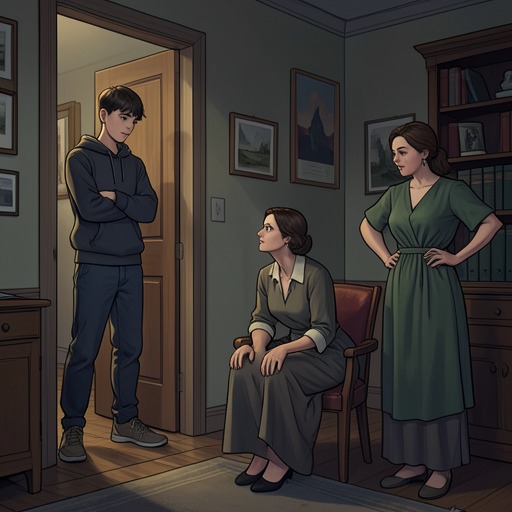
Queenie moves in with her grandparents
QueenieQueenie moves in with her grandparents after leaving the damp, crumbling house in Brixton, trading a home she had endured for a family household she expects to help her recover. The move’s decisive tension lies in the gap between that expectation and what follows: instead of quiet and rest, Queenie meets early mornings, chores, and a demand to keep going even as she feels ill. The new address offers care and shelter, but does not immediately feel like safety.
Departure and Expectations
With everything packed into Eardley’s van, Queenie walks down the steps of the Brixton house and leaves its key on the kitchen table. She thinks she will not miss the place; what surprises her is not that she is leaving, but that she lasted there as long as she did. The description of the house as damp and crumbling makes the departure a material break as well as a change of address. Yet her initial certainty does not hold. Days later, she admits to herself that she misses it once the reality of living with her grandparents sets in.
Queenie arrives with a clear, modest picture of what recovery will look like: sleep, rest, quiet, and food. Instead, the first night is sleepless. She tosses and turns until dawn, worrying that her life is over and measuring the indignity of her situation against her age: she is almost twenty-six and has moved in with her grandparents. Her fear is not simply about where she sleeps. The move makes her feel that her adult life has stopped, while the home she has entered imposes a new daily routine before she has found her footing.
The Household’s Terms
The morning begins after Queenie has only just fallen asleep, around five. Her grandmother comes into the room and orders her up, tells her to make the bed, and directs her to serve the porridge on the stove. The brisk sequence leaves no transition from night-long worry to morning activity: Queenie jumps up, unsure what to do first, while her grandmother is already moving through the household’s demands. Her exhaustion is physical and immediate, and the porridge, rather than being a quiet comfort, is something she is hurried to dish out for everyone.
The chores soon become explicit. After bathing, Queenie is expected to vacuum, take sheets to the launderette for a service wash, and use the trolley on the way back to pick up groceries from Brixton Market. Her grandmother has already put the sheets in the porch trolley and promises to give her a shopping list. Queenie objects that she came to rest, not to take on housework. Her grandmother answers that Queenie has working arms and legs and must help if she is going to stay there. The exchange defines the terms of residence as her grandmother sees them: shelter comes with participation, while Queenie’s account of being unwell does not persuade her that the work should stop.
Queenie attempts to negotiate by postponing the bath until after the chores, but her grandmother insists that she wash first. The argument turns on the household’s own practical and social logic: her grandmother invokes the possibility of Queenie being hit by a car and taken to hospital in dirty clothes, and warns that the hot water will be turned off in ten minutes. Queenie agrees to do what is asked but draws a boundary around Sunday church, the one demand she refuses in that exchange. Even that limited assertion does not give her the rest she came for; she goes upstairs with a spoonful of porridge still in her mouth and tries to return to bed, only to be told not to.
The Bath and the Panic Attack
In the bath, Queenie tries to imagine that the move is temporary and that the next day will bring her back to work and ordinary life. She carefully keeps her headscarf dry as she lies back in the water, attempting to make the moment a refuge from the upheaval. The effort to picture herself elsewhere instead gives way to a sudden panic. She sits upright, feels unease spread through her body, cannot make her legs obey, and experiences a pounding heart and blurred vision.
Queenie tries to call for help but cannot draw enough air to get the word out. She hyperventilates until the water turns cold. Her grandmother’s response, when she calls from outside, is to hurry Queenie along because the sheets still need to be taken out. When Queenie shows her shaking hands and says she feels strange, her grandmother compares it with shaking she experienced after giving birth to Queenie’s mother and tells her to get out of the bath. The episode exposes how sharply their readings of distress diverge: Queenie experiences a frightening loss of bodily control, while her grandmother answers through her own history and the continuing demands of the day.
The First Fortnight
The move does not quickly settle into the restorative stay Queenie had imagined. Two weeks pass in a cycle of chores, feeling very ill, refusing phone calls, and ignoring messages. She panics silently so that her grandparents will not see what she regards as weakness. The silence is consequential: although she is living among family, she keeps her distress from them rather than finding relief in the new household. Her surroundings have changed, but the burden of managing what she feels remains largely private.
The move therefore marks an unstable threshold in Queenie’s life. Leaving the Brixton house ends one period of residence, but the arrival at her grandparents’ home does not resolve her crisis or restore the normal life she imagines. Its daily details—the porridge, the bed, the bath, the trolley, the launderette, and the cold water—make the mismatch between need and expectation concrete. Family care is present as food, accommodation, and routine; so is a demanding standard of self-sufficiency. For Queenie, moving home is both a retreat from the house she had endured and the beginning of a difficult adjustment in which illness, obligation, and fear of appearing weak coexist.