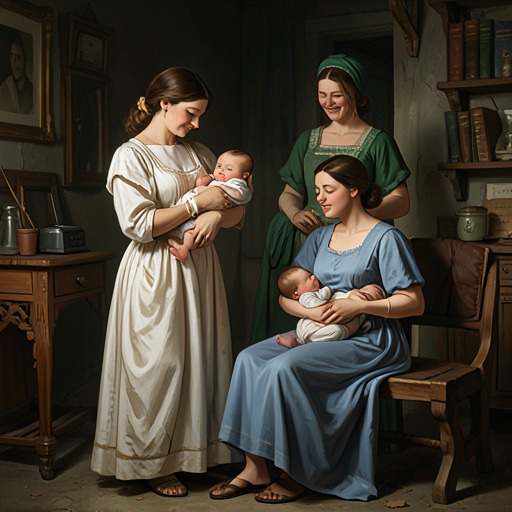
Karen Williams and Sandra MacIntire
REKaren Williams and Sandra MacIntire are friends whose relationship joins two different kinds of care: Karen’s outspoken, interventionist protection and Sandra’s quieter, more cautious responsibility. Both are married to Springton police officers and are mothers, but the friendship is not presented as a simple bond between equals. Karen appears socially dominant and financially secure, while Sandra is younger and still trying to keep her household functioning after Darren MacIntire is shot. Their connection becomes a practical alliance through which Tabitha Moore is treated not merely as a troubled child, but as someone who needs immediate protection, dignity, and a place to belong.
Formation and Social Balance
The friendship is first understood through contrast. Karen is described as aggressively social, well connected, and associated with the Williams family’s relative wealth, including the Williams family lake house. Sandra, by comparison, is still “getting there” and does not seem to have her life fully organized. The narrative therefore suggests that Karen has taken Sandra under her wing: Karen supplies confidence, access, and social force, while Sandra brings a younger household’s more immediate domestic pressures and a careful awareness of what can and cannot be asked of Tabitha.
Their common ground is substantial. Both women are police officers’ wives and mothers, and both are drawn into the consequences of Darren’s shooting and Tabitha’s rescue of him. Their friendship operates through shared family networks rather than private sentiment alone. When Darren is released from the hospital, Karen’s household and the MacIntire household are close enough to combine their Thanksgiving plans, turning friendship into an organized support system at the very moment when ordinary family arrangements are breaking down around Tabitha.
Care During Crisis
Karen and Sandra respond differently but cooperatively to Tabitha’s vulnerability. Karen repeatedly takes the role of the person who will act. When Tabitha calls her after leaving home, Karen insists that Tabitha was right to seek help and tells her not to call her “Mrs. Williams” but “Momma Williams” instead. The change in address is more than warmth: it offers Tabitha an alternative maternal relationship and declares that Karen is willing to assume emotional responsibility when Tabitha’s parents cannot protect her from the conflict at home.
Sandra’s care is more deliberately non-coercive. At the MacIntire household, she and Karen make sure Tabitha is offered food, coffee, a toothbrush, clothing, and a place at Thanksgiving, while Sandra intervenes when Karen begins to overwhelm the exhausted girl with offers and plans. Sandra recognizes that generosity can become another pressure if it is delivered too insistently. Her restraint complements Karen’s urgency, allowing the two women to protect Tabitha without entirely replacing her agency.
The friendship also contains a history of mutual emotional labor. Sandra is present when Mrs. Moore is physically and emotionally devastated by Tabitha’s apparent legal brain death and inexplicable awakening. Karen later takes Tabitha on a hospital stroll to relieve her cabin fever and tries to address the awkward subject of sexual education at Mrs. Moore’s request. These moments show the women distributing tasks that the Moore family has been unable or unwilling to manage: comforting adults, distracting a recovering child, mediating embarrassment, and keeping communication possible.
Thanksgiving Alliance
The clearest expression of Karen and Sandra’s friendship comes when they decide to create a shared Thanksgiving. Karen initially reacts with mock outrage when Sandra considers not making a turkey, calling the idea blasphemous, but the comic disagreement reveals intimacy rather than hostility. Sandra’s decision becomes the occasion for Karen to bring the families together, and Karen explicitly invites Tabitha to remain with them, while also making clear that returning her home remains an option.
Their collaboration is visible in the practical details. Karen offers breakfast and other food, welcomes Tabitha without treating her as a burden, and prepares mashed potatoes; Sandra offers to drive Tabitha back to the trailer park so that she can shower, change, and cook her own scalloped potatoes before returning. The arrangement lets Tabitha contribute rather than remain only a recipient of charity. Karen’s hospitality gives her shelter, while Sandra’s transportation makes it possible for Tabitha to preserve a measure of competence and self-respect.
The shared meal also places the women against the damaging behavior inside Tabitha’s extended family. At the Moore Thanksgiving, Lisa threatens Aiden and the other children over food, forcing ham onto their plates and turning a family meal into an exercise of intimidation. By contrast, Karen and Sandra make room for Tabitha’s preferences, limitations, and need to participate on her own terms. Their friendship thus becomes legible through a contrast between coercive family obligation and chosen, responsive care.
Protection and Chosen Family
When Tabitha explains that she has left home because her parents are incapable of confronting Lisa, Karen’s anger becomes a protective force, while Sandra helps convert that anger into a viable arrangement. Karen promises to confront Tabitha’s parents and tells Tabitha that she is welcome in the Williams home. Sandra then offers a spare bedroom and proposes that Tabitha become a paid live-in helper for Hannah MacIntire while also remaining present during Darren’s recovery. The offer includes childcare, emergency availability, and financial support, but Sandra carefully excludes intimate medical duties that would be inappropriate for a thirteen-year-old.
Sandra’s proposal is shaped by both practical need and genuine attachment. She needs help with Hannah while returning to work in Fairfield, does not want to depend constantly on Karen, and worries about complications while Darren is learning to stand and walk again. Yet she also says that Hannah adores Tabitha, that she loves Tabitha, and that the MacIntire home is open to her if she needs somewhere else to live. Karen’s earlier “Momma Williams” invitation and Sandra’s spare-room offer together create a layered chosen-family possibility: Karen provides emphatic public advocacy, while Sandra offers domestic shelter and a defined role.
The women do not erase one another’s boundaries. Karen is ready to confront the Moore family directly, but Sandra warns against overwhelming Tabitha. Sandra asks whether Tabitha truly wants to remain with her parents and accepts that staying elsewhere may be necessary, provided the household crisis does not simply recur. Their friendship therefore functions as a system of complementary judgment: Karen pushes against neglect, Sandra checks the pace and shape of intervention.
Narrative Significance
Karen Williams and Sandra MacIntire’s friendship transforms adult friendship into a form of child protection. The women are not interchangeable rescuers. Karen’s social confidence and fierce language make her an advocate who will force others to listen; Sandra’s youth, caution, and practical obligations make her the person who can offer a sustainable home arrangement. Their differences produce the relationship’s strength.
Through them, the narrative contrasts blood family with chosen family without presenting escape as a complete solution. Tabitha worries that accepting Sandra’s offer could become a way to avoid the difficult work of confronting her parents and resolving the Moore family’s problems. Even so, Karen and Sandra establish that protection must come before forced reconciliation. Their friendship gives Tabitha a temporary community in which hospitality is reciprocal, vulnerability is noticed, and a traumatized child is allowed to ask for help without being treated as an inconvenience.