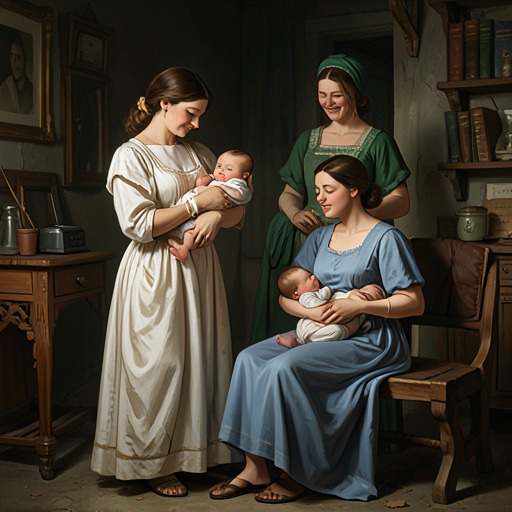
Tabitha Moore–Karen Williams found-family relationship
REThe Tabitha Moore–Karen Williams found-family relationship is one of the clearest examples of chosen family in the story: Karen Williams does not replace Tabitha’s biological mother, Shannon Moore, but offers a form of maternal presence defined by welcome, conversation, physical comfort, and dependable advocacy. Their bond becomes especially important after Tabitha’s near-death experience, when illness, family conflict, bullying, and the burden of her hidden knowledge leave her needing an adult who will listen without demanding that she minimize what she feels.
Identity and Beginning
Karen first approaches Tabitha as a warm, socially confident adult connected to the Williams family and the local church community. When she visits Tabitha in the hospital, she does not treat the girl as a fragile problem to be managed. She brings movement and ordinary conversation into an environment dominated by medical procedures and confinement, taking Tabitha on a wheelchair stroll through Springton General Hospital rather than allowing the visit to dissolve into silence. The gesture is modest, but its meaning is substantial: Karen recognizes that recovery also requires companionship, distraction, and the restoration of everyday human contact.
Karen’s relationship with Tabitha is also linked to the possibility of a wider community. Tabitha tells her that she wants her parents to join a church because she believes they need to belong to something larger than themselves. Karen immediately welcomes the idea, saying that the family would be glad to have them and revealing that she has already spoken about Tabitha to the women in the choir. Her response gives Tabitha more than an invitation to attend services. It places the girl within a network of adults who know her, value her, and are prepared to receive her family rather than judge them solely by their poverty or social reputation.
Maternal Care and Emotional Availability
The relationship changes from friendly support into an explicit maternal connection when Tabitha begins to confess how overwhelmed she has become. She explains that almost dying has altered her, that she has spent too much time confined with her thoughts, and that she now feels compelled to release everything she has been carrying. She worries that speaking about the “trailer trash” stigma, the conflict involving Lisa Moore, and the secrets she has disclosed to Elena Seelbaugh may have made other people uncomfortable. Karen answers not with correction or suspicion but with permission: Tabitha is told that she does not need to apologize for needing to talk.
Karen then stops the wheelchair, kneels beside Tabitha, and embraces her. The physical action matters because it interrupts the institutional setting of the hospital and places care at the level of the body: the frightened, exhausted child is held rather than questioned. Karen assures her that the Moore family is not “trailer trash,” that Tabitha herself is not “trailer trash,” and that she is not an impostor. This directly addresses Tabitha’s class shame and identity anxiety. Karen’s care therefore operates on two levels at once. She offers emotional shelter, while also rejecting the labels that have helped make Tabitha feel contaminated by her home and uncertain of her right to belong elsewhere.
The relationship receives its defining name when Karen tells Tabitha to call her “Mom” or “Momma Williams,” as Hannah MacIntire does. The invitation is presented playfully, but it is not superficial. Karen promises an open channel for discussion about the damaged vehicle in the yard, church, boys, family troubles, Tabitha’s writing, and faith. She also offers to find novels for Tabitha so they can share a literary interest. This broad range is crucial: Karen does not limit maternal care to crisis management. She imagines a continuing relationship made from ordinary subjects, shared tastes, laughter, advice, and listening.
Protection, Responsibility, and Chosen Family
Karen’s protectiveness extends beyond words. After Tabitha rescues Officer Darren MacIntire, she asks him to become the best father possible for Hannah, because Hannah nearly lost him and would have suffered without him. Karen is present for this exchange and participates in the network of reciprocal care surrounding Tabitha. Tabitha is not merely being rescued by adults; she is also trying to secure the futures of children and families she has come to value. Karen’s response helps frame that instinct as legitimate rather than burdensome.
Karen also becomes a witness to the disparity between the care Tabitha needs and the care her biological family can provide. Tabitha’s parents are devastated when their daughter is declared legally brain dead and later wakes, while Shannon Moore is physically and emotionally hollowed out by grief and fear. Their suffering is real, but it does not automatically produce the sustained communication Tabitha requires. Karen, by contrast, makes conversation itself a form of care. She is willing to hear subjects that Tabitha finds difficult to raise with her parents, and she does not require the girl to perform gratitude, composure, or uncomplicated happiness before offering affection.
This distinction becomes especially important as the wider family system grows more dangerous. Tabitha remembers that the Taylor sisters abused both her and Ashlee Taylor; Ashlee’s home is later visited by an attorney, social worker, school-board representative, and police officer after signs of abuse and truancy become impossible to ignore. At Thanksgiving, Lisa Moore publicly pressures Aiden Moore to eat food he had not chosen and threatens the children over dessert, while Tabitha experiences the scene as another instance of adults overriding children’s boundaries. Against these patterns of coercion, Karen’s approach is notable for its invitation rather than command. She asks Tabitha to speak, offers topics instead of imposing them, and makes room for refusal, embarrassment, and emotional excess.
Continuity Through Crisis and Separation
The found-family bond remains active after Tabitha leaves the Moore household. When Tabitha announces that she is going to stay somewhere else for a while, Alan Moore immediately refuses, but Tabitha repeats that she is leaving. The decision places her in a vulnerable position, yet Karen’s earlier promise gives the departure a relational destination: Tabitha is not simply fleeing; she is moving toward people who have demonstrated that they will receive her.
Later, while Tabitha is staying with Karen Williams, she calls Karen “Momma” and apologizes for the disorder surrounding her escape. Karen watches her struggle through the call, noticing the girl’s exhaustion, pale face, dark circles, frazzled red hair, and still-present cast. Her anger turns outward toward the adults and circumstances that have failed Tabitha: the bullying that drove her from school, the Halloween attack, the crisis involving Erica Taylor, and the drug-related danger surrounding Lisa Moore. Karen’s reaction shows that the maternal role she claimed is not ceremonial. She interprets Tabitha’s condition as evidence of accumulated adult failures and responds with protective outrage.
Karen’s support is also expressed through hospitality. The MacIntire family extends an invitation to the Moores for Thanksgiving, planning a feast to celebrate Officer Darren MacIntire’s release even though he will initially be unable to eat solid food. Within this circle, Tabitha is treated as someone whose survival deserves communal celebration. The invitation contrasts with the hostility and instability of the Moore household and reinforces the idea that family can be assembled through acts of welcome, shared meals, humor, and responsibility rather than secured by blood alone.
Narrative Significance
Karen Williams embodies a form of chosen motherhood grounded in emotional labor that is neither hidden nor treated as weakness. She notices when Tabitha is trapped in hospital cabin fever, supplies conversation when silence becomes oppressive, comforts her physically when confession becomes painful, and offers an enduring title—“Momma Williams”—that acknowledges the relationship’s emotional reality. Her maternal care is expansive rather than possessive: it does not demand that Tabitha reject Shannon Moore, only that Tabitha have another adult bond in which she can be safe and heard.
The relationship also gives concrete shape to Tabitha’s changing identity. Tabitha has an adult consciousness inside a thirteen-year-old life, carries memories that isolate her from other people, and repeatedly finds herself forced into responsibilities beyond her age. Karen does not know every secret behind Tabitha’s behavior, yet she recognizes the visible consequences: the girl needs to talk, needs reassurance that she is not defined by class stigma, and needs adults who will remain present. In that sense, Karen’s acceptance supplies a counterforce to both familial estrangement and social classification.
The bond’s decisive meaning lies in its ordinary promise. Karen offers to discuss books, church, boys, family troubles, faith, and household repairs; she offers to listen even when the subject is difficult or embarrassing. That breadth makes the relationship more than a rescue arrangement. It is a pledge of continuity, giving Tabitha a maternal home in which care is practiced through attention, humor, touch, advocacy, and the freedom to speak until the burden becomes bearable.