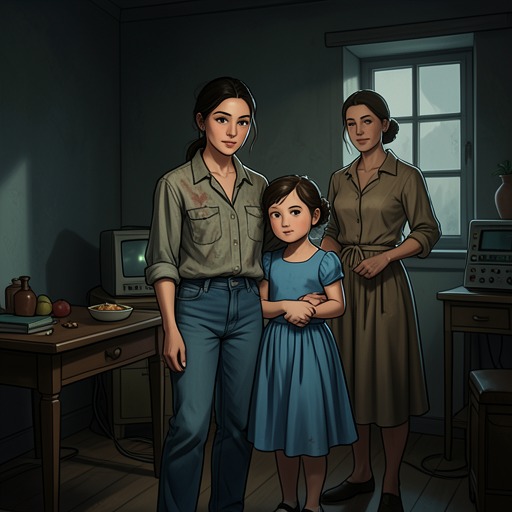
Tabitha Moore–Alicia Brooks friendship
REThe Tabitha Moore–Alicia Brooks friendship is one of the book’s central chosen-family relationships: it joins Tabitha Moore, a girl carrying memories from 2045 into 1998, with Alicia Brooks, an initially solitary artist who becomes her witness, confidante, investigator, and active ally. What begins when Alicia is approached over her sketchbook grows into a friendship capable of holding secrets, skepticism, attraction, fear, and the repeated shocks produced by time displacement and timeline restarts.
First Meeting and Artistic Recognition
Alicia Brooks is first presented as socially withdrawn and absorbed in her own artistic world. A “pretty white girl with red hair” interrupts her thoughts, introduces herself as Tabitha, and notices the sketchbook that distinguishes Alicia from the surrounding students. Tabitha’s opening question about whether Alicia draws establishes the basis of their connection: Alicia is seen not through school popularity or conventional social ease, but through her creative work.
Tabitha Moore actively pursues the connection rather than treating the encounter as a passing introduction. She remembers their conversation and seeks Alicia out during lunch the following day, appearing in another carefully chosen outfit, an asymmetrical light blue blouse with white floral embroidery. The detail matters because Alicia notices Tabitha’s conspicuous beauty and social confidence even as Tabitha directs her attention toward Alicia’s drawings. Their friendship therefore begins across an apparent difference in status and temperament: Tabitha is the visible school belle, while Alicia is accustomed to sitting alone and keeping her distance.
The artistic exchange is not immediately effortless. Tabitha apologizes when Alicia thinks she may be taking copies of her work without permission, explaining that she wanted the drawings for later reference and asking whether Alicia has duplicates. Alicia declines as diplomatically as possible, saying that she is not really interested in “all that kind of stuff.” The refusal gives their eventual friendship a useful resistance. Alicia is not won over simply by Tabitha’s appearance, and Tabitha’s interest in her art has to become personal rather than merely acquisitive.
From Curiosity to Trust
Alicia’s concern for Tabitha becomes visible before she understands the larger truth surrounding her. When Tabitha appears troubled, Alicia interrupts her own thoughts to ask whether she is all right. Later, in the darkness of a shared sleeping space, Alicia asks whether she may call her “Tabs,” a small sign of growing familiarity. The intimacy is immediately complicated by Tabitha’s secrecy. Alicia tells her that, if they are going to be friends, Tabitha has to explain what is happening, even though the explanation may sound frightening or unbelievable.
Tabitha eventually admits that she wanted a friend because she did not want to go through everything alone. This confession identifies the emotional need beneath her guarded behavior. Her problem is not only that she possesses impossible information; it is that the information isolates her from everyone around her. Alicia responds by making friendship conditional neither on proof nor on complete understanding. She tells Tabitha that they are friends whether Tabitha is somehow making everything up or not. The relationship thus becomes a form of trust that precedes certainty.
Their conversations repeatedly return to the strain of Tabitha’s future knowledge. Alicia asks what happened next when Tabitha recounts earlier events, listening with genuine interest to the consequences of the photograph Alicia herself took. She is thrilled by the possibility that her image has become connected to people most affected by the incident, but her fascination does not erase her role as a friend. Alicia’s curiosity gives Tabitha room to narrate experiences that otherwise remain psychologically sealed away.
Alliance Under Pressure
The friendship becomes more consequential as Tabitha’s account of the future and the violence surrounding her grows more difficult to dismiss. On the bus, Alicia normally sits alone, slouching with her knees against the seat ahead and watching the scenery pass. Her irritation when another student identifies her as Tabitha’s friend shows that the label has social consequences: association with Tabitha exposes Alicia to unwanted attention, even though Alicia remains temperamentally private. She does not retreat from the relationship. When Elena Seelbaugh approaches Tabitha with news that her parents intend to do something about the crisis around her, Alicia is part of the expanding circle that begins to treat Tabitha’s danger as real.
Alicia also listens while other students speculate about Tabitha’s supposed vendetta against a man and insist that the story may be fabricated. This atmosphere of rumor and misinterpretation places pressure on their friendship from outside. Alicia knows that Tabitha’s conduct can look inexplicable, yet her own experience of Tabitha has taught her that unexplained behavior is not the same as invented behavior.
The relationship reaches a practical turning point when Tabitha proposes investing in Google, describing it as an internet search engine and their best chance at securing a future advantage. Alicia accepts immediately, not because she has reduced Tabitha’s claims to a proven financial plan, but because she would have joined her even without believing the time-travel explanation. Her loyalty is therefore both emotional and material. She is willing to act on Tabitha’s knowledge while preserving the deeper reason for doing so: Tabitha is her friend.
When Alicia asks how the current experience differs from Tabitha’s first time through events, she demonstrates that she has moved beyond passive belief. She is learning the structure of Tabitha’s repeated life, asking comparative questions about divergent timelines and recognizing that the same apparent beginning can produce different outcomes. Tabitha tells Alicia that it means a great deal to be believed and that she could not do this alone. Alicia answers with physical reassurance, pulling Tabitha into a quick hug, and promises that Tabitha, Alicia, and Elena will work everything out together.
Affection, Art, and Witnessing
Alicia’s attachment to Tabitha becomes more complicated than ordinary school friendship. She privately recognizes a significant crush and an unusual attraction, while struggling to decide how to name it. She does not confidently classify the feeling as sexual; instead, she experiences Tabitha as special, irreplaceable, and emotionally singular. The uncertainty is important because the friendship is narrated through a form of intimacy that exceeds easy categories without being converted into a declared romance.
Art becomes Alicia’s way of preserving and interpreting that attachment. Tabitha’s beauty appears to Alicia as something that begins inwardly and radiates outward, and Tabitha becomes Alicia’s muse. The photograph of Tabitha in motion is Alicia’s current masterpiece, while sketches of Tabitha’s expressions crowd out other subjects in her artbook. Even Alicia’s formerly private practice drawings are replaced by studies of Tabitha’s shoulders and neck. These images do not merely document appearance; they show Alicia trying to understand a person whose identity is divided between the girl visible in 1998 and the adult consciousness that remembers 2045.
The artistic gaze also makes Alicia a witness to Tabitha’s instability. She is not only hearing an extraordinary story but continually observing the bodily and emotional cost of carrying it. When Tabitha admits that she has little energy, has not been taking care of herself, and has struggled to eat, Alicia receives the future traveler as a vulnerable friend rather than as a source of useful predictions. Her attention moves between awe, concern, and practical solidarity.
Public Revelation and Repeated Time
Alicia eventually becomes so convinced of Tabitha’s identity that she blurts out to others that Tabitha is from the future. She repeats the claim, citing Tabitha’s knowledge of events such as the shooting as evidence that nobody else could possess. This is a decisive change in Alicia’s position. Earlier, she had promised friendship even if Tabitha’s explanation proved false; now she publicly stakes her own credibility on the explanation being true.
The friendship is tested again when Alicia and her companions have missed spending time together with Tabitha and are trying to resume ordinary companionship around extraordinary circumstances. Alicia’s excited reaction acknowledges that everything around Tabitha becomes chaotic, but it also affirms that the desire to “hang out” remains. The relationship is not sustained only by emergencies. It retains the ordinary longing to share time, conversation, and mutual presence.
The most severe strain comes from Tabitha’s repeated timeline experience. The 2045 prototype MRI accident has sent her mind back forty-seven years to the 1998 incident at the children’s hospital, and later Tabitha explains that after collapsing at the lake house she may have died and started the timeline over again from waking in the MRI in May 1998. Alicia’s friendship therefore has to survive not one disclosure but an expanding sequence of revelations in which Tabitha’s own memories become unstable evidence. Alicia’s role is to remain a witness while acknowledging that the story may contain different timelines, altered outcomes, and facts that even Tabitha cannot confidently organize.
Narrative Significance
The Tabitha Moore–Alicia Brooks friendship transforms belief into action. Alicia begins as a girl who sits alone on the bus and guards her artistic interests, but Tabitha’s attention draws her into a relationship where listening, questioning, creating, investing, defending, and comforting become forms of rescue. Tabitha, meanwhile, gains something her future knowledge cannot provide: a friend who does not require the impossible to become ordinary before offering loyalty.
The friendship also supplies a counterpoint to the book’s cycles of violence, exclusion, and abandonment. Tabitha’s time displacement repeatedly separates her from the life she is trying to repair, while school rumor and disbelief threaten to isolate her in the present. Alicia answers that isolation by insisting on connection even under uncertainty. Her art makes Tabitha visible, her questions make the fractured chronology discussable, and her promises convert private sympathy into a shared plan.
Because Alicia does not simply accept Tabitha’s account without fear or challenge, the relationship avoids becoming a one-sided rescue. Alicia asks for explanations, admits discomfort, refuses some of Tabitha’s early requests, and still chooses friendship. That combination of boundaries and commitment gives the bond its distinctive strength. In a story shaped by second chances and unstable timelines, Alicia becomes the human continuity Tabitha cannot recover through memory alone: the person who sees the impossible girl in front of her, believes enough to help, and stays present when the future changes again.